On-Grid Solar · Solar + Electricity Grid
On-Grid solar systems in Nagercoil
Generate solar power during the day, use it first, and buy fewer units from the electricity board. The most common rooftop solar choice for homes, shops, offices and commercial establishments.
What is on-grid solar?
Solar that works alongside your EB connection
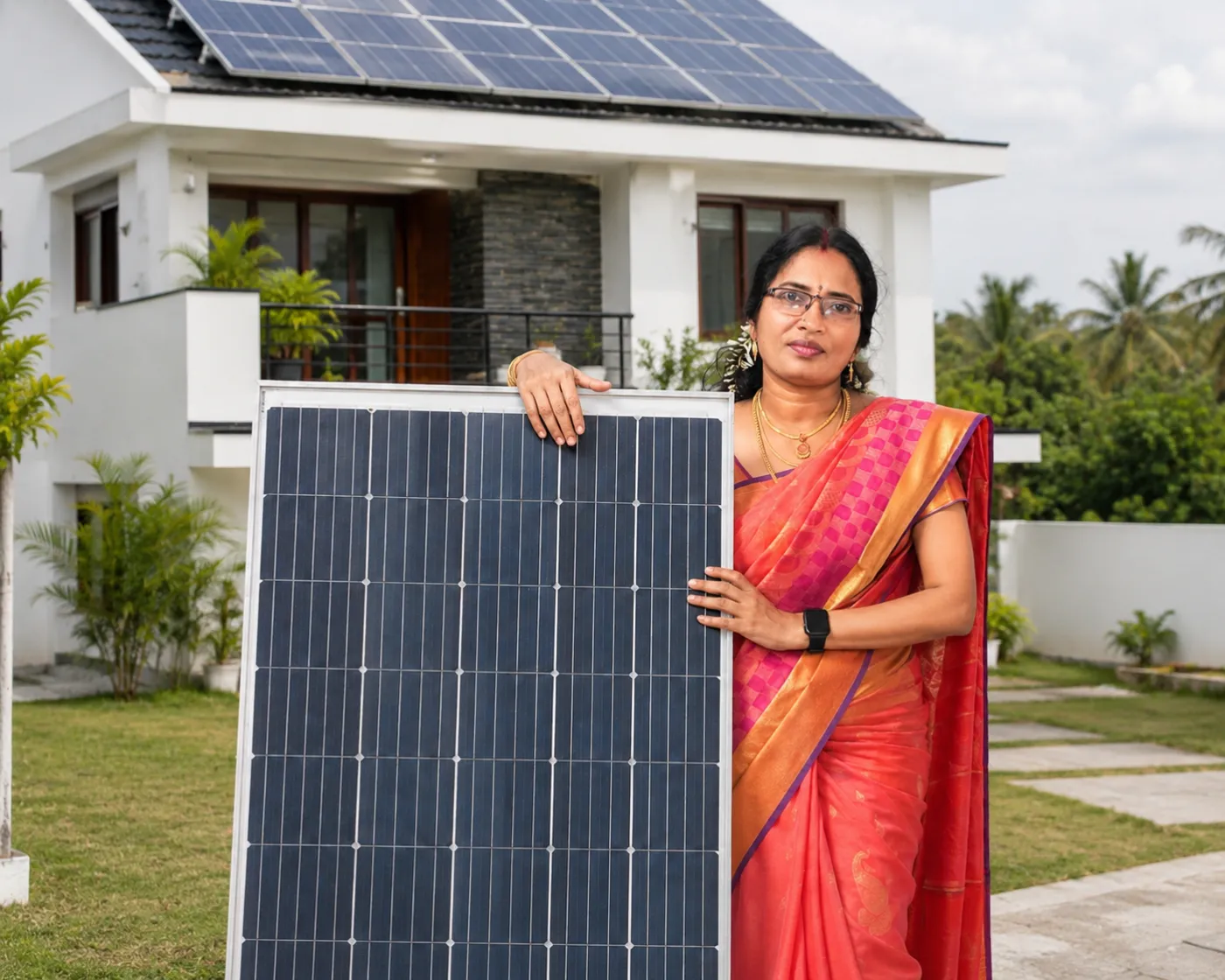
An on-grid solar system is connected to the electricity grid and uses solar power to reduce the amount of electricity you need to purchase from the grid.
During daylight hours your panels generate DC electricity. The inverter converts it into usable AC power, and your property consumes that power first. Anything your solar does not cover continues to come from your existing EB connection, exactly as before — nothing about how you use electricity has to change.
Because there is no battery in the system, on-grid is the simplest and most direct way to reduce your EB bill. It is also the configuration the residential rooftop subsidy programme is built around.
How it works, step by step
- Solar panels on your roof convert sunlight into DC electricity.
- The inverter converts that DC into AC electricity at the correct voltage and frequency.
- Your property uses the solar power for whatever is running at that moment.
- The grid supplies the balance when solar is not enough — at night, or on a dull day.
- Net metering, where applicable, accounts for the energy exchange with the grid.
Key benefits
- Generate clean solar energy on your own roof
- Reduce your EB bill every billing cycle
- Efficient daytime solar generation
- Suitable for homes, shops, offices and commercial buildings
- Works with your existing electricity grid connection
- No battery to maintain or replace
Who needs it
On-grid solar is usually the right fit if…
You have a stable EB connection
Grid supply at your property is generally reliable, and your main concern is the EB bill rather than outages.
Your usage is mainly in the daytime
Homes with daytime load, shops, offices and commercial establishments benefit most because generation and consumption overlap.
You have shadow-free roof area
A clear, mostly unshaded roof or terrace area is available for mounting panels facing a suitable direction.
You want the simplest system
No battery bank means lower upfront cost, less maintenance and no battery replacement cycle to plan for.
Power cuts are a concern for you? Then look at hybrid instead.
Explore Hybrid SolarWhat JRS provides
A complete on-grid installation, not just panels
Every on-grid project we take on covers the full chain — from the first survey to the moment your system is commissioned.
Free site survey
Roof condition, available space, shading, orientation and electrical assessment before any quotation.
System design & quotation
Capacity, panel and inverter selection and a written quotation matched to your usage and budget.
Panels & inverters
Panels from Waaree, Vikram Solar, Tata Power Solar, Emmvee and Adani Solar; inverters from Sungrow, Deye, Growatt, Polycab and Eastman.
Structure & balance of system
Mounting structure, ACDB/DCDB, solar DC cables, earthing and lightning protection.
EB & documentation support
Applicable EB documentation, application support, inspection process and approvals.
Net metering & commissioning
Coordination of the net-metering procedure and commissioning after the required process.
Subsidy assistance
Guidance through the applicable residential rooftop subsidy process and documentation.
1-year free service support
One year of free service support after installation, with continued technical assistance.
What you should consider
Things worth thinking about before you sign
- Shading is the biggest performance factor. A tree or a neighbouring wall shading part of the array during peak hours affects output more than most people expect.
- Roof area limits capacity. Roughly speaking, each kilowatt needs a meaningful amount of shadow-free area, so the roof — not the budget — often decides the maximum size.
- Generation varies. Sunlight, weather, orientation, shading and system performance all affect actual output. Any figure quoted before installation is indicative.
- No backup during outages. If uninterrupted power matters, plan for hybrid from the start rather than retrofitting later.
- Subsidy is not automatic. Eligibility, amount and conditions follow current government guidelines and can change.
Indicative generation
What a system might generate
These figures are indicative for typical systems under suitable sunlight conditions in this region.
| System | Per day | Per 60-day cycle | Bill value / cycle |
|---|---|---|---|
| 2 kW | 9 units | 540 units | ₹2,376 |
| 3 kW | 13.5 units | 810 units | ₹4,875 |
| 4 kW | 18 units | 1,080 units | ₹7,794 |
| 5 kW | 22.5 units | 1,350 units | ₹10,913 |
Actual generation depends on sunlight, weather, roof orientation, shading and overall system performance.
Installation process
From enquiry to commissioning
Contact Us
Tell us your electricity requirement — a recent EB bill helps us understand your usage.
Free Site Survey
We visit and assess your roof, shading, orientation and electrical requirements.
System Design & Quotation
We recommend a suitable solar solution and give you a written quotation.
Installation
Professional installation of panels, structure, inverter, cabling and protection.
EB & Documentation
We assist with the applicable EB and documentation procedures.
Commissioning
Your system is tested and commissioned after the required process is completed.
After-Sales Support
We remain available for service and technical assistance.
On-grid solar FAQ
Questions we get asked about on-grid systems
Normally, no. For safety reasons an on-grid solar system automatically shuts down during a grid outage so that it does not feed power into lines that linemen may be working on. If backup during power cuts matters to you, a hybrid solar system with battery storage is the option to consider.
No. An on-grid system works directly with your existing grid connection and does not need a battery. That keeps the system simpler and removes battery replacement from your long-term costs.
It depends on your electricity consumption, available shadow-free roof area, budget and site conditions. We review your recent EB bill and survey the roof before recommending a capacity.
Yes. We assist with the applicable EB documentation, application support, the required inspection process, the net metering procedure and system commissioning.
Eligible residential customers may qualify for the applicable government rooftop solar subsidy programme, subject to current government guidelines and eligibility conditions. We guide you through the applicable process.
Next step
Ready to reduce your electricity bill?
Send us your recent EB bill and we will survey your roof free of charge, then recommend a suitable on-grid capacity with a written quotation.
- Your electricity requirement and 60-day EB bill
- Property type — home, shop, office, farm or institution
- Backup requirement and available roof space
Related: Hybrid Solar · Solar Subsidy · Finance & EMI · Products
Free site survey · Kottar, Nagercoil