Solar site survey
Shadow Free Area for Solar Panels
See how shade, roof shape and nearby structures change the usable area, and how we map a layout that fits the roof you actually have.
Site survey basics
Why the shadow free area for solar panels decides the whole layout
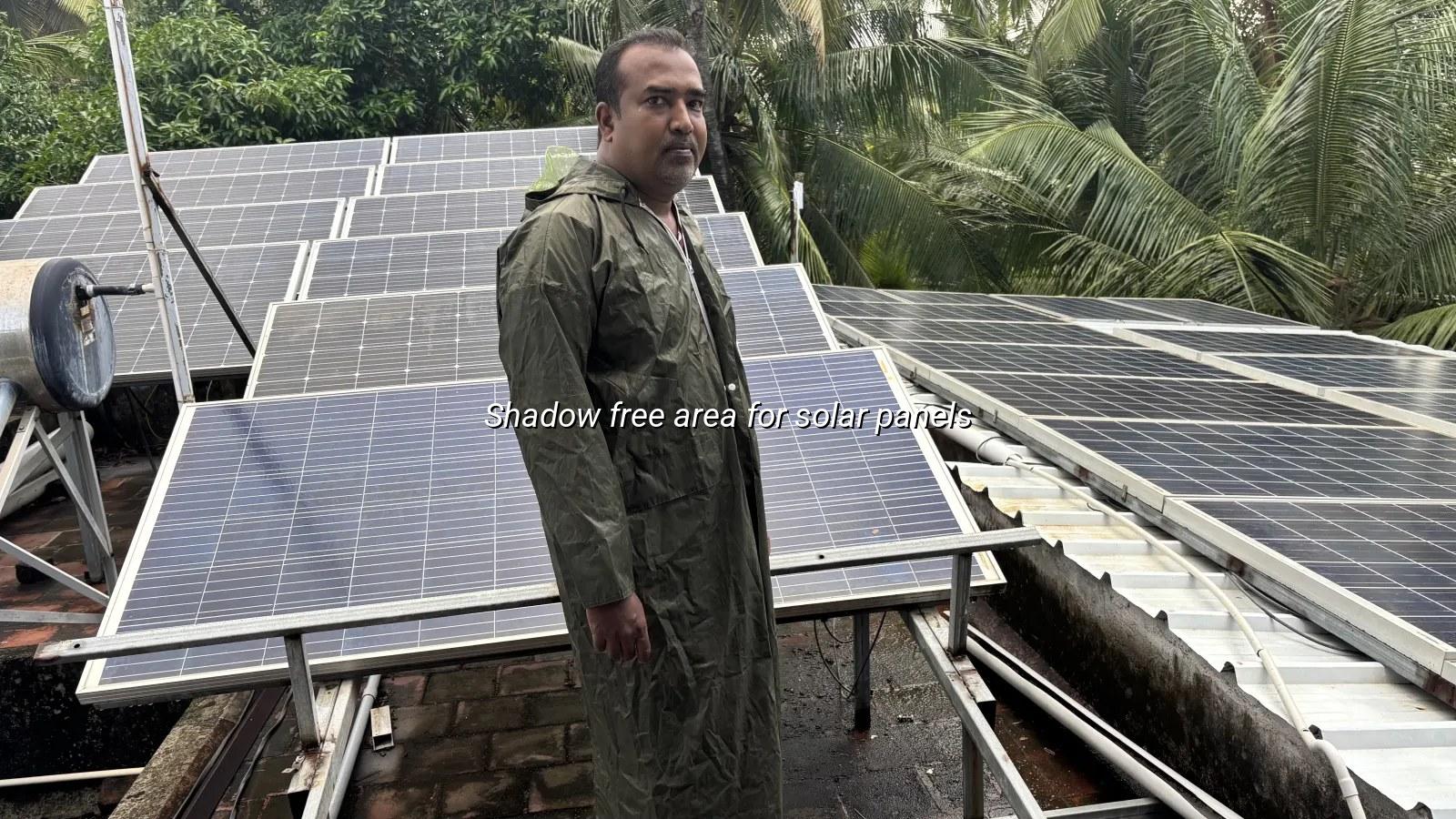
Shadow free area for solar panels is where the plan really starts. If a roof has a steady patch of direct sun, the design becomes cleaner and the panel placement is easier to keep tidy. If the roof is cut by shade, we have to plan around that from day one, not after the work is already underway.
In Kottar and the rest of Nagercoil, we rarely see a roof that is open in every direction. There may be a water tank, a stair headroom, a parapet wall or a neighbouring building that throws shade for part of the day. We check all of that in the free site survey, map the real usable area and then build the layout around facts, not assumptions.
What we check first
Roof details that tell us how much sun is really available
We start with the roof itself, then we look at the things around it that make shade at different times of the day.
Flat RCC roofs, tanks and parapets
Many homes in Vadasery and Ozhuginasery sit on RCC terraces, and those terraces usually carry more than one fixed object. A water tank, a staircase block and a parapet wall can each create a different shadow line. Something that looks harmless at noon may still block the early sun or the late sun, and that matters if the panel rows are pushed too close together.
We measure the open area with the obstructions in place, not after moving things around in theory. That helps us keep the array away from shade and gives us room for servicing later. It also means the structure can be placed where the roof behaves well, not where it only appears open from ground level.
Wind exposure and coastal conditions
In much of Kanyakumari District, shade is only part of the story. The district is known for strong wind exposure, and the air near the coast carries salt, so the mounting structure and cable routing matter just as much as sunlight. On a roof closer to the shore, we look harder at edge clearance, fixing points and how the hardware will hold up.
We have seen that in places like Manavalakurichi and Colachel. The best sunlit patch still needs the right fixing approach if the site is open to wind and sea air, and that is why we never judge a roof by the sunny bit alone. Drainage, sealing and the route for the cables all enter the plan too.
- Check the roof direction. We see how the roof faces and where the useful sunlight falls through the day.
- Mark the fixed blocks. Tanks, walls, poles, trees and nearby buildings are noted before the layout is drawn.
- Watch the shade timing. A roof may look open at noon but still lose the first or last hours of light.
- Match the area to your EB use. Your units over the 60-day billing cycle help us judge what size makes sense.
- Set the mounting and cable route. We keep the layout safe, reachable and easy to inspect after installation.
Why shade matters
How shading changes output and why the design has to fit the site
Solar panels work best when the sunlight is steady. If one section of a string is shaded, the rest of the system may not behave the way a customer expects, which is why the shadow free area for solar panels is such a big part of the planning stage. Sometimes the issue is obvious from the roof. Other times the shadow shows up only when a tank edge, a tree branch or a parapet wall blocks the morning sun.
That is why we ask for a proper survey instead of a quick quote based on the EB bill alone. If a house in Suchindram has a good open face but a tree shades one side, we can shift the layout. If a shop in Marthandam has a sheet roof with shade from the next building, we may choose a different arrangement that makes better use of the open strip. Small changes in placement matter more than most people think.
A simple rule we use on visits
We look for the part of the roof that gets the most useful daylight during the day and stays open through the main working hours. If that area is broken by shadow, we reduce the usable space and design around it. That sounds plain because it is plain, but it saves people from ending up with a system that looks large on paper and feels awkward on the roof. And yes, we would rather say no to a bad layout than force one in.
Reference points
How different roof conditions change the planning
A roof does not need to be perfect for solar. It just needs a layout that fits the open area, the shaded area and the way the site behaves during the day.
| Roof situation | What we check | Planning response |
|---|---|---|
| Open RCC terrace | Sun path, tank position, parapet height, maintenance space | Use the cleanest central zone and keep room for service work |
| Roof with one tall obstruction | Shade timing, obstruction width, space around the blockage | Shift the array away from the shadow line and split the layout if needed |
| Coastal roof with wind exposure | Hardware choice, edge clearance, cable sealing, corrosion risk | Use stronger structure planning and protect the exposed points carefully |
| Sheet roof or sloped roof | Pitch, fixing points, span, access path | Fit the panels to the roof angle and leave enough room for inspection |
| Agricultural site or open land | Open sky, pump location, cable run, wind load, ground conditions | Plan around the water need and the site conditions instead of forcing a standard layout |
- Do not judge the roof only from one photograph; sunlight changes through the day.
- Check the neighbour's wall if the houses are close together, because that shadow can move with the sun.
- Keep an eye on the path used to carry panels up, since service access matters later.
- On windy roofs, think about the structure before you think about the panel count.
- If there is a water tank, measure the real shade line around the tank, not just around the base.
How we work
The way we handle a roof that has shade
Most people who call us already suspect there is a shading issue. That's fine. We would rather hear it early. A survey usually starts with the EB connection details, the roof type and the way the building is used during the day. Then we walk the site and mark the things that block sunlight.
In Thuckalay and Padmanabhapuram, we often see mixed roof shapes where one part is good for solar and another part is not. On those sites we may treat the roof as separate usable zones instead of pretending every square foot is the same. That gives you a layout that feels neat, not crowded.
The order we usually follow
First, you contact us. Tell us the roof type and send a clear photo if you have one. Next, we do a free site survey. We check the roof on the spot, including the places that will actually get sun. Then, we prepare the system design and quotation. If shade reduces the usable area, we say so plainly. After that, installation and EB documentation follow. Then we commission the system and stay with you for after-sales support.
That process sounds simple because it should be. Real roofs are not simple, so the planning has to be careful. A small mistake in the shadow free area for solar panels can make the rest of the layout feel awkward, and nobody wants that after the work is already done.
Local angle
Where roof shape and EB planning meet in daily use
Around Kanyakumari District, the mix of roof types is what makes site checking worth doing properly. You can have a neat terrace in one house and a sheet roof or a sloped tile roof next door, and the usable area changes a lot from one building to the next. Near the sea, salt-laden air also changes how we think about mounting hardware and exposed connections.
We also pay attention to the seasons. The south-west and north-east monsoon periods can change drainage on the roof, and loose water paths or badly sealed cable routes become a real nuisance later. On a solar water pump site or an open land setup, the exposure is different again, so a site at Thovalai can call for a different approach than a home roof in Kottar. Same district, different conditions.
How JRS SunTech Energy can help
We start from the roof you have
We handle rooftop solar by starting with the actual site, not a guess from behind a desk. If your roof in Nagercoil, Kottar or a nearby town has shade from tanks, walls or trees, we will tell you what can work and what needs a different layout. We also guide you through the EB and documentation side, and we provide one year of free service support after installation, with continued technical help afterwards.
For homes, shops, offices and agricultural sites, that usually means a better first design and fewer surprises later. If you want honest advice on the usable area, send us your EB details and a few roof photos, or book a site visit and we will take it from there. JRS SunTech Energy, Door No. 227, First Floor, Cape Road, St. Xavier's Church Junction, Kottar, Nagercoil, Kanyakumari District, Tamil Nadu - 629002. Phone: 9787775999. Email: jrssuntechenergy@gmail.com.
Frequently asked
Questions about shadow free area for solar panels
It means the part of the roof or ground space that gets clear sunlight for most of the day, without being blocked by tanks, walls, trees or other buildings. We look for that area first because shade on even one section can change how the array should be laid out.
Yes, in many cases they can. We may shift the layout, leave space around the obstruction or choose a different configuration after checking the roof, the EB connection and the way the building sits in Nagercoil or Kottar.
We check roof direction, parapet height, nearby walls, water tanks, trees, access space and the likely shade line through the day. If the site is close to the coast or exposed to wind, we also keep the mounting structure and cable sealing in mind while planning.
There is no single rule that fits every roof. A little shade at the edge may be workable on one site, while shade during the main sun hours can make another site much less suitable, so we look at the timing and position of the shadow, not just the size of it.
Because the panel count should follow the roof, not the other way around. If we know the clean area, we can keep the layout practical, leave space for maintenance and avoid squeezing panels into a spot that looks open only from a distance.
Yes. We do not sell one standard system. We start from the EB usage, the roof space, the structure and the site conditions, then tell you honestly what is workable and what needs a different plan.
Hurry up!Subsidy ends 31 March 2027 · 134 days left
Next step
Is your roof actually clear enough for solar?
Send us your EB details and a few roof photos, and we will tell you what part of the roof is usable and what layout makes sense.
- Your electricity requirement and 60-day EB bill
- Property type — home, shop, office, farm or institution
- Backup requirement and available roof space
Related: Solar Solutions · Solar Maintenance · Contact
Free site survey · Kottar, Nagercoil