Solar guide
Why One Standard Solar System Does Not Suit Every Home
The right rooftop solar setup should follow your roof, your EB use, and the site itself, not a fixed package.
Solar planning for homes
Start with the house, not the package
Why one standard solar system does not suit every home is something we explain often to people who call our Kottar office. A solar setup is not a ready-made appliance you take off the shelf. Your EB usage, roof shape, shade, family routine, and the way the house was built all change the final result.
Some homes need a compact on-grid system for daytime use. Others need battery backup because supply is irregular or because certain loads have to stay on during an outage. We see the difference clearly in Nagercoil and Boothapandi, where one roof may be open and easy while another has tanks, parapets, trees, or a tricky slope that changes the design completely.
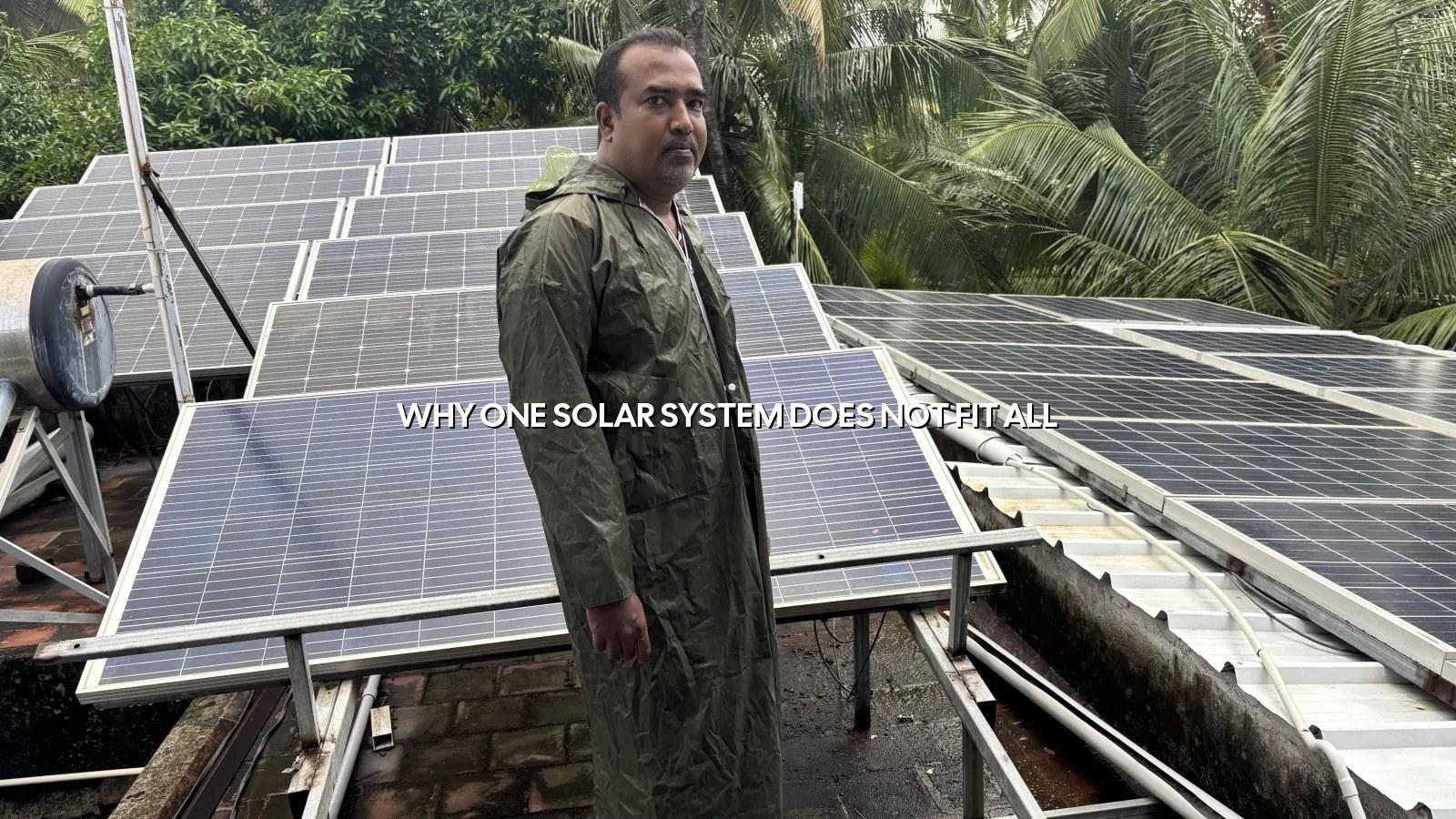
What changes the design
Why the same solar quote can be right for one house and wrong for another
A good rooftop design starts with the site, then the usage, then the equipment. If you reverse that order, you end up forcing the roof to fit the brochure. We don't work that way.
Roof shape and usable space
A flat RCC roof gives you more freedom, but it still has limits. Water tanks, stair headrooms, and parapet edges reduce the neat usable area, and the final layout has to leave safe walk paths for cleaning and maintenance. On a sloped tiled roof the story is different, because the angle is already built in and the mounting structure has to respect the tile line and drainage.
Shade, wind, and the local weather cycle
In Kanyakumari District, strong sunshine is there through the year, but so is wind exposure, especially in open stretches and near the coast. That means a mounting structure has to be chosen carefully, not just for strength but for the way it handles movement over time. During the south-west and north-east monsoon periods, cable sealing and roof drainage matter just as much as panel placement.
- Check the EB bill first. We look at the 60-day units, because that tells us what the house actually uses, not what someone thinks it uses.
- Measure the roof properly. A roof may look large from the ground and still hold only a limited array once shade and service space are marked.
- Study the load pattern. Fans, pumps, fridges, computers, and battery backup needs all point in different directions.
- Match the system type. On-grid, off-grid, or hybrid depends on how the household wants to use solar day by day.
- Plan for structure and weather. Wind, salt-laden air, and monsoon drainage affect hardware, routing, and connection points.
Common home differences
Homes in the same district can still need very different solar systems
In a family home at Kottar, the daytime use may be light because people are out of the house. In another home at Ozhuginasery, there may be children studying online, more fans running, and a different fridge and pump schedule. Both are residential rooftops, but the design logic is not the same.
We also see that some homes want the system mainly to reduce EB units, while others want backup for the essentials when supply dips. That difference alone can change the answer. If you want only daytime generation, an on-grid setup may be enough. If you want stored power, the inverter and battery choice becomes part of the core design, not an afterthought.
Things we check before we recommend anything
- How many units the home uses in a normal 60-day EB cycle
- Which appliances must keep running during supply cuts
- Whether the roof is RCC, tiled, or sheet roofing
- Shading from nearby buildings, trees, tanks, or overhead lines
- Whether salt air, wind exposure, or roof access changes the mounting choice
System comparison
A simple reference for choosing the right type of home solar system
There is no one-size-fits-all answer, but the table below shows how the main residential options behave in real use. It helps people see why the same package cannot suit every roof.
| System type | Best fit | What the roof and site must support |
|---|---|---|
| On-grid solar | Homes with a regular EB connection and mostly daytime use | Clear roof space, safe wiring path, and a layout that matches the load pattern |
| Off-grid solar | Homes or sites where backup and independence matter more than grid tie-in | Room for batteries, careful load planning, and a place for equipment that stays dry |
| Hybrid solar | Homes that want both grid support and battery backup | More planning space, a stronger design review, and a clear decision on what stays on backup |
| Solar with maintenance focus | Existing homes where the issue is output, wiring, inverter behaviour, or ageing parts | Access for inspection, safe testing points, and a proper look at the original installation |
How we size it
Our process avoids guesswork from the first visit
We start with your bill, because the bill shows real usage. Then we check the roof, the structure, and the shade pattern at the site. That sounds simple, but it saves people from buying a system that looks fine in a quotation and later feels wrong on the roof.
For some homes in Marthandam or Thuckalay the answer is straightforward because the roof is open and the load is steady. For others the answer shifts after we check the sheet roof fixing, the cable route, or the way the afternoon shade falls. The final recommendation needs all of that, not just one number.
What happens step by step
- Contact us. Tell us your location, the type of roof, and what you want the system to do.
- Free site survey. We visit, check shade, structure, and the practical roof area.
- System design and quotation. We match the capacity and equipment to the site, not the other way round.
- Installation. Our team mounts the panels and sets the wiring with the site conditions in mind.
- EB and documentation. We guide the connection process and the applicable government paperwork.
- Commissioning. We test the system and check that the flow is correct.
- After-sales support. You get one year of free service support after installation, with continued technical help afterwards.
Choosing the right match
What people often miss before they order solar
A brochure can make every setup look tidy and identical. Reality is less neat. A home near the coast at Manavalakurichi may need a stronger eye on corrosion and fasteners than a house farther inland, while a family home in Ramanputhur may need a different layout because the roof is smaller than it first appears. Same district, same sun, different answer.
We also see people assume that bigger is always better. It isn't. If the roof cannot safely hold the layout, or if the family's usage does not justify that capacity, the system becomes harder to live with. A smaller design that suits the house is usually the better call.
Useful things to keep in mind
- Match the system to the real EB usage, not a rough guess
- Check whether the roof can handle the mounting structure and movement from wind
- Do not ignore shade from trees, tanks, neighbouring buildings, or chimneys
- Ask how the cables will be sealed during monsoon periods
- Make sure the design leaves access for cleaning and future inspection
- Choose the system type based on backup needs, not just on panel count
How JRS SunTech Energy can help
We size the system to your home, your roof, and your EB connection
Our team at JRS SunTech Energy looks at the whole picture before we recommend anything. We handle home rooftop solar, on-grid, off-grid, hybrid systems, inverters and batteries, solar maintenance, and the documentation support that often trips people up. If your house needs a fresh installation or you're trying to fix an existing setup, we can inspect it honestly and tell you what makes sense.
We also guide customers through the subsidy procedure where applicable and keep the EB process clear. If you want a plan that fits your actual roof and not a stock package, speak with us and we'll take it from there.
Contact JRS SunTech Energy, Door No. 227, First Floor, Cape Road, St. Xavier's Church Junction, Kottar, Nagercoil, Kanyakumari District, Tamil Nadu - 629002. Phone: 9787775999. Email: jrssuntechenergy@gmail.com.
Frequently asked
Questions we hear before a home goes solar
Because no two houses use power the same way and no two roofs are laid out the same. A flat RCC roof in Kottar does not behave like a sloped tiled roof in Suchindram, and the daily load pattern matters just as much as the roof shape. If that is ignored, the system can look tidy in a quotation and still feel awkward on site.
We begin with the EB bill, especially the 60-day units, then check usable roof space, shade, structure, and the house layout. After that we see whether the home wants daytime savings, backup support, or both. That order keeps us from forcing the same answer onto every customer.
Yes, sometimes it can, but the layout has to be planned properly. Panel count, inverter placement, shade from tanks or nearby walls, and safe walking space all matter. On compact rooftops in Vadasery or Ramanputhur, a neat plan usually works better than squeezing in a bigger system badly.
Then the mounting method changes. Tiled roofs need careful fixing and waterproofing, while sheet roofs need proper fastening and structure so wind does not work the fittings loose. In Kanyakumari District, coastal air and monsoon drainage also need attention.
Yes. We guide customers through the EB connection process, the documents, and the applicable subsidy procedure where it fits the government programme. We keep the paperwork clear so you know what to submit and when.
Yes, we do solar service and maintenance for existing systems too. If the issue is wiring, inverter behaviour, mounting, or poor output, we can inspect it and tell you what needs attention. Sometimes the fix is small, and sometimes the layout itself needs a rethink.
Hurry up!Subsidy ends 31 March 2027 · 134 days left
Next step
Need a solar system that actually fits your home?
Send us your EB bill, roof photos, and a quick note on what you want the system to do. We’ll look at the site and suggest a setup that suits it.
- Your electricity requirement and 60-day EB bill
- Property type — home, shop, office, farm or institution
- Backup requirement and available roof space
Related: Solar Solutions · Subsidy Guidance · Contact
Free site survey · Kottar, Nagercoil