Solar guide
How Does a Rooftop Solar System Work
A straight answer on what the panels, inverter and EB connection actually do on a real roof, and how we size the system for your building.
Solar basics
What really happens after sunlight hits the roof
How does a rooftop solar system work is usually the first thing people ask us, and it’s a fair question. The answer starts with the panels making power in the daytime, moves through the inverter, and ends with your appliances using that power while the EB connection stays ready in the background.
That simple chain still needs careful design. On a house in Kottar or a shop in Vadasery, we check shade from tanks and nearby buildings, roof direction, and the way the building uses power through the day before we even talk about capacity. If those pieces are ignored, the system may still look neat from the road, but it won’t feel right in daily use.
Inside the system
The parts that do the work day after day
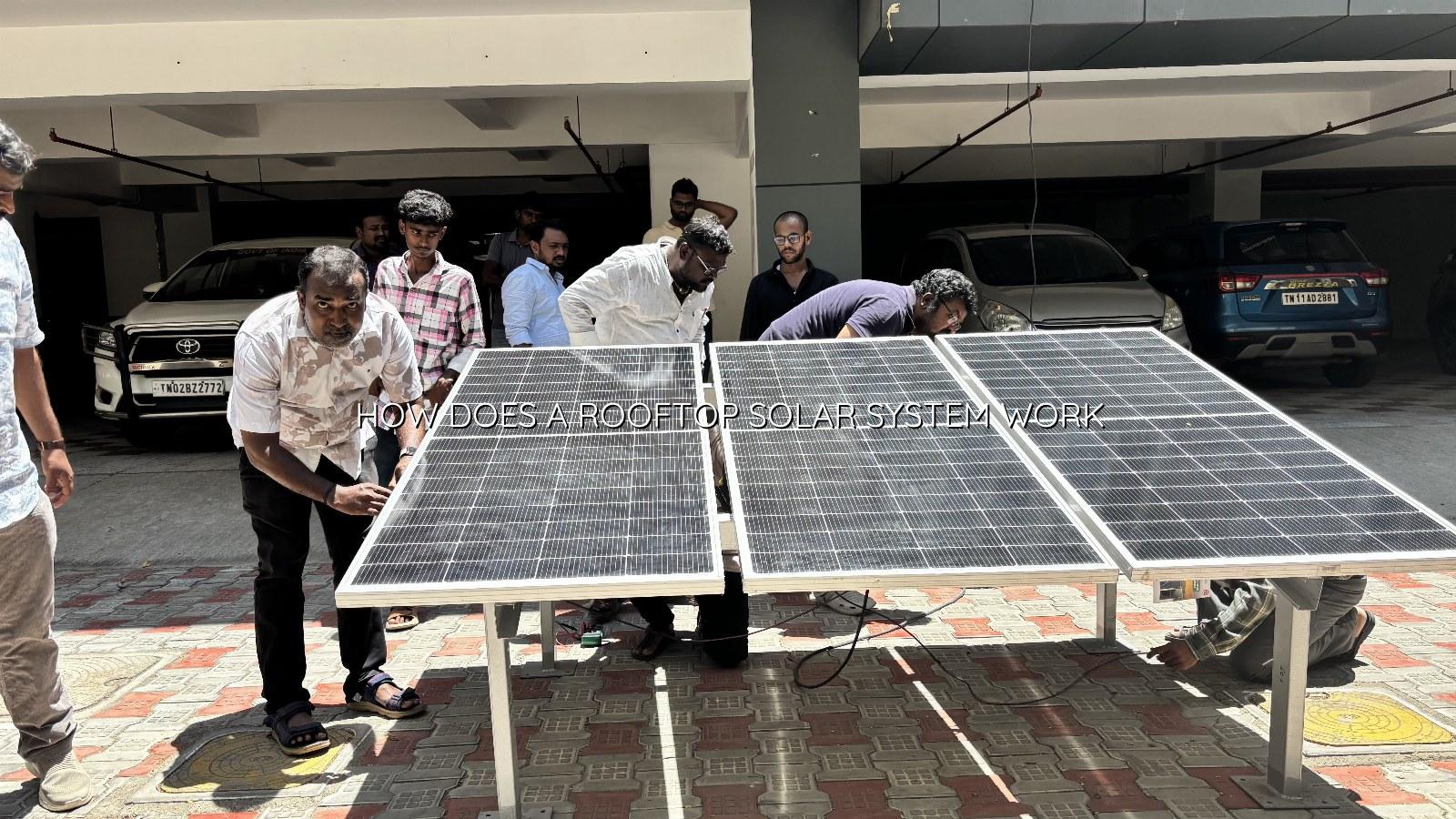
A rooftop solar system isn’t one device. It’s a set of parts that have to match each other. If one piece is wrong, the whole thing feels off. The better question is not just how does a rooftop solar system work, but what each part does once it’s fixed on your roof and tied into the building.
Panels and mounting
The panels are the visible part, but the mounting structure is just as important. In Kanyakumari District we deal with year-round sunshine, strong wind in open stretches, and near-coastal air in many places, so the frame and fasteners need to suit the site, not just the catalogue photo.
On RCC flat roofs, the array can usually be laid out in orderly rows. On sloped tiled roofs, the fixing points and waterproofing need more care. We’ve seen plenty of roofs where the solar layout was fine, but the cable entry or the roof penetration was the thing that caused trouble later.
The inverter and the load in your building
The inverter is the part that makes solar power usable for your lights, fans, fridge, computer and office equipment. It changes the panel output into AC supply, which is the form your appliances understand. In grid-tied systems, it also works with the EB side so the solar can support daytime use instead of sitting there on its own.
We don’t treat inverter choice like a box-ticking exercise. A small office in Thuckalay with computers and air-conditioning needs a different setup from a family home with mostly lighting and fans. Same district, different pattern, different result. That’s why the first conversation is always about the load you actually run.
- Solar panels make DC power before any appliance can use it.
- The inverter changes that DC power into AC power for the building.
- The EB connection decides how solar and grid supply interact.
- Mounting structure choice changes with roof type and wind exposure.
- Cable routing, earthing and sealing matter more near the coast and during monsoon months.
How we size it
The process we follow before any drilling starts
Most customers want a simple answer, and that’s fair. But a system works well only when the roof, the EB bill and the daily load all point in the same direction. This is the sequence we use on real jobs, whether it’s a home, a shop or a mixed-use building.
- We look at the bill first. The EB bill tells us the pattern of use, not just the total. A house in Suchindram with light daytime use is different from a shop near Marthandam that runs hard through the working day.
- We study the roof and the shade. Tanks, nearby walls, trees and parapets all affect output. On a tiled roof, we also pay attention to where fixing can happen without creating a leak later.
- We check the structure and the wind. The district sees strong winds in exposed areas, and that changes how the mounting is built. It’s not the place to cut corners.
- We design the layout around the real need. We don’t sell one standard system. We size from roof space, structure, budget, shading and the load pattern you actually live with.
- We install, connect and test. The panels, inverter, protections, earthing and cable path all have to work together. Once the hardware is in, the EB and documentation steps are handled with care so the customer isn’t left guessing.
- We show you how to use it. Before we leave, we explain the basic behaviour in daylight, what normal operation looks like, and what should make you call us.
Local conditions
Why the district changes the way a rooftop solar system is built
The same solar kit doesn’t suit every roof in Kanyakumari District. The coast, the wind and the monsoon all leave their mark. That’s why the design choice for a house in Manavalakurichi can be different from one farther inland in Boothapandi, even if the roofs look similar at first glance.
Coast, salt air and hardware
In coastal and near-coastal places like Colachel and Muttom, salt-laden air is real. It doesn’t mean solar won’t work there. It does mean the mounting, fixings and electrical connections need more thought than usual so they stay dependable after repeated weather exposure.
The cable route matters too. A neat installation isn’t just about straight lines; it’s about keeping water out, preventing loose points and making sure the system remains serviceable. If a job looks tidy but is awkward to reach later, that is usually a bad sign.
Monsoon season and daily output
The district gets strong sunshine for much of the year, but the south-west and north-east monsoon periods still change the pattern of generation. Cloud cover and rain can reduce output for part of the day, so the system should be understood as a daytime helper, not a one-line answer to every EB unit.
Drainage and sealing become extra important in those months. If water enters a junction box or collects where it should not, the system can suffer. A good design already expects that problem and tries to keep it out from the beginning. That’s why we look at roof slope, cable entries and weather exposure during the survey, not after.
System types
Which rooftop setup suits which kind of user?
People often think there’s only one solar setup. There isn’t. The right arrangement depends on whether you need daytime savings, backup during a power cut, or complete independence from the grid. This table gives a plain comparison.
| System type | Best suited for | How it behaves | What we check first |
|---|---|---|---|
| On-grid solar | Homes, shops and offices with a regular EB connection | Solar runs daytime loads and works with the grid supply | Roof space, shading and daytime consumption |
| Off-grid solar | Remote sites and places with unreliable grid supply | Solar works with a battery bank and stands apart from the grid | Backup need, load pattern and battery placement |
| Hybrid solar | Users who want solar, grid and battery together | Solar supports the building, battery covers selected loads, grid stays available | Critical loads, inverter choice and changeover behaviour |
| Solar for pumping | Agricultural land and borewell use | Solar power drives pumping during sun hours | Water depth, pump rating and site access |
For a family home in Ozhuginasery, on-grid solar is often the cleanest fit because the loads are steady and daytime use is easy to match. For a farm near Thovalai, the conversation changes quickly, because pumping hours, borewell depth and field access decide the design before anything else.
Small checks
Details that decide whether the system feels easy or awkward
A lot of people focus only on panel count. That’s natural, but it isn’t the whole job. The stronger systems usually come from the smaller choices: the mounting angle, the cable clips, the protection near the inverter, and whether the roof access is sensible for service. We’ve seen plenty of systems that looked fine on day one but became annoying because nobody thought about the path back to them later.
What we check before we quote
We want to know how the roof is used, whether the building is a house, shop or mixed-use site, and how the EB connection is arranged. We also check for shade, access and roof condition. If you’re comparing on-grid solar with hybrid solar, the load pattern usually decides the direction. And if backup matters, we may talk about inverters and batteries or lithium batteries where the site really needs that kind of support.
Why service access matters
Solar isn’t just an install, it’s something that should remain reachable later. That means clean cable routing, safe access to the roof, and hardware placed so inspection and maintenance don’t become a headache. In our experience, the second visit is where people start noticing whether the original work was thoughtful or rushed. It shows.
How JRS SunTech Energy Can Help
How JRS SunTech Energy Can Help
We handle rooftop solar the way real customers need it handled: site survey, system design, installation, EB and documentation guidance, commissioning and after-sales support. Our office is in Kottar, Nagercoil, and our work takes us across Kanyakumari District, so the advice you get is based on local roofs, local weather and local usage, not a copy-paste pitch.
If you want to understand how does a rooftop solar system work on your own building, send us your EB bill and a couple of roof photos. We’ll tell you honestly what looks practical, what needs another look, and whether the better route is a solar solution, subsidy guidance or a finance conversation through solar finance and EMI options. Contact: JRS SunTech Energy, Door No. 227, First Floor, Cape Road, St. Xavier's Church Junction, Kottar, Nagercoil, Kanyakumari District, Tamil Nadu - 629002. Phone: 9787775999. Email: jrssuntechenergy@gmail.com.
Frequently asked
Questions people ask before they put solar on the roof
The panels make DC power in daylight, the inverter changes it to AC, and your home or shop uses that power first. What happens after that depends on the system type and the EB setup, so the meter arrangement has to be planned properly from the start.
The usual set is solar panels, mounting structure, inverter, DC and AC cables, earthing, protections and the EB connection point. Some sites also add batteries, which changes how the system behaves during a power cut and how the load is carried through the day.
No, you don’t. We install on RCC flat roofs, sloped tiled roofs and sheet roofs, but the mounting structure changes with the roof type and wind exposure. On homes in Kottar and Vadasery we often look at shade, roof strength and cable routing before we recommend a layout.
The inverter is what turns solar power into the kind your appliances can use. It also handles protection and syncing in many setups, so the brand and capacity should suit the real load pattern instead of being chosen by guesswork.
We start with the EB bill, roof space, load pattern and site conditions. A home in Ozhuginasery with mainly evening use is not the same as a shop near Marthandam with long daytime loading, so the design should change with the building.
Yes, though output changes with cloud cover and shorter bright hours. In Kanyakumari District the monsoon and the coastal weather make drainage, sealing and clean cable work more important, and that sits right in the middle of a good design.
Hurry up!Subsidy ends 31 March 2027 · 134 days left
Next step
Thinking about solar for your roof?
Send us your EB bill, roof photo and location, and we will help you understand the right system for your home, shop or farm.
- Your electricity requirement and 60-day EB bill
- Property type — home, shop, office, farm or institution
- Backup requirement and available roof space
Related: On-Grid Solar · Subsidy Guidance · Contact
Free site survey · Kottar, Nagercoil