Solar guide
What Is a Bifacial Solar Panel
A practical look at how panels that use both sides behave on roofs and farm structures, and what decides whether they are worth considering.
Solar panel basics
What Is a Bifacial Solar Panel, and Why Does the Site Decide Everything?
What is a bifacial solar panel? It is a module that can gather sunlight from the front and make use of light that bounces up to the back. That sounds simple, but the real result depends on the roof, the mounting height, the surface below and the amount of shade around the array. We see people assume it is always the smarter option. It is not that tidy.
In Kanyakumari District, the answer changes quickly from one property to another. A house in Kottar with a tight RCC roof, parapet walls and tanks close by may leave very little room for the rear face to do useful work. A more open structure near Thovalai or a farm installation by Boothapandi can give the underside the space it needs, so the same panel behaves differently even though the brand and size are the same.
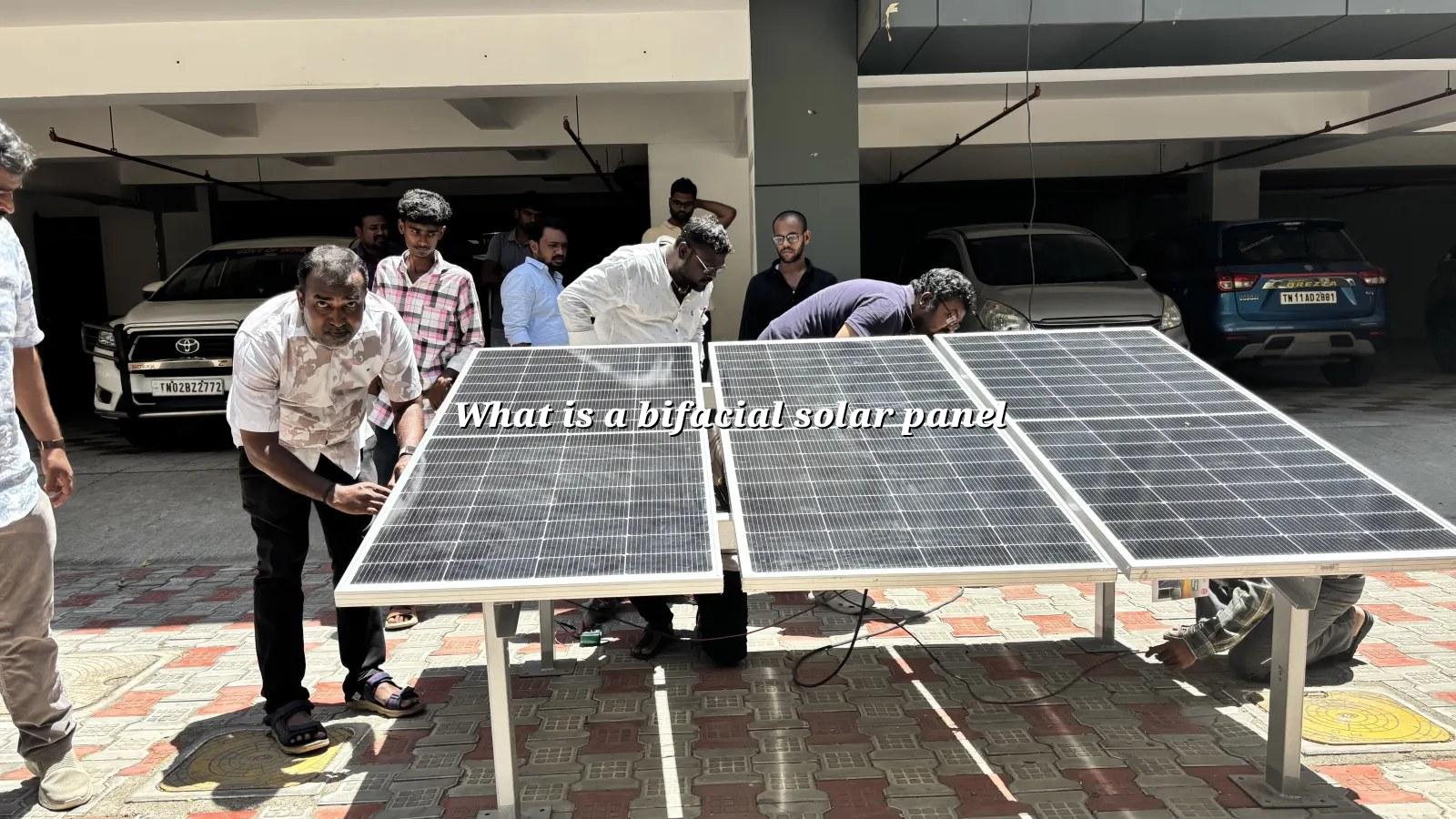
How it works
How bifacial panels use light from both sides
A standard module gets most of its energy from the front. A bifacial panel does that too, but its rear side can also pick up reflected light from the roof, the ground or the mounting surface beneath it. That extra side only becomes useful when the design gives it clear access to reflected light, and the amount varies more than most people expect.
Front face, rear face and real-world gain
Every solar module still turns sunlight into electricity the same basic way. The difference is that bifacial panels can do some of that work from the back as well. That does not mean double output, and it is easy to overread the brochures. The rear side usually contributes a smaller lift, and the lift changes with tilt, row spacing, roof colour, mounting height and what sits underneath the panel.
Why the mounting structure is part of the decision
If a panel sits low over a dark roof, or if a parapet wall blocks the reflected light path, the back side has little to collect. A raised frame over an open surface gives the panel a better chance. In coastal parts of the district like Muttom and Colachel, that same structure also needs to stand up to wind and resist corrosion, so the mounting choice and hardware selection become part of the panel choice. One weak fixing point can spoil the whole idea.
- The rear face needs reflected light, not just a marketing claim.
- Height off the surface changes the gain more than people expect.
- Dark roofs and low frames usually limit the benefit.
- Open structures are often a better match than cramped rooftops.
- Wind loading and sealing matter across Kanyakumari District.
Where it fits
When bifacial panels make sense, and when a regular panel is cleaner
We are often asked about bifacial panels after someone sees them online and wants the same setup at home. That is fair, but the product has to match the place. If the roof is small, the shade pattern is messy, or the underside will sit close to the roof sheet, a standard module can be the better answer because there is less to compromise.
On a house in Vadasery, we might first map the usable roof area, tanks, shade and the pattern of EB use over the 60-day cycle before saying anything about module type. On a farm near Thovalai, the question often shifts to open space, pumping load and how high the structure can sit above the ground. Same word, bifacial, but two very different conversations.
| Site condition | Bifacial fit | What we check | Practical note |
|---|---|---|---|
| Open RCC roof with raised mounting | Often suitable | Clearance, tilt, roof obstacles, shade from nearby walls | Rear side can see reflected light if the layout is open |
| Low roof with tight spacing | Less suitable | Gap below module, parapet height, nearby obstructions | Back side may add very little |
| Sheet roof with strong wind exposure | Possible with care | Structure strength, fasteners, cable sealing, corrosion risk | The mounting design matters as much as the panel choice |
| Open farm structure | Often worth discussing | Ground reflectivity, pump load, access, maintenance space | Good clearance can make the rear face more useful |
A few checks that save bad decisions later
We start with the site, not the sales pitch. First we look at shade, roof or land size, the EB connection and the way the structure will actually hold the array. Then we compare bifacial with other module types. In many commercial buildings in Marthandam or Karungal, a roof may have decent width but awkward pipes, vents or cable routes, and those details can wipe out the theoretical gain from the rear face.
The district’s weather also pulls the choice in a certain direction. Kanyakumari District gets strong sunshine through the year, yet the southwest and northeast monsoon periods can push water into weak cable runs and expose poor drainage. Add in the sea air around the coast and you can see why we talk about hardware and sealing so early. A panel choice that ignores the structure is only half a choice.
Our approach
How we decide whether bifacial is the right fit
We keep the process plain. No forced upsell, no blanket answer. If bifacial makes sense for your place, we will say so. If it doesn’t, we’ll say that too and point you to the simpler option.
- We check your usage first. The EB bill, the 60-day unit pattern and the connection type tell us what size range is worth discussing.
- We inspect the site. Roof shape, structure, shade, slope and the space below the panel all shape the rear-side gain.
- We compare the module choices. Sometimes bifacial is useful, sometimes a standard module is the better fit, and sometimes the wider system design needs more attention than the panel itself.
- We plan the mounting and wiring. Near the coast we pay close attention to fastening, sealing and corrosion resistance, and on agricultural sites we keep cable runs protected and tidy.
- We explain the trade-offs clearly. You should know why a setup is being proposed. If there’s a catch, we will say it.
Local notes
What changes in Kottar, Thuckalay and the coastal belt?
In Kottar, many rooftops are shaped by tanks, stair blocks and parapet walls, so the back side of a bifacial panel may not have much to see unless the layout is planned around it. In Thuckalay, some commercial roofs give you more open width, which can improve the chances of a rear-side gain. And on the coast, the question is never just output. It is whether the installation will still look neat and stay sound after wind, moisture and salt-laden air have done their bit.
That is why we do not treat the panel as a standalone product. We look at the roof or land, the mounting structure, the local exposure and the kind of solar system the customer actually needs. If you are comparing this with on-grid solar or hybrid solar, the module type is only one piece of the picture, and usually not the biggest one.
For some homes, the right answer is still a conventional panel on a sensible frame. For some farms, bifacial can be a better fit because the open setting lets the underside do useful work. The important thing is to test the idea against the real site in front of you, not against a picture from somewhere else.
How we help
How JRS SunTech Energy Can Help
We help you decide whether a bifacial solar panel is actually worth considering for your roof, your farm or your business site. Our team at Kottar, Nagercoil looks at the real place first, then recommends a practical system based on shade, structure, available space and the EB connection. If bifacial fits, we will show you why. If it doesn’t, we’ll tell you that plainly and suggest the better route.
We also guide customers through installation, EB and documentation support, and the required steps around the applicable government solar programme. If you want a site visit or a straightforward opinion, contact JRS SunTech Energy, Door No. 227, First Floor, Cape Road, St. Xavier's Church Junction, Kottar, Nagercoil, Kanyakumari District, Tamil Nadu - 629002. Phone: 9787775999. Email: jrssuntechenergy@gmail.com.
Frequently asked
Questions people ask about bifacial solar panels
It is a solar module that can take in light from the front and also make use of reflected light on the back. The rear side only helps when the mounting, spacing and surface below give it something useful to work with.
No, and that is the bit people miss. On a crowded RCC roof with low clearance or heavy shade, the back side may not add much at all.
They tend to suit open structures, some commercial sheds and farm sites where the underside sees light and airflow. The more open the setup, the better the chance of getting a real rear-side benefit.
Look at shade, mounting height, roof or ground colour, wind exposure and how much space sits under the array. If those parts are not right, the panel type alone will not save the design.
Yes. They can work well on raised structures for pumping or other farm loads, especially where the ground and layout allow reflected light to reach the rear face. We still check the pump duty and the structure first.
We begin with your EB usage, roof or land area and the local site conditions, then compare bifacial with other module options. If it is not the best fit, we tell you that plainly and suggest a better setup.
They do. Near the shore, wind loading, corrosion resistance and neat cable sealing matter a lot, so the mounting choice can matter as much as the module itself.
Hurry up!Subsidy ends 31 March 2027 · 134 days left
Next step
Not sure if bifacial is the right panel for your site?
Send us your site photo, rough roof or land size and your EB details, and we will tell you honestly if bifacial makes sense.
- Your electricity requirement and 60-day EB bill
- Property type — home, shop, office, farm or institution
- Backup requirement and available roof space
Related: Solar Solutions · Products · Contact
Free site survey · Kottar, Nagercoil