Solar structure guide
Effect of Wind on Rooftop Solar Structures
How we decide on roof fixing, support spacing and hardware so a solar array stays steady through strong breeze, monsoon weather and day-to-day use.
Roof checks first
What wind really does to a solar roof
The effect of wind on rooftop solar structures is mostly about uplift, vibration and the tiny movements that add up over time. A terrace in Kottar can look calm from the road, yet the edge of the roof may catch a strong gust and start working against the frame. That's why we never treat one roof like the next.
In Kanyakumari District we get good sunlight through the year, but we also get monsoon spells, coastal breeze and open stretches where wind finds its own path. That matters on RCC flat roofs, on sloped tiled roofs and on sheet roofs too. The support system has to suit the building, the roof edge and the local weather pattern, not just the panel size.
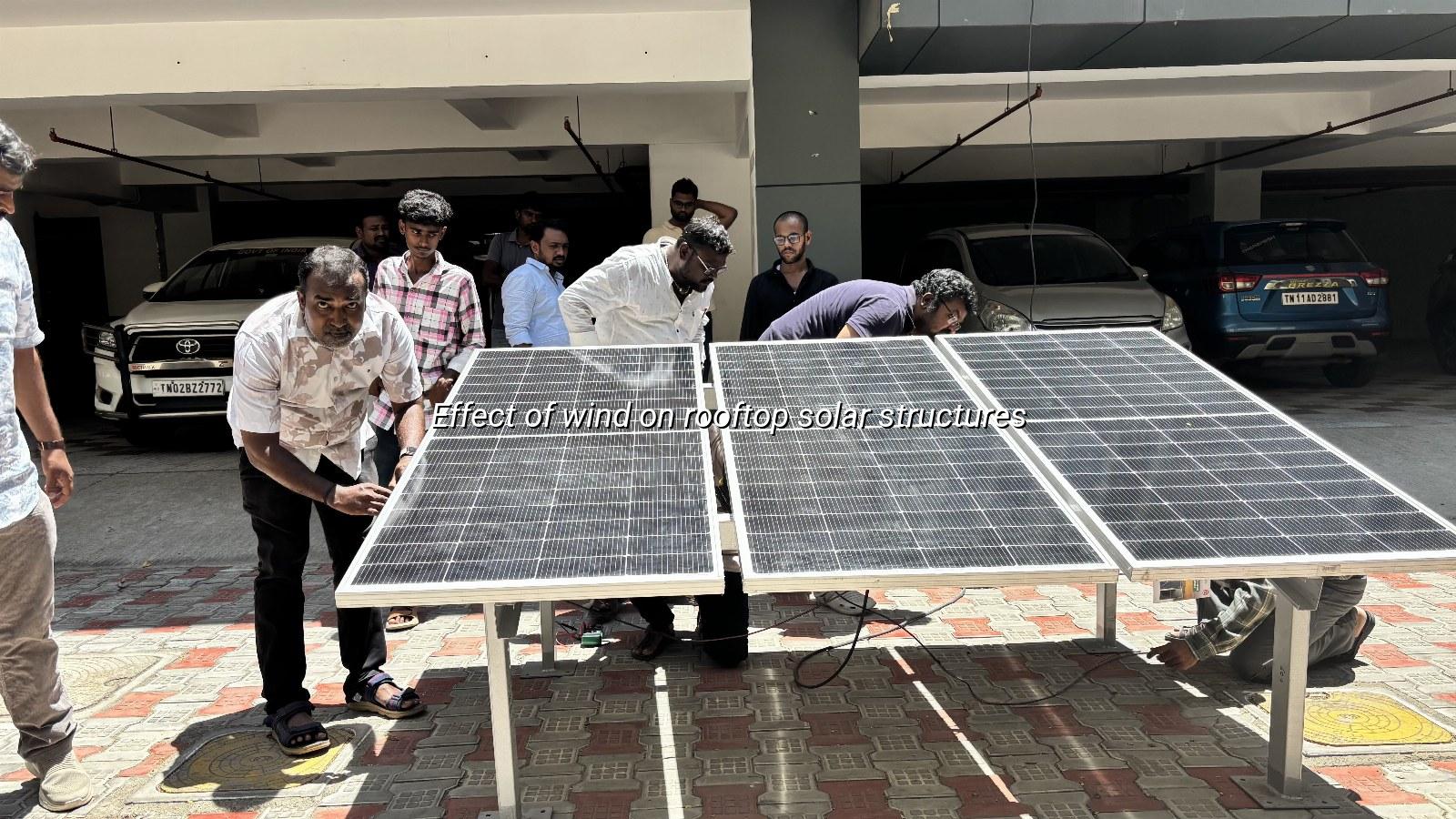
Wind load basics
Why one mounting layout doesn't suit every roof
Wind changes at the corners, around parapets, beside water tanks and across open gaps between buildings. So a neat drawing on paper can behave very differently once the system is fixed on the actual roof. That is normal, and it is why we survey first.
Uplift is the part people usually miss
Most people think of wind as something that presses down. On a rooftop array, the more annoying force is often uplift, because it tries to pull at the panel edge and at the mounting base. If the frame is too low, too light or anchored in the wrong place, the movement starts small and gets worse each rough spell.
Vibration can loosen a tidy install
A system can look neat on day one and still be a poor choice for a windy site. Repeated vibration works on fasteners, clamp joints and cable supports, and that shows up later as noise, slack, or a cover that won't stay in place. We see it more often on coastal properties and on taller buildings in Thuckalay and Marthandam where the roof edge is more exposed than the owner expected.
- Roof edges usually need more attention than the middle area.
- Mounting legs, clamps and base plates should match the roof material.
- Cable clips and conduit entries need sealing so wind-driven rain does not enter.
- Coastal air is hard on hardware, especially near Manavalakurichi and Muttom.
- Panel spacing should still allow drainage and make cleaning possible.
| Roof condition | Wind concern | What we check |
|---|---|---|
| RCC flat roof | Edge uplift and parapet turbulence | Anchor points, base support, cable path |
| Sloped tiled roof | Tile movement and slip points | Rafter condition, fixing method, water sealing |
| Sheet roof | Panel flutter and frame vibration | Sheet thickness, purlin support, fastening line |
| Coastal property | Salt-laden air and gust pressure | Hardware choice, corrosion resistance, connection cover |
Before we fix anything
How we assess a roof and choose the structure
We don't pick a mounting structure from a catalogue and hope it fits. The roof shape, the building's direction, the shade pattern and the local breeze all matter. A home in Ozhuginasery does not behave the same way as a farm shed near Aralvaimozhi, so the structure should follow the roof, not fight it.
- We study the roof first. RCC slab, tile, sheet, patchwork repairs, crack lines, parapet height and the small details that tell us how the roof behaves.
- We read the wind path. Open corners, nearby taller buildings, sea-facing exposure and anything else that can make turbulence worse.
- We match the support system. Frame, clamps, fasteners and cable routing are chosen for that roof, not for a generic drawing.
- We check water movement. If rainwater can pool or run under a joint, the sealing plan has to change before installation starts.
- We finalise the design and quotation. Then we move on to installation, EB and documentation work, commissioning and after-sales support in the normal seven-step process.
This is where a lot of careless jobs go wrong. Someone places panels in a clean row, leaves poor cable support and assumes the work is done. A few months later the owner hears rattling in the wind, or spots a loose clip after the first monsoon spell. We prefer to slow down at the front end so the roof doesn't become a problem later.
If your property is near the coast, hardware choice matters even more. We have seen the difference on houses closer to Rajakkamangalam and Kanyakumari where the air carries salt, and on more sheltered inland roofs where corrosion is slower. Same district, different stress on the system. That part is easy to miss if you're only looking at the panels.
Practical checks
What makes a rooftop solar structure steadier in wind
The best way to handle wind is to think about the whole roof, not just the panel. A structure gets steadier with the right support spacing, proper anchoring, a sensible tilt and sealing around every entry point. We also keep maintenance access in mind, because a roof that can't be inspected soon becomes a roof with hidden trouble.
On many homes, especially around Suchindram and Agasteeswaram, the problem isn't extreme failure. It is minor movement, a loose fastener or a cable cover that was never fixed properly in the first place. Those little things matter more than people expect. They make the difference between a roof that feels solid and one that starts to sing in the wind.
What we usually tell customers to watch for
- Any rattling noise after a windy night should be checked quickly.
- Panel edges should not sit awkwardly higher than the rest of the frame.
- Water seals around cable entries must stay intact through the monsoon.
- Rust stains or white powder on hardware can point to corrosion issues.
- Loose conduit or hanging cable ties are a warning sign, even if generation still looks normal.
And if you already have a solar plant, don't wait for a major fault. A small inspection is often enough to catch a loose mount, a tilted leg or a cover that has started to lift in the wind. We have found that simple checks save people from bigger repairs later, and in a place with this much sun and breeze, that habit pays off.
Related systems
Wind affects on-grid, off-grid and hybrid solar in different ways
Not every solar system carries the same weight or uses the same roof layout. A mounting structure for an on-grid array may be simpler than a hybrid system with battery gear, while an off-grid installation at a farm site can face wider open wind and dust. The support plan should match the job.
On-grid roofs in town areas
Homes and small businesses in Nagercoil often want a clean roof layout with easy access for inspection. On-grid systems need a stable frame because they usually sit on the roof for years, through both monsoon seasons and dry months. If the roof is open and exposed, we may change the panel layout or support spacing to reduce edge stress. You can see the related service at on-grid solar.
Off-grid and hybrid work in open sites
Farms and remote sheds can be more exposed than houses, especially where there is less surrounding structure to break the wind. That is common in agricultural areas and pump sites around Thovalai and Boothapandi. For those jobs, we think about structure strength, battery placement, cable protection and service access together. If you want to compare the options, see off-grid solar and hybrid solar.
For solar water pumps, wind still matters, though people often forget that a pump shed or controller cover can be the first thing to suffer if the install is careless. For maintenance work, the wind angle tells us a lot about why a system has started to move or make noise. Our solar service & maintenance page explains the kind of inspection we do.
Process and fix
What usually happens after we spot a wind issue
A wind complaint is often less dramatic than people fear. Most of the time it's a weak fixing line, a loose clamp, a support that was placed with the wrong spacing or a cable that has started rubbing against metal. We check the roof, then the array, then the hardware, because the cause is not always where the noise is.
If the problem is on a roof near the sea, we look harder at corrosion and the condition of exposed fasteners. If the property is inland, we still check the support path, but the likely cause may be different. The point is to find the actual reason before anyone starts replacing parts that are still fine.
- We inspect the roof line. We look for movement, loosened fittings and signs of water entering where it shouldn't.
- We test the array support. Clamps, legs and base plates are checked against the roof type and the wind exposure.
- We check wiring and covers. Cable clips, conduits and junction points should be fixed, sealed and protected from rubbing.
- We decide the next step. Sometimes it needs tightening, sometimes sealing, sometimes part replacement, and sometimes the layout itself needs change.
That is also how we handle systems we didn't install ourselves. If the frame is usable, we say so. If it needs work, we'll say that too. People appreciate a straight answer more than a polished one that doesn't hold up once the wind picks up.
How JRS SunTech Energy can help
A steadier roof starts with the right survey
If you're planning rooftop solar or your current array feels shaky in the wind, we can check the roof, the mounting structure and the cable routing before the trouble gets worse. We work from our Kottar, Nagercoil office and serve homes, businesses and agricultural sites across Kanyakumari District, with one year of free service support after installation and continued help after that.
We also guide you through the EB documentation and subsidy procedure where applicable, and we'll be honest if a repair, a replacement or simply a tighter fixing is the better move. Call us for a site visit and we'll look at the actual roof, not an assumption.
JRS SunTech Energy, Door No. 227, First Floor, Cape Road, St. Xavier's Church Junction, Kottar, Nagercoil, Kanyakumari District, Tamil Nadu - 629002. Phone: 9787775999. Email: jrssuntechenergy@gmail.com.
Frequently asked
Questions we hear about wind and rooftop solar
Wind changes the load on the mounting frame, the fasteners and the cable supports. On a roof edge or a higher terrace, a gust can create uplift and vibration, so the fixing points need to suit the actual roof and not a generic layout.
Sheet roofs and sloped tiled roofs usually need the closest checking because the fixing method is different from an RCC flat roof. We look at how the structure is anchored, how water moves, and whether the roof members can take the load without movement.
Yes, if the structure is too light for the site or the hardware is not chosen properly. Small movement can loosen clamps, disturb conduit and leave the array noisy, especially where wind and salt air keep working on the same points.
We do. Sometimes the answer is a loose clamp, sometimes it is a poor slope or an anchor that needs rework, and sometimes the problem is in the cable routing rather than the frame itself. We can inspect systems even when they were installed by another company.
Because the district has strong sunshine, wind exposure and coastal air in the same year. A roof in Manavalakurichi or Muttom faces different stress from a more sheltered site inland, so the structure should be picked for the place where it will actually sit.
It helps a great deal, but the roof condition, panel layout and cable protection still have to be right. Good structure is one part of the job, not the whole job.
Hurry up!Subsidy ends 31 March 2027 · 134 days left
Next step
Worried about wind on your roof?
Send us your roof type, a photo if you have one, and your EB connection details. We will tell you what needs checking and whether the structure looks suitable.
- Your electricity requirement and 60-day EB bill
- Property type — home, shop, office, farm or institution
- Backup requirement and available roof space
Related: Solar Maintenance · Solar Solutions · Contact
Free site survey · Kottar, Nagercoil