Solar pump guide
DC Solar Pump vs AC Solar Pump
A plain comparison for farmers and site owners who want to choose the right pumping setup for their land, borewell or storage tank.
Solar pump guide
Choose the right pump type for your water source
DC solar pump vs AC solar pump is a question we hear from farmers, borewell owners and field managers who want straight answers, not sales talk. The short version is that both can work well, but they suit different motors, different depths and different site habits. The wrong choice usually shows up later as awkward starting, poor discharge or a system that is harder to keep in shape.
In Kanyakumari District, sunlight is usually strong enough for solar pumping on most working days, but the rest of the site still matters. A plot in Thovalai with a deep borewell does not behave like a shallow irrigation point near Boothapandi, and a coastal farm near Muttom needs different mounting and cable care than an inland site. We look at the water need first, then we match the pump to the job. No guessing.
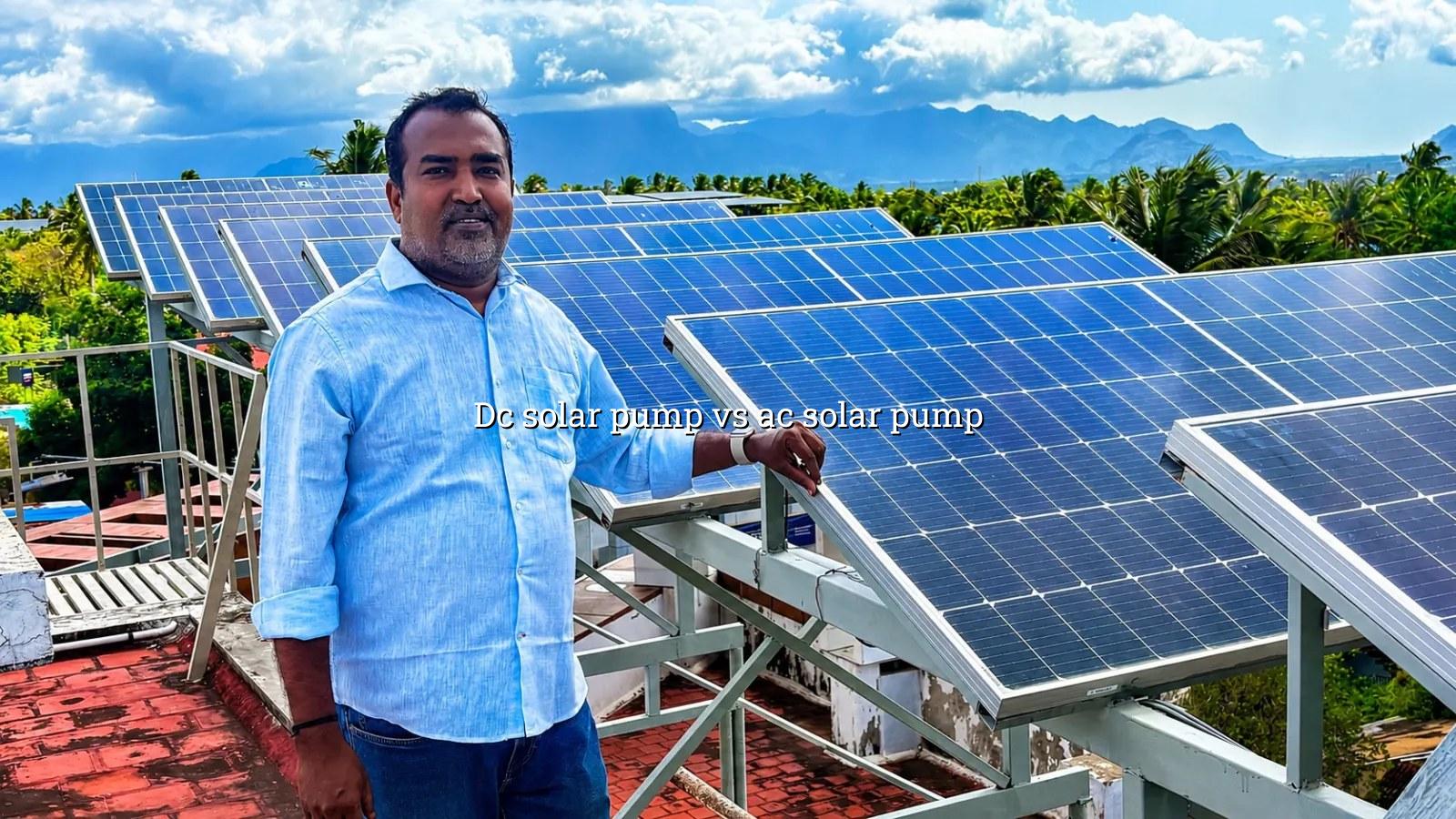
Pump comparison
What the comparison really means on site
People often ask as if the answer is only about electricity type. It isn't. The better choice depends on the motor style, controller, available panel space, pipe run and the way the water is used through the day.
DC solar pumps in simple terms
A DC solar pump uses direct current from the solar array through a controller, then drives the pump motor in that same family of power. That can make the layout neat for small to medium pumping jobs where the site wants direct daytime pumping without extra conversion steps. In our work, DC systems are often discussed for farms where the water need is predictable and the pump point is fixed.
AC solar pumps in simple terms
An AC solar pump uses an AC motor with the right inverter or drive arrangement so the solar array can run it properly. This is a good fit when the existing pump set is already AC, or when the site needs a motor setup that matches common agricultural hardware. For larger or more familiar pump installations, many owners feel more comfortable staying with AC because the maintenance pathway is easier for their local electrician to understand.
- DC systems can be simpler for a direct solar pumping layout.
- AC systems suit many existing pump sets and familiar motor arrangements.
- The water head, pipe length and discharge target matter as much as the motor type.
- Wind load and mounting strength matter on open land, especially around the Aralvaimozhi side.
- Salt-laden air near the coast calls for better hardware, cable sealing and neat earthing practice.
Selection process
How we decide between DC and AC
We don't sell one standard pump package. The same rule we use for rooftop solar applies here too: start from the real site, not from a brochure. When the water source, land and daily use are clear, the right answer usually becomes obvious.
- Check the water source. Borewell, open well, sump and canal lift jobs behave differently. A deeper source usually changes the pump selection more than people expect.
- Measure the head and pipe run. The vertical lift and the length of the pipe line decide how hard the pump has to work, and that affects whether a DC or AC setup feels sensible.
- Match the daily water need. A small vegetable plot near Suchindram is not the same as an irrigated patch closer to Kulasekharam. The schedule for watering can point you toward a simpler direct system or a more flexible AC-based one.
- Look at the panel space and mounting. On sheet roofs, RCC roofs and ground-mounted farm frames, the structure is different. In windy stretches of the district, the frame and fasteners matter as much as the pump.
- Review maintenance access. If the site owner wants a system that a nearby technician can understand quickly, AC can be the easier language. If the job is a neat direct solar pumping point, DC may be the cleaner fit.
Reference table
DC vs AC at a glance
This table is a practical comparison, not a rulebook. A good installation can still fail if the pipework is poor or the cabling is messy, so we always treat the whole site as one system.
| Point | DC solar pump | AC solar pump |
|---|---|---|
| Best fit | Direct solar pumping jobs with a simple layout | Sites that already suit an AC motor or need familiar pump hardware |
| System feel | Usually straightforward when the pump, controller and panels are matched well | Often preferred when the site wants easier motor-service familiarity |
| Site preference | Good for small to medium agricultural points with clear daytime pumping need | Good where the pump set, usage pattern and wiring approach suit AC equipment |
| Installation focus | Controller placement, cable protection and panel matching | Drive/inverter matching, start-up behaviour and earthing layout |
| Where we pay extra attention | Open fields with strong wind and long cable runs | Sites with older pump rooms, mixed wiring or uncertain load behaviour |
Local conditions
Why location inside the district still changes the answer
Kanyakumari District has good sunshine, but the land and air around it are not all the same. On coastal plots near Muttom, salt air can be hard on metal parts and terminations, so we like to keep hardware choices tight and the cable sealing neat. Inland, in places like Thovalai and Boothapandi, wind load and frame stiffness take centre stage because the open land can push on the mounting structure more than the owner expects.
A farmer in Aralvaimozhi may care less about the motor label and more about whether the frame stays steady through the windy season. Someone working near Kulasekharam often asks about day-to-day water timing, because the crop schedule and storage tank size decide whether the pump should run in short bursts or in longer stretches. That is why dc solar pump vs ac solar pump should never be answered from a desk alone. The site decides.
What we usually check before we recommend anything
We inspect the water source, the motor condition if one already exists, the route for the solar cables, the structure for the panels and the likely maintenance access. If the ground is uneven or the frame is exposed, we also look at how the mounting will resist shaking, loosening and long monsoon periods. The south-west and north-east monsoon seasons matter here because water ingress and drainage around the pump yard can turn a neat plan into a messy one if the layout is rushed.
Practical tips
Things to get right before you place the order
- Ask for a layout that shows the panel position, controller position and cable path together.
- Keep the pump shed or controller point dry and easy to reach during monsoon months.
- Use hardware that suits coastal air if your land is closer to the shore.
- Check whether the existing pump can still be used, or whether a fresh pump set makes more sense.
- Choose the structure for real wind, not the calm day you saw during the first visit.
- Make sure the water storage plan is clear, because storage can reduce unnecessary pump running.
How we help
How JRS SunTech Energy Can Help
We help you compare dc solar pump vs ac solar pump against your actual site, not against a fixed package. Our team visits the farm, checks the borewell or water point, looks at the structure and then explains the choice in plain words. If the system needs support later, we also handle inspection, troubleshooting and preventive maintenance, including for equipment installed by other companies.
You can reach JRS SunTech Energy, Door No. 227, First Floor, Cape Road, St. Xavier's Church Junction, Kottar, Nagercoil, Kanyakumari District, Tamil Nadu - 629002. Call 9787775999 or WhatsApp 9787775999, and we will help you sort out the pump type that actually fits your land.
We also guide customers through the EB side of the project where needed, and we give one year of free service support after installation, with continued technical assistance afterwards. Specific service terms vary by product, manufacturer warranty and installation.
Frequently asked
Questions we hear about DC and AC solar pumps
It depends on the site and the pump size, not just the panel count. DC pumps are often simpler on small direct pumping jobs, while AC solar pumps make sense when the pump set, controller and power profile suit an AC motor. We check the borewell depth, discharge need and water storage plan before saying anything firm.
In many small systems, the electronics are simpler and that can make troubleshooting easier. Even so, the real answer depends on the quality of the controller, the motor, cable run and how the pump is installed. A clean wiring layout matters more than people think.
Yes, in some cases a hybrid arrangement can work, but the choice has to match the motor type and the control gear. For agricultural sites around Thovalai or Boothapandi, we first look at the pump duty and the land setup, then suggest the cleaner option.
Look at the water source, daily pumping need, pipe length, head height, roof or ground space for panels, and whether the site sees strong wind or salt air. On coastal plots near Muttom or Manavalakurichi, the mounting and cable protection deserve extra attention.
Yes. We handle site survey, design, installation, EB-side documentation where needed, commissioning and after-sales support. If the pump is part of a wider solar plan, we can also connect it with our solar water pumps page and the right product setup.
Yes, that is exactly the kind of call we get. We listen to the water need, check the site and then explain the pros and limits in simple words so you can choose without guessing.
Hurry up!Subsidy ends 31 March 2027 · 134 days left
Next step
Still deciding between DC and AC?
Send us your water source details, borewell depth, pipe length and a photo of the site, and we will tell you which pump type fits best.
- Your electricity requirement and 60-day EB bill
- Property type — home, shop, office, farm or institution
- Backup requirement and available roof space
Related: Solar Water Pumps · Solar Maintenance · Contact
Free site survey · Kottar, Nagercoil