Solar guide
Solar DC Cable Selection
How we choose the right DC cable for a solar array, inverter run and site conditions in Kottar, Nagercoil and across the district.
Cable sizing help
Start with the route, not the roll of cable
Solar dc cable selection gets a lot easier once you stop treating it like a parts list item and start treating it like a site decision. The cable has to suit the current, the distance, the roof material, the inverter position and the way the line will be fixed. If any one of those changes, the answer can change too.
We see this most clearly on rooftops around Kottar and Vadasery, where one home has a clean RCC terrace and the next has a sloped tiled roof with a few awkward bends and a narrow service path. The cable that works on one roof may be a poor fit on the next. And once you add district weather, direct sun and occasional salt air, the route matters just as much as the conductor inside the cable.
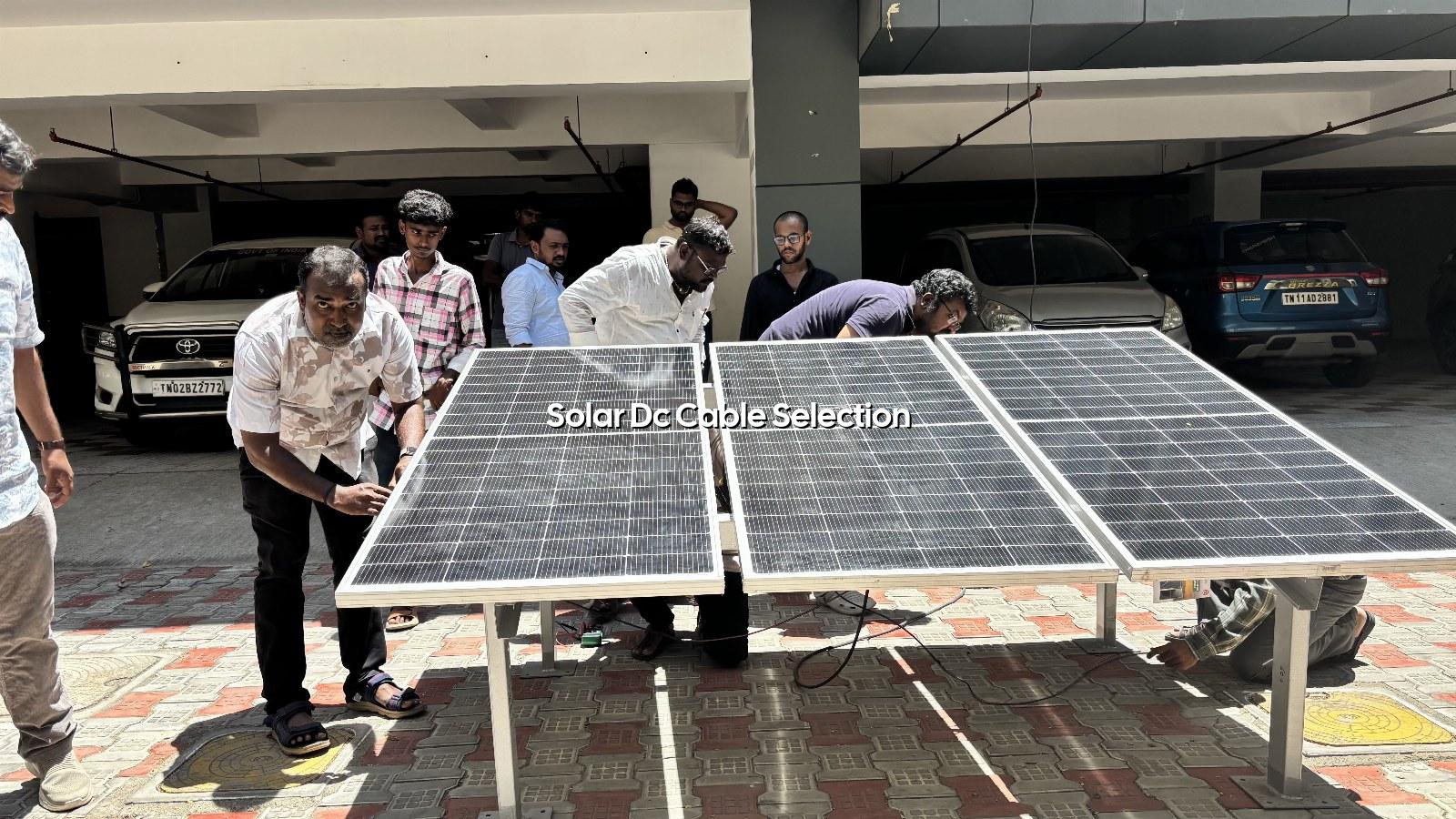
What changes the answer
The practical checks we make before we size the cable
People often ask for a cable size first, but the proper way is to check the site and then pick the cable. That is how you avoid loose routing, heat build-up and awkward terminations later on.
Current and distance
We begin with the string current and the route length from the modules to the inverter. The shorter the route, the simpler the job usually is, but the real test is still how the cable will perform once it is clipped, bent and pulled through the actual path. A neat five-metre run can be easier than a messy eight-metre one, or the other way around if the roof layout is awkward.
On commercial roofs in Thuckalay and Marthandam, for example, the line may have to cross service corridors, terrace access points and a few more cable supports than a small home system. That does not mean the job is difficult. It just means the route needs to be planned properly so the final install stays tidy and easy to inspect.
Heat, sunlight and movement
Solar DC cable sits outdoors for the full life of the system, so the jacket and the fixing method both matter. A cable resting loosely on a hot roof or running across a sharp edge will age badly no matter how good the solar panels are. We try to keep the line supported, shaded where possible and away from rubbing points.
In the windier stretches near Aralvaimozhi, that extra support becomes even more important. Roof movement, vibration and exposed mounting structures can all create wear over time, so we make the run stable from the start instead of hoping it will stay put. It’s a small thing until it isn’t.
| Site condition | What we check | What it changes in the cable plan |
|---|---|---|
| Short rooftop run | Inverter near the array, few bends, easy access | Keep the route neat and avoid unnecessary slack |
| Longer inverter run | Distance, tray path, bends and termination points | Confirm the route carefully before fixing the cable |
| Coastal exposure | Salt air, glands, junctions and exposed supports | Seal better and pay closer attention to hardware |
| Monsoon-prone roof | Drainage, entry points and water sitting on the line | Raise, clip and seal so water does not stay there |
| Sheet or tiled roof | Rubbing points, movement, fixing method and access | Protect the cable from edges and vibration |
Step by step
How we work out the right solar DC cable selection
Our process is simple enough to explain, but it only works if each step is done on the real site. That is why a survey matters more than guesses from a phone call.
- Measure the real route. We walk the roof, note the inverter position and see where the cable will actually travel instead of drawing a straight line on paper.
- Check the electrical load. The current in the string tells us how the line behaves, and it helps us think about voltage drop before the first clip goes on.
- Study the roof type. RCC, tiled and sheet roofs each need different fixing points and different care near edges, corners and sheet joints.
- Plan for weather. In coastal pockets and during the monsoon periods, sealing and support become a bigger part of the decision than many people expect.
- Leave the line serviceable. We fix the route so a later inspection can be done without lifting half the installation or pulling fittings apart.
Small mistakes that cause big headaches
- Do not let the cable sit loose on a hot roof where it can sag or rub.
- Do not run DC wiring through unsealed gaps in sheet roofing.
- Do not mix cable types just because one is already lying on site.
- Do not clamp it so tightly that later inspection becomes a problem.
- Do not ignore a warm connector, a dark patch or a brittle section near the inverter.
Local conditions
Why the district changes what we recommend
Kanyakumari District gets strong sunshine through the year, which helps generation, but that same sun is hard on weak routing and poor terminations. A cable that is barely supported can shift, rub or heat up more than it should. That is why we look at the roof as a working surface, not just a place to park panels.
Coastal air matters too. Around Colachel and Muttom, salt-laden air can age exposed fittings faster than inland sites, so the terminations, glands and support points need careful attention. We do not treat a coastal house the same way we would treat an inland roof, because the wear pattern is different and the fix has to match it.
The monsoon seasons change the job again. Water can find a low point in the route, a loose entry point or a weak seal in a hurry. At a home in Kottar that may mean a problem shows up after the first heavy rain, while at a farm site near Thovalai the issue may be dust, movement and long exposed runs instead. The site decides the detail.
A few habits that save trouble later
Keep connectors dry. Keep bends gentle. Keep the line away from sharp metal. These are ordinary habits, but they stop most of the avoidable damage we get called to inspect. We we see the same story often enough: the cable itself was never the only issue, it was the route and the fixing around it.
What we look for on service calls
Signs the cable path needs attention
Some people only call after a fault, but a visual check usually gives clues earlier. Heat marks, a loose clip or a poorly sealed entry point can tell a clear story before the system stops working.
Things that can be seen quickly
A cable that has shifted from its original position usually leaves a clue. You might see rubbing marks on a roof edge, a section that lies flatter than the rest, or a connector that looks discoloured near the inverter. Those small signs are worth checking because they often point to the place where the real problem started.
On repairs and service visits we also look at the cable support itself, not just the conductor. If clips are broken or too far apart, the line moves more than it should. In a windy district that movement can become wear, and wear becomes a fault sooner than most owners expect.
When replacement is the better answer
Sometimes a re-termination is enough, and sometimes it isn’t. If the insulation is cut, baked hard by the sun or badly routed from the start, we would rather tell you to replace the affected run than make a quick patch that fails later. That’s the honest answer, and it saves repeat visits.
Our team handles service for systems we installed and for systems installed by other companies too. So if the wiring has become untidy over time, or the cable run no longer matches the roof after changes or repairs, we can inspect it and tell you what needs to happen next.
How JRS SunTech helps
How JRS SunTech Energy Can Help
We handle cable selection as part of the full solar job, not as a last-minute add-on. That means we check the EB connection, roof type, inverter position and support points before we install anything. For homes, shops and farm systems, that detail matters because the cable has to fit the site you actually have.
If you already have a system and want a second look, we can inspect the wiring and tell you honestly whether it needs a repair, a replacement or simply a cleaner route. Call 9787775999, email jrssuntechenergy@gmail.com or visit us at Door No. 227, First Floor, Cape Road, St. Xavier's Church Junction, Kottar, Nagercoil, Kanyakumari District, Tamil Nadu - 629002.
Frequently asked
Questions we get about solar DC cable selection
The right size depends on the current, the run length and how much voltage drop you can live with. We size the cable after checking the string layout, the inverter location and the route the cable will take, because a short run on an RCC roof is very different from a longer run on a shed or sloped roof.
No, not as a general habit. Solar DC cable is made for outdoor use, sunlight and the electrical behaviour of DC systems, while the route also needs neat sealing and proper termination. On many jobs we see problems start with the wrong insulation choice or poor gland fitting, not the panel itself.
Yes, it does. In parts of Kanyakumari District near the coast, salt-laden air can attack terminations, glands and exposed metal faster than people expect, so we look closely at the cable jacket, end fittings and the way the cable is supported. A site near Colachel is not treated the same as an inland roof.
We keep the route raised where needed, avoid low points that hold water, use proper clips and seal entry points carefully. During the south-west and north-east monsoon periods, water finds weak spots quickly, so drainage and cable sealing matter as much as the cable size itself.
Yes, we do. Our service team checks for heat marks, cut insulation, loose joints and poor routing, then we tell you plainly whether the issue needs repair, replacement or just a better re-termination. We handle service for systems we installed and also for systems done by others.
Absolutely. A flat RCC roof in Kottar may allow a clean straight route, while a sheet roof or a house with long shading gaps needs a different path and sometimes a different protection approach. The cable choice follows the site, not the other way round.
Hurry up!Subsidy ends 31 March 2027 · 134 days left
Next step
Need help with the cable run on your solar roof?
Send us your roof photo, inverter location and EB bill details, and we will suggest the right solar wiring approach for your site.
- Your electricity requirement and 60-day EB bill
- Property type — home, shop, office, farm or institution
- Backup requirement and available roof space
Related: Solar Maintenance · Solar Solutions · Contact
Free site survey · Kottar, Nagercoil