Subsidy guide
How to Apply for the PM Surya Ghar Subsidy
A straightforward look at the paperwork, the roof checks and the EB steps we handle from our Kottar office.
Subsidy steps
How to apply for the PM Surya Ghar subsidy without getting tangled up
If you're trying to work out how to apply for the PM Surya Ghar subsidy, the short answer is this: start with the roof, the EB connection and the documents you already have. The form itself is rarely the problem. The trouble usually starts when the applicant name, the bank details or the site record do not line up cleanly, and then someone has to step in and sort the pieces one by one.
At JRS SunTech Energy, we keep the process practical. We look at your EB bill in units, the actual roof space, the site structure and the shade on the property before we suggest the next step. Around Nagercoil and the wider Kanyakumari District, that matters because the same paperwork can sit on very different roofs — RCC terraces, sloped tiled roofs and sheet roofs each need a different way of thinking about mounting, drainage and cable sealing.
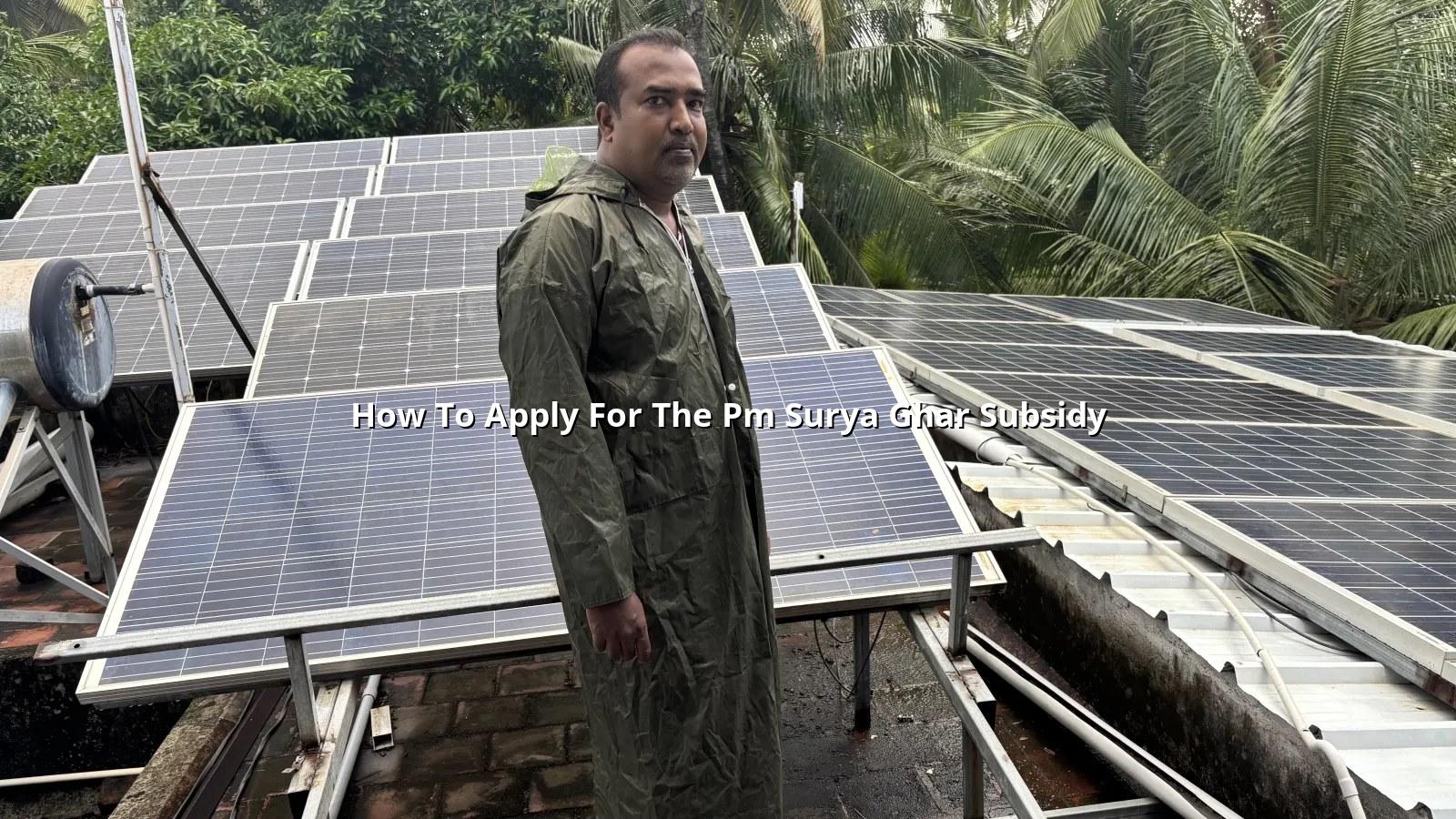
Application path
What the PM Surya Ghar file needs before it moves forward
People often imagine the application is mostly typing into a form. In practice, the file gets accepted more smoothly when the roof survey, the EB details and the ownership papers already make sense together. A good start usually prevents the kind of back-and-forth that eats up a week for no real reason.
Begin with the roof and the EB connection
The first check is not the paper, it's the site. We see whether the roof can take solar properly, whether the cable path is sensible and whether the EB connection details are ready to use. On homes in Kottar, Ozhuginasery and Ramanputhur, that step often shows the difference between a straightforward application and one that needs a little correction first.
If the roof needs cleaning, a better route for the wiring or a small civil fix, we say so early. That's better than waiting until the file is already moving and then discovering the house needs a practical change. Most people prefer honesty at the start, not polite confusion later.
The 60-day EB billing cycle matters too. The units you use help us read the pattern of the home, which is how we avoid oversizing or undersizing the proposal. It sounds simple, but it keeps the plan tied to real usage instead of guesswork.
Get the documents aligned before submission
A lot of files slow down because the name on the EB account is slightly different from the name on the ID proof, or the bank details are still pending. We check those details before the form is sent anywhere. If the house belongs to more than one person, or if the roof sits within a shared structure, we also look at consent and ownership with the same care.
In Kanyakumari District, the weather adds its own small complications. Salt-laden air near the coast and the monsoon periods mean cable sealing and hardware selection deserve attention, even while the paperwork is being prepared. The site and the documents belong together, because a clean application should point to a clean installation.
That is why we do not treat the subsidy application like a stand-alone office job. It is tied to the property, the roof and the way the system will actually be built.
| Checkpoint | What we review | Why it matters |
|---|---|---|
| Applicant details | Name, address and identity proof should match the file | Prevents avoidable correction later |
| EB connection | Connection details and recent bill information | Helps the solar plan match the actual supply |
| Roof suitability | Space, shade, slope and structural condition | Shows whether the site needs a different layout |
| Bank details | Applicant-linked account information ready for use | Stops the file from stalling at a later stage |
| Site photos | Clear photos of the roof and electrical area | Useful for planning, review and installation prep |
- Step one: share your EB bill, address and applicant details so we can see whether the basics are already in order.
- Step two: we do a free site survey and check the roof, the shade, the cable route and the mounting needs of the property.
- Step three: we prepare the system design and quotation, then guide the subsidy paperwork with the real site information in front of us.
- Step four: after the plan is in place, we handle installation, EB-related documentation and commissioning.
- Step five: we stay available after the work is done, because support questions usually show up after the system has been running for a bit.
Local conditions
Why district weather and roof type change the way we handle the application
Kanyakumari District has strong sunshine through the year, but it also has wind exposure that affects the way a rooftop system should be mounted. On open houses, the structure choice matters more than people expect. A roof near the coast can look neat from the road and still need stronger attention to hardware and connections because salt in the air is not kind to careless work.
That is why we look carefully at the site before the paperwork settles into a final plan. The south-west and north-east monsoon periods also matter, because drainage and cable sealing need to be thought through while the system is being planned, not after the first heavy rain. On a house in Colachel, for example, we would think differently about the mounting and sealing than we would on a more sheltered inland roof at Thovalai.
One file, but not one standard roof
The application may look similar from house to house, but the roof under it rarely does. An RCC flat roof in Nagercoil can be easy to lay out, while a tiled roof with awkward edges needs a more careful path for the structure and cabling. If the site is cramped, shaded or exposed to strong wind, we will tell you plainly and recommend what suits the property instead of forcing a design that only looks tidy on paper.
For people asking how to apply for the PM Surya Ghar subsidy, that local judgment is part of the answer. The scheme is tied to a real installation, not just a form sitting in a folder. In places such as Boothapandi, where site conditions can vary quite a bit from one home to the next, the survey is what keeps the application honest and useful.
We also find that this approach saves time during EB documentation later. When the roof, the documents and the proposed system all point in the same direction, the next steps become much easier to manage.
Before you file
Small checks that stop the subsidy file from stalling
A neat file is usually the result of a few careful checks before the application is sent. Most delays are small ones. A missing consent, a fuzzy photo, a name mismatch, or a roof detail nobody mentioned at the start can slow the whole thing down.
Document details that people miss
We often see a mismatch between the EB record and the identity proof, or a bank account that is not ready when the rest of the file is. Sometimes the address is technically correct but written in a way that creates confusion for the paperwork. There there are also cases where the person applying is not the same person named on every roof or ownership paper, and that needs to be handled first.
A photocopy that looks fine in person can still be hard to use if the text is faint or cut off. That sounds small, but it can make a clerk or reviewer ask for the same thing again.
Site details that shape the installation
On the site side, a roof with afternoon shade, a crowded electrical corner or a hard-to-reach parapet will change the layout. In Marthandam and Thuckalay, where shops, offices and mixed-use buildings often have more awkward roof arrangements than a simple home terrace, that planning step matters a lot. The survey tells us what the file should really say and what the installation will really need.
And if the roof is full of loose material, old wiring or waterlogging signs, we point it out early. It is much better to hear that before the application goes in than after someone has already started imagining an easy job.
- Keep the latest EB bill handy, because the units help frame the solar plan.
- Make sure the applicant name stays consistent across the main documents.
- Tell us if the roof is RCC, tiled or sheet, since each one needs a different approach.
- Share any shading from trees, tanks or nearby structures before the survey.
- Let us know if the property is shared, rented or jointly used, because that affects the paperwork.
How the work moves
What happens after you contact us about the subsidy
The process starts with a conversation, not a sale. You send the basic details, we check whether the site is ready for a survey, and then we plan the next step around what is actually there. If the case is simple, it moves quickly. If there is a document mismatch or a roof issue, we slow it down just enough to fix the right thing first.
How we handle it, step by step
Most customers like to know the order in advance, so we keep it plain.
- Contact us: share your address, EB connection details and what kind of roof you have.
- Free site survey: we visit, inspect the roof and see how the system should fit the site.
- System design and quotation: we match the plan to your usage, roof space and structure.
- Installation: our team sets up the system with the right mounting and electrical work.
- EB and documentation: we guide the paperwork needed around the connection and the installation record.
- Commissioning: once everything is in place, we move to the final startup stage.
- After-sales support: you still have one year of free service support after installation, with continued technical help afterwards as the product and installation terms allow.
In practical terms, the second visit is often the one that clears up most things. The roof has been seen, the paperwork has been looked over, and the customer knows what is being built. That is usually where the job feels real.
How we help
How JRS SunTech Energy can help with the subsidy process
We handle rooftop solar as a full job, not a loose promise. That means we can check the site, suggest the solar capacity based on your EB bill and roof space, guide the subsidy paperwork, install the system and stay with you through EB documentation and commissioning. People usually find that easier than trying to coordinate the pieces on their own.
If you need help with how to apply for the PM Surya Ghar subsidy, send us your EB details, roof type and address. Our office is at Door No. 227, First Floor, Cape Road, St. Xavier's Church Junction, Kottar, Nagercoil, Kanyakumari District, Tamil Nadu - 629002. Phone: 9787775999. Email: jrssuntechenergy@gmail.com.
We also provide one year of free service support after installation, and after that we continue technical assistance as the product, manufacturer warranty and installation allow. If you'd like us to look at your site first, book the survey and we’ll take it from there.
Frequently asked
Questions people ask about the PM Surya Ghar subsidy
Start with the basics: your EB connection details, the applicant name, the site address and a roof that is ready for survey. If those first details are muddled, the file tends to slow down before it even reaches the next stage.
Yes, we do. That survey is where we see the real roof type, the shade pattern, the cable route and whether the structure needs a different mounting approach. It saves a lot of guesswork later.
We normally look at identity proof, address proof, EB connection details, bank account details and roof ownership or consent where the case calls for it. The exact list can shift a little from one customer to another, so we check the file before anything goes ahead.
Yes. We work from our Kottar, Nagercoil office and regularly visit homes in nearby parts of the district, so the process stays local and practical. The paperwork may be the same, but the roof and site details still matter a great deal.
You need a workable plan, not a guess. We look at your EB bill in units, roof space, shade and structure, then recommend a capacity that fits the site before the paperwork moves further.
After that, the site work, installation, EB documentation and commissioning become the next parts of the job. We stay involved through those stages, so you’re not left chasing different people for each step.
The rule set is the same, but the roof layout often isn’t. In places like those, we still begin with the survey, because the space available and the way the roof is built decide how the application should be handled.
Hurry up!Subsidy ends 31 March 2027 · 134 days left
Next step
Ready to start your subsidy file?
Send us your EB bill, roof type and address, and we will help you check the next step for your rooftop solar application.
- Your electricity requirement and 60-day EB bill
- Property type — home, shop, office, farm or institution
- Backup requirement and available roof space
Related: Subsidy Guidance · Solar Finance & EMI · Contact
Free site survey · Kottar, Nagercoil