Solar product guide
Polycab and Eastman Solar Inverters Explained
A practical look at where these inverter brands fit for homes, offices, and backup systems in Kottar and across Kanyakumari District.
Solar product guide
Start with the site, then choose the inverter
Polycab and Eastman solar inverters explained the way we talk about them on site visits: what each unit does, where it fits, and what can go wrong if the design is rushed. Most customers call first asking for a brand name, but the better question is what your roof, loads, and EB connection actually need. A neat inverter on the wall does not help much if the system was sized without checking the house.
In Kanyakumari District, that means looking at the roof shape, the 60-day EB usage, the space available for wiring, and the weather around the site. Wind exposure, salt in the air, and monsoon drainage all affect how the installation is laid out. We see the difference clearly between a simple home in Kottar and a shop floor that keeps running well into the evening.
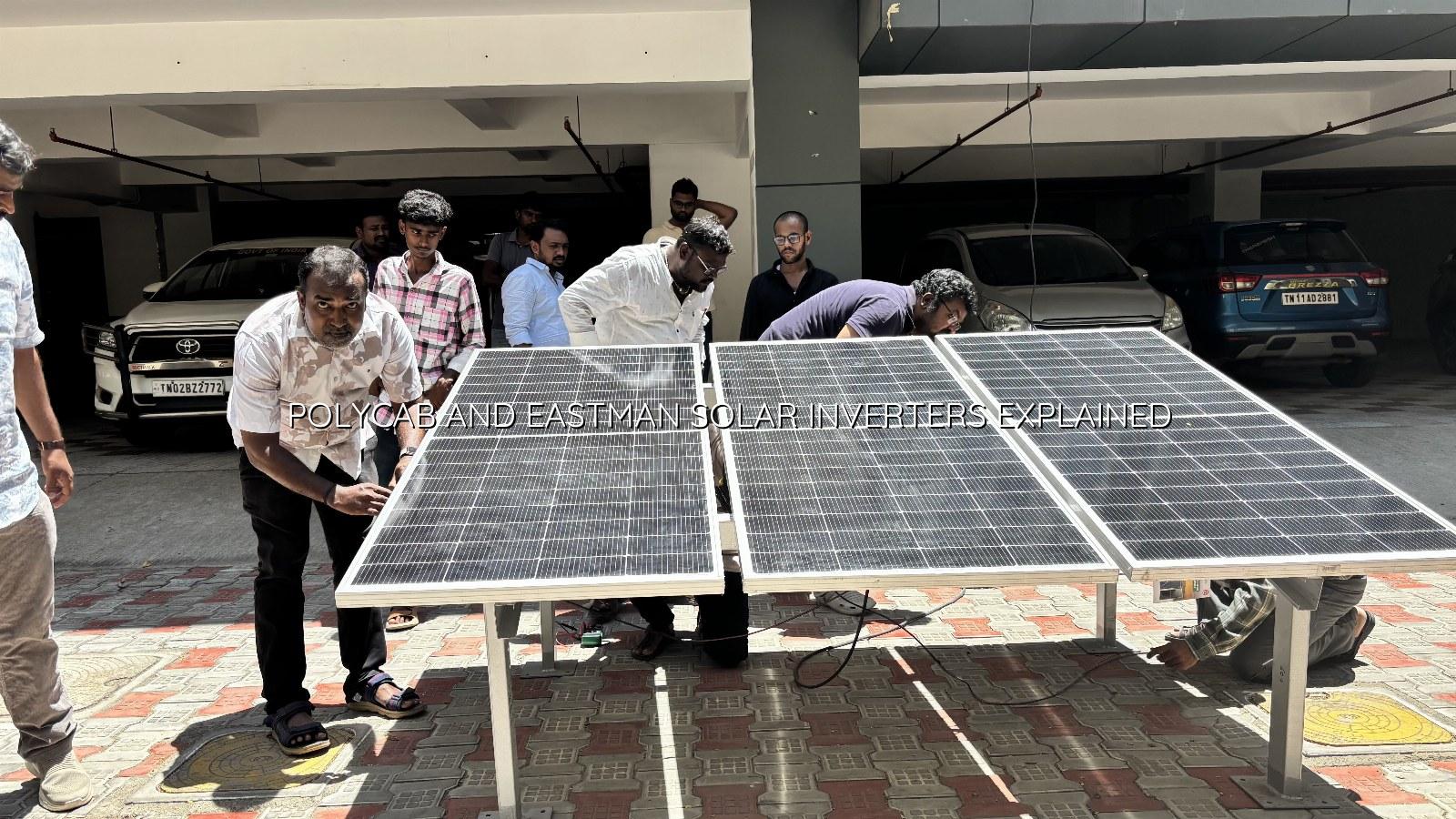
Brand basics
What these inverter brands are doing in a solar system
The inverter is the part that turns the solar setup into useful power for your home or business. In some systems it just handles solar conversion, in others it also works with batteries and the EB supply. The brand matters, but the way the equipment fits your actual use matters more. We get that conversation often in Thuckalay and Kuzhithurai, where one customer may want only daytime support while another wants backup to cover a longer stretch.
Where Polycab fits comfortably
Polycab solar inverters are usually considered by people who want a familiar electrical brand alongside their panels, DC cables, and other balance-of-system parts. That makes sense for many RCC flat roofs in residential areas, where the layout can be kept tidy and the inverter can sit close to the load side without getting in the way. Still, the box itself is only one part of the picture. We look at heat, access, cable length, and whether the unit suits the way the house uses power through the day.
Where Eastman is often discussed
Eastman solar inverters also come up in mixed solar-and-backup plans, especially when a customer wants better control over battery support during EB interruptions or at night. That comes up a lot with office owners in Nagercoil who keep equipment running after normal hours. If battery backup is part of the plan, the inverter needs to be selected with the battery and charging behaviour in mind from day one. Otherwise the system looks complete and still behaves badly in real use.
- The load list should come before the brand name.
- A cool, dry mounting point makes service easier later.
- Loose terminations create trouble faster than most buyers expect.
- Salt-laden air near the coast calls for better cable sealing and hardware care.
- Battery systems need the inverter and battery type to be chosen together.
How we size it
The steps we follow before recommending a model
- Check the EB connection and the load pattern. We ask what appliances matter, how many units you use in a 60-day cycle, and whether the goal is savings, backup, or both.
- Inspect the roof and the inverter location. RCC, sloped tile, and sheet roofs all behave differently, and the inverter should sit where air can move and water cannot collect.
- Choose the system type first. On-grid, off-grid, hybrid, and battery-backed arrangements solve different problems, so the type has to match the site before the brand is chosen.
- Plan cable paths and protection points. We check DC routing, earthing, isolators, and the route back to the EB side so future service work is not a mess.
- Test the system before handover. We look at display readings, charging behaviour, and the changeover path so you know the setup is working as intended.
Quick comparison
What we compare before you commit to a solar inverter
A brochure can tell you what the inverter can do. A site visit tells you whether it will do it well in your building. These are the points we usually compare before a customer chooses between Polycab and Eastman.
| Check point | Why it matters | What we look for on site |
|---|---|---|
| Load type | Decides whether you need solar conversion alone or battery support too. | Lights, fans, fridge, pumps, office equipment, and any heavy start-up load. |
| Roof and placement | A hot or cramped spot can shorten service life and make maintenance awkward. | Wall strength, shade, ventilation, cable length, and safe access for inspection. |
| Grid behaviour | Useful when the EB supply is steady, weak, or interrupted at odd times. | How the inverter handles supply changeover, charging, and day-to-day stability. |
| Battery plan | Battery choice changes the whole system, especially for backup-heavy homes. | Battery type, available space, charging logic, and how long you expect support to last. |
| Service access | Easy access saves time when a future check or troubleshooting visit is needed. | Whether the unit can be reached without dismantling other parts of the install. |
Local fitting notes
Why district conditions change the way we install
Kanyakumari District gives you strong sunshine through the year, but it also gives you wind and coastal air in many places, which changes how we treat the mounting and wiring. A roof in Manavalakurichi will not be treated exactly the same as a roof inland at Boothapandi. One might need more attention on corrosion resistance, while the other may push us harder on wind loading and mounting structure strength.
The monsoon periods matter too. Water paths, cable sealing, and the neatness of the terminations become more than a finish issue, they affect whether the setup stays dependable after the rain starts. In a sheet-roof property, even one loose opening can become a nuisance later, so we keep a close eye on every junction.
Where these systems often get used
Homes in Kottar often need a practical battery-backed plan for lights, fans, and a refrigerator. Shops and offices in Thuckalay and Nagercoil may want a different design because business hours are longer and the load stays active through the day. So the same brand can still lead to a different answer, depending on how the building is used.
We also notice that many customers begin by asking whether a particular inverter is “better”, but the right follow-up is often simpler: what problem are you trying to solve? If the answer is daytime solar use only, the design becomes one thing. If you want backup during EB interruptions, it becomes another.
How JRS SunTech Energy Can Help
We match the inverter to the roof, the load, and the way you use power
At JRS SunTech Energy, we supply solar inverters, panels, batteries, home and office inverters, and complete hybrid solar power system packages, including Polycab and Eastman options when they fit the job. We also handle on-grid solar, off-grid solar, hybrid solar, inverter and battery setups, and solar service and maintenance, so you are not left calling different people for different parts of the system. We start with your EB usage, roof space, shade, and service needs, then build from there.
Contact: JRS SunTech Energy, Door No. 227, First Floor, Cape Road, St. Xavier's Church Junction, Kottar, Nagercoil, Kanyakumari District, Tamil Nadu - 629002. Phone: +91 97877 75999 | WhatsApp: 919787775999 | Email: jrssuntechenergy@gmail.com
Frequently asked
Questions people ask before they choose an inverter
We start with the EB connection, the daily loads you actually run, and whether you want solar power only or backup as well. Then we check roof space, cable routing, ventilation, and where the inverter can sit without getting hot or damp.
Yes, if the inverter type and the battery type are planned together. A battery-backed system needs the inverter, charging settings, and wiring to work as one unit, not as separate parts bought in a hurry.
Look at working hours, the kind of equipment you run, and whether the load stays steady or jumps through the day. A shop in Marthandam may need a different arrangement from an office with lighter evening use, even if the brands being discussed are the same.
They can be used in coastal and near-coastal parts of the district when the mounting, terminations, and cable sealing are handled carefully. Salt-laden air and strong wind mean the installation details matter as much as the inverter box itself.
A lot. Lights, fans, a fridge, and a few sockets need one kind of design, while a home that also runs a pump or heavier kitchen load needs something different. We usually ask for the appliance list before we size anything.
We provide one year of free service support after installation, and after that we keep helping based on the product, installation, and manufacturer warranty terms. If the system behaves oddly, we inspect the wiring, settings, battery condition, and load before saying what needs attention.
Yes, we do solar service and maintenance too, including inverter troubleshooting, electrical connection inspection, and preventive checks for systems installed elsewhere. Sometimes the issue is a small setting or a loose connection, not a replacement part.
Before you place an order
Small checks that save trouble later
A solar inverter should never be chosen only because the name sounds familiar. What matters is whether it fits the roof, the load, and the place where it will live. If the unit is going on a coastal wall or a hot utility corner, the setup needs to respect that from the start.
- Keep the inverter in a dry, ventilated place with room for future service.
- Check whether the system should be solar only, solar plus battery, or tied closely to the EB supply.
- Ask how the wiring will be protected from moisture and salty air if your site is near the coast.
- Make sure the service route is simple. A buried tangle of wires causes headaches later.
- Keep your appliance list ready before the survey so sizing is based on real use.
We usually learn the most during the second look at a site, when the owner has thought through what must stay on during an outage and what can wait. That is also where small details show up, like a wall that needs better support or a cable path that should be shortened. If you already have a system and it is acting up, we can still inspect it and tell you honestly whether it needs a repair, a replacement, or just a proper check.
Hurry up!Subsidy ends 31 March 2027 · 134 days left
Next step
Need help choosing between Polycab and Eastman?
Send us your roof type, EB connection details, and the loads you want to run. We will help you compare the options honestly and suggest a setup that fits your site in Kanyakumari District.
- Your electricity requirement and 60-day EB bill
- Property type — home, shop, office, farm or institution
- Backup requirement and available roof space
Related: Products · Solar Inverters & Batteries · Contact
Free site survey · Kottar, Nagercoil