Solar guide
Solar Panel Direction and Tilt Angle for Tamil Nadu
A practical way to choose roof direction, tilt and mounting details before you install solar at home, office, or farm in Kanyakumari District.
Rooftop planning
Start with the roof, not with a rule book
Solar panel direction and tilt angle for Tamil Nadu sounds like one neat question, but on an actual site it turns into a few decisions at once. You need to think about the roof shape, the way shade moves, the mounting structure, and what the EB connection is doing over a normal 60-day billing cycle. A house in Kottar and a shop roof in Thuckalay can both support solar, but they usually need a different layout if you want the array to sit properly and stay easy to work on.
We begin with what the roof gives us. Year-round sunshine helps a lot in Kanyakumari District, yet the district also brings strong wind, coastal air in many areas, and monsoon rain that quickly exposes weak sealing or a lazy cable route. That means the right angle is never just about the sun path on a chart; it is about whether the structure, hardware and roof surface can live with that choice for the long term.
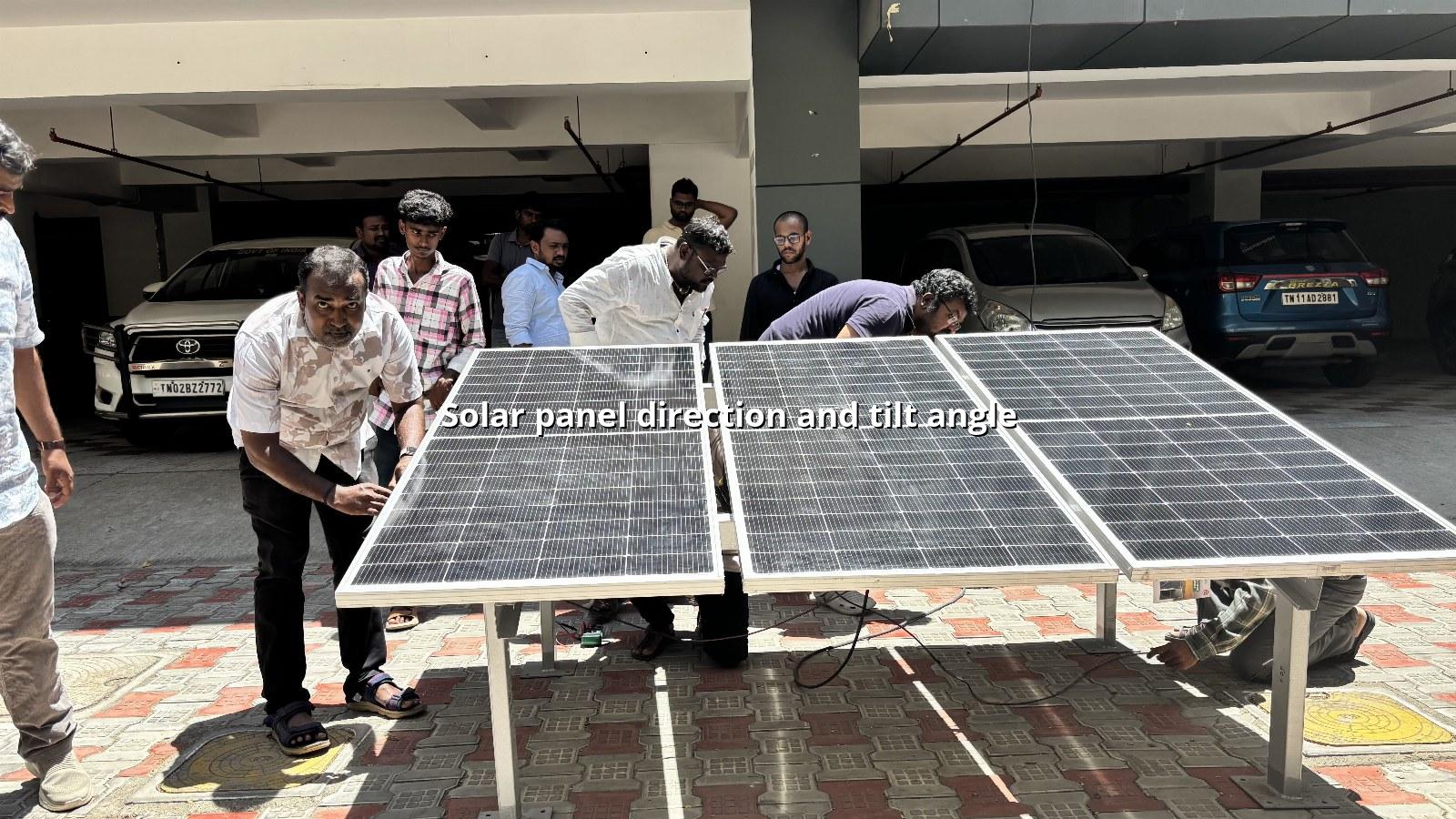
Direction basics
Why the panel face matters more than most people think
Direction decides how the array spends its day. Tilt decides how it sits on the roof and how the roof behaves around it. Those two things work together, so we usually talk about them together instead of pretending one number solves everything.
South is the first check, not a blind rule
For a lot of homes, a south-facing array is the first layout we look at because it is the cleanest starting point for many rooftops in Tamil Nadu. But a good installer does not stop there. If the roof in Vadasery faces a little east or west, or if a terrace wall eats into the usable span, we look at the real roof rather than forcing a textbook answer. The panel direction has to work with the building, the available space and the way the inverter and cables can be placed neatly.
On commercial roofs in Marthandam or Kuzhithurai, the shape of the roof often matters as much as the direction itself. Wide roofs, narrow roofs, roofs split by parapet walls, all of them change the layout. That is where planning saves you from awkward cable runs and odd mounting positions later on.
Tilt follows the structure under it
The tilt angle is not chosen in isolation. On an RCC flat terrace, we use the mounting structure to create the incline and keep water moving away from the base. On a sloped tiled roof, the roof pitch already gives part of the angle, so the mounting is adjusted to fit the roof rather than forcing a new shape on it. Sheet roofs need a different touch again because the frame, fixing points and sealing have to suit the sheet.
In coastal stretches such as Colachel, Manavalakurichi, and Muttom, we think about wind and salt air at the same time. Hardware choice, clamp finish, cable sealing and earthing routes all matter, because a neat-looking array can still age badly if those details are rushed. It’s the small things that usually cause the trouble later.
| Roof or site condition | What we usually check | Why it changes the layout |
|---|---|---|
| RCC flat terrace | Available span, parapet height, water flow, cable path | Needs a mounting structure to create the right tilt and keep drainage clear |
| Sloped tiled roof | Existing pitch, tile condition, fixing points | The roof angle may already help, so the structure is chosen to suit the slope |
| Sheet roof | Frame strength, corrosion exposure, wind load, fixing method | Mounting and sealing matter more because the sheet itself can flex in wind |
| Coastal or near-coastal site | Salt air, fastener finish, cable terminations, earthing route | Hardware choice and connection protection become more important over time |
| Farm or pump site | Open land, shade, pole height, cable run, water point location | Solar pumping layouts are planned for ground conditions, not only roof rules |
- South-facing is the usual starting point, but roof reality comes first.
- Flat roofs need a structure that handles both tilt and drainage.
- Wind exposure in the Aralvaimozhi side of the district can change the frame choice.
- Salt-laden air near the coast asks for careful hardware and cleaner electrical finishing.
- Shading from tanks, walls, trees, and nearby structures should be checked at site level, not guessed from a photo.
What we inspect
The details that decide whether the layout feels right
When we visit a site, we do not start by guessing a number. We look at the roof, the shade pattern, the space for the inverter, and the way the installation can be serviced later without turning it into a repair headache. If the house is in Nagercoil town, the roof may be hemmed in by water tanks or parapet walls; if it is in Boothapandi, there may be a different set of roof lines and cable paths. Same district, different problem.
The EB connection matters too. A system has to suit the way the building uses units over a 60-day billing cycle, because that tells us more about the practical design than a generic suggestion ever could. We also check access. If a panel row is hard to reach, cleaning and inspection become a chore, and people put things off until there is a fault or a leak.
So the first job is really simple: make sure the roof gives us a sensible place to put the array. Once that is clear, the direction and tilt angle become part of a proper plan instead of a guess on paper.
A site visit usually follows this order
- Measure the usable roof area. We check where the panels can actually sit, not just where they might fit in a drawing.
- Watch the shade during the day. Tanks, trees, chimneys, walls and nearby structures can change the best layout.
- Match the mounting structure to the roof. RCC, tile and sheet roofs each need a different kind of fixing approach.
- Choose the direction and tilt together. The angle has to work with drainage, wind and cable routing at the same time.
- Check inverter and cable placement. A neat route makes the system simpler to inspect and service later.
Weather and wear
Why monsoon and coastal conditions change the answer
In Kanyakumari District, the roof does not live in a laboratory. It deals with rain, wind and salt-laden air, and those things change what makes sense. During the south-west and north-east monsoon periods, drainage becomes a real design point. If water can sit around a mounting foot or move into a cable entry, the job starts looking tidy on day one and troublesome later.
Around Rajakkamangalam, and on exposed roofs closer to the shore, we pay extra attention to the finish on the metal parts and the way the panel frame is held down. Strong wind can try to lift a badly planned array, and the problem usually starts with weak support rather than the panel itself. A good mounting structure is not showy, but it holds the whole system together.
The same goes for older roofs. A building that has been patched a few times may still take solar, but the fixing points and roof condition need a closer look. That is why we avoid giving site advice from a phone call alone when the roof deserves a proper inspection.
Things people often miss before installation
- Panel angle should leave enough room for rainwater to drain freely.
- Wind loading can change the mounting frame we recommend.
- Shade from a water tank or parapet wall can be more damaging than a small angle difference.
- Sheet roofs need careful fixing and sealing, not just a light frame.
- Coastal air means hardware and electrical connections need cleaner finishing.
Some roofs are better than people expect, and some are more awkward than they first look. We say that because we see it every week. The photo on WhatsApp helps, but the second look, on the roof itself, is where the real decision gets made.
What we suggest on site
How we settle on the final angle without guessing
We start with the site conditions and work toward a layout that is practical to install and easy to live with. If the roof is wide and open, a straightforward layout may be fine. If the roof is broken by tank stands, roof edges or shade, we may change the row spacing or the direction so the system sits better and the wiring stays sensible.
In homes around Suchindram, one common issue is a roof that looks open from the road but is not as open once you stand on it. In buildings near Kottar, the challenge can be the opposite: usable roof space exists, but the edges and obstructions mean the module rows need a bit more care. This is why we check before we recommend.
A few practical questions we ask before we confirm the plan
- Which side of the roof is free from long shade during the main daylight hours?
- Where will water travel during heavy rain?
- How much of the roof is safe to use without crowding access paths?
- Can the inverter and cables be placed without long exposed runs?
- Does the mounting structure need extra care because of wind or salt air?
Once those are answered, the angle stops being a theory question. It becomes part of the system layout, and that is how it should be.
How JRS SunTech Energy Can Help
How JRS SunTech Energy Can Help
We handle rooftop solar by looking at the actual roof first and then choosing the direction, tilt and mounting details that fit the site. That is how we work on homes, shops, offices and agricultural sites across Kanyakumari District, and it is the only honest way to answer this question. We also guide you through installation, EB and documentation support for the applicable government solar programme, commissioning, and the after-sales support that comes after the system is running.
If you want a clear answer about solar panel direction and tilt angle for Tamil Nadu, send us a roof photo and your EB bill, or book a site visit from our office in Kottar, Nagercoil. We will tell you what fits, what needs adjustment, and what should be left alone.
Contact JRS SunTech Energy, Door No. 227, First Floor, Cape Road, St. Xavier's Church Junction, Kottar, Nagercoil, Kanyakumari District, Tamil Nadu - 629002. Phone: 9787775999. Email: jrssuntechenergy@gmail.com.
Common questions
Frequently asked questions about roof angle and direction
For most rooftop solar systems in Tamil Nadu, a south-facing layout is the usual starting point, then the tilt is adjusted to suit the roof and the actual site. If the roof cannot face south, we look at the available span, shading, and how the building sits in real life rather than forcing one fixed rule.
Yes, they can. East and west roofs are common on homes and shop buildings, so the design is often adapted by choosing the right structure, cable route, and capacity plan instead of rejecting the roof outright.
It does. A sloped tiled roof, an RCC terrace, and a sheet roof all need a different mounting approach, and the structure should match the roof instead of fighting it. That helps with drainage, wind loading, and long-term stability.
In Kanyakumari District, wind and salt-laden air are real factors. We pay close attention to the hardware, cable sealing, and how water moves across the roof during the south-west and north-east monsoons so the system stays tidy and easier to maintain.
Yes, that is how we work. We start with the roof shape, shade, EB connection, and the actual place where the array can sit, then we suggest a direction and tilt that fits your site instead of giving a generic answer.
We do. We visit homes and business sites from our office in Kottar, Nagercoil, and we often see different roof styles in Vadasery, Suchindram, and other parts of the district, so the final setting is always site-based.
Next topics
What to read next if you are planning a rooftop system
Once people understand direction and tilt, they usually want to know how the rest of the system should be chosen. That leads to the type of solar setup, the products used, and the paperwork around subsidy guidance. We see this often with homeowners in Agasteeswaram who start with one roof question and end up needing help with the full plan.
You can keep reading about on-grid solar, hybrid solar, and subsidy guidance. If the site needs batteries or backup support, the guides on off-grid solar and inverters and batteries are useful too. For the parts and brands we supply, see products.
Hurry up!Subsidy ends 31 March 2027 · 134 days left
Next step
Need help choosing the right roof angle?
Send us your roof photo, EB bill, and site location so we can suggest a practical direction and tilt for your solar plan.
- Your electricity requirement and 60-day EB bill
- Property type — home, shop, office, farm or institution
- Backup requirement and available roof space
Related: Solar Solutions · Contact · FAQ
Free site survey · Kottar, Nagercoil