Solar guide
String Inverter vs Microinverter
A practical rooftop comparison for shade, roof shape and EB usage, written for customers in Nagercoil and across Kanyakumari District.
Solar inverter choice
String inverter vs microinverter on a real roof
Most people call us after comparing two quotations that seem to promise the same result, only the inverter name looks different. That is where the confusion starts. The two setups both use solar panels, but they handle power in a different way and behave differently when a roof has shade, odd corners or separate slopes.
For a home in Kottar, a shop roof in Thuckalay or an office terrace in Marthandam, the better choice depends on what the roof really looks like once you stand on it. We check the actual site, the EB connection, the 60-day bill cycle and the roof structure, because Kanyakumari District has strong year-round sunshine but also wind exposure and salt-laden air in many places. A tidy roof can suit one answer, while a roof with tanks, parapets, trees or multiple faces often pushes the decision the other way.
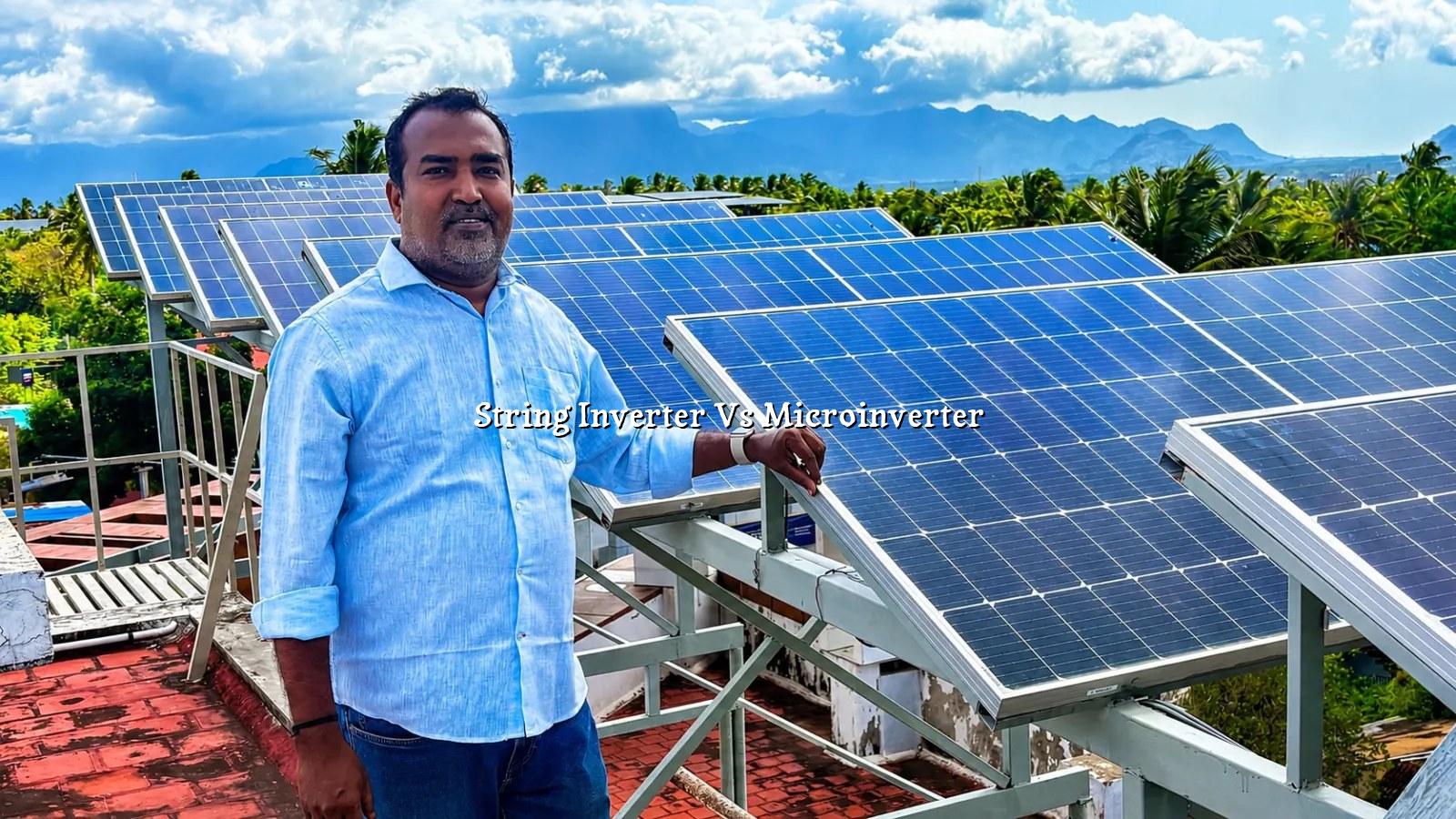
How the systems differ
What actually changes between the two?
Both systems collect sunlight from the panels and send usable power to your home or business. What changes is where the conversion happens and how the system reacts when one panel is shaded, dirty or facing a slightly different direction. That single design choice affects cabling, service access and the kind of roof it suits best.
String inverter systems
A string inverter joins several panels into one circuit and sends that combined output to a central inverter. It is the layout many people picture first because the gear stays more compact and the roof looks simpler once the work is done. On an RCC flat roof in Vadasery or a clean sheet roof in Suchindram, this style often works well when the panels can be arranged in the same direction and get similar sunlight through the day.
Microinverter systems
Microinverters move that conversion closer to each panel, so each module behaves more on its own. That helps when a parapet wall throws shade for part of the day, or when the roof has small usable patches instead of one open rectangle. We see that on some homes near Ozhuginasery and Parvathipuram where the roof is not difficult, just divided in a way that needs more detailed planning. It is not a magic fix, but it does give more independence at the panel level.
| Point of comparison | String inverter | Microinverter |
|---|---|---|
| Roof layout | Works well on simple roof areas with similar orientation | Useful when the roof has mixed faces or split usable areas |
| Shade response | Shade on one panel can affect the string more noticeably | Each panel behaves more independently |
| Service approach | One main inverter to inspect and troubleshoot | More roof-level devices, so inspection is more spread out |
| Planning effort | Usually simpler when the roof is open and uniform | Needs more detailed roof mapping and connection care |
| Local fit | Common on homes and businesses with open roofs in Nagercoil | Helpful where shade, parapets or trees are part of the site |
- Look at the roof after midday, not only in the morning, because shade changes through the day.
- Check whether the panels will share the same direction or sit on different roof faces.
- Watch for shade from a water tank, wall, tree or adjacent building.
- Ask how easy the inverter and roof equipment will be to inspect later.
- Think about cable routing and sealing, especially in coastal parts of the district.
How we choose for a site
The way we decide which setup suits you
We do not begin with a brand name or a sales package. We start with the roof, the EB connection and what your bill looks like over the normal 60-day cycle. That gives a more honest answer than a brochure does. A roof with open sunlight across the day will usually point one way, while a roof with broken shade or different angles can point the other.
The steps we follow on every survey
- Contact us: You call, WhatsApp or email us with your location and the kind of roof you have.
- Free site survey: We visit the site, check the roof space, structure, shading and access.
- System design: We compare the panel layout, inverter type, cable route and mounting method.
- Quotation: You get a practical proposal built around the actual site, not a stock package.
- Installation: Our team fits the panels, inverter and electrical parts with proper care.
- EB and documentation: We guide the paperwork and the steps needed for the connection process.
- Commissioning and support: We test the system, explain the basics and stay available after handover.
On a house near Colachel, for example, we look harder at corrosion resistance because salt air gets into places people do not expect. On a roof in Aralvaimozhi, wind loading is a bigger part of the conversation and the mounting structure has to be right before anything else. A solar job that ignores those two things can look fine on day one and be awkward later, so we we take the roof as it is.
What to check before you choose
Practical points that change the answer
Where a string inverter fits neatly
A string inverter usually suits a roof where the panels can be lined up in a clean block and the sunlight is fairly even. Many homes in Kottar and offices around Kuzhithurai fit that pattern better than people expect. The setup stays compact, the main equipment is easier to reach, and the whole roof generally looks less busy once the installation is complete.
Where microinverters earn their place
Microinverters make more sense when the roof is cut into smaller parts or one corner gets shade from a nearby wall or tree. We see that on older tiled roofs and on mixed roof layouts where one panel row faces south and another points a bit differently. The layout becomes more detailed, but the roof can still produce well if the design is thoughtful and the connections are done properly.
The small details people forget
- Salt air near the coast means hardware and connections need proper attention.
- Strong wind can affect mounting and cable fixing on exposed rooftops.
- Shade from a tank, parapet or tree changes how a string behaves.
- Maintenance access matters later, especially on roofs you do not climb often.
- Different roof directions can make a microinverter layout worth considering.
In many homes, the roof looks simpler on paper than it is in person. A straight run of panels sounds easy until a water tank shadow appears at 2 pm, and then the whole decision shifts. That is why we always inspect the roof first and talk about the inverter second.
Maintenance and service
What happens after the system is installed?
A good installation should still be easy to live with once the panels are on the roof. That means the inverter should be reachable, the wiring should be neat, and the system should not turn routine checks into a headache. We provide one year of free service support after installation, and after that we still continue technical assistance based on the product, manufacturer warranty and the way the installation was done.
If a customer calls us later with a drop in output, we do not jump to conclusions. We check the inverter, the electrical connections, the mounting, the panel condition and the visible signs on the roof first. That same approach works whether the system is a string inverter setup or a microinverter setup. It saves time, and it stops people from replacing parts that do not need replacing.
Useful questions to ask during the site visit
- How much shade does the roof get through the day?
- Will the panels face one direction or several?
- Is the roof RCC, tiled or sheet, and does that change the fixing method?
- Can the inverter and roof wiring be reached safely for inspection?
- What kind of maintenance will the system need later?
On a roof in Meenakshipuram or Suchindram, these questions often decide the answer faster than the product brochure ever could. A small roof with clean sun can be ideal for one type, while a mixed roof with patches of shade may call for something else. The right choice is the one that fits the site you actually have.
How JRS SunTech Energy can help
Help with the comparison, from survey to support
We help customers compare string inverter vs microinverter choices in plain language, based on the roof and the EB connection instead of guesswork. Our team handles the free site survey, system design, installation, EB documentation, commissioning and after-sales support, and we also offer solar service and maintenance for systems installed by other companies. If you want a straight answer for your roof, we can look at it and tell you what makes sense.
We are based at Door No. 227, First Floor, Cape Road, St. Xavier's Church Junction, Kottar, Nagercoil, Kanyakumari District, Tamil Nadu - 629002. Call 9787775999, WhatsApp +919787775999 or email jrssuntechenergy@gmail.com and we will take it from there.
A quick survey usually clears up the decision.
Frequently asked
Questions people ask about string inverter vs microinverter
It depends on the roof, not on the label. A string inverter is often the cleaner fit when the panels can sit in one simple layout, while microinverters help when shade, different roof faces or broken roof space make one big string harder to manage.
Yes, that is the main reason people ask for it. If a tree, tank wall or nearby structure shades only part of the roof during the day, the shaded panel is less likely to drag the rest down in the same way a string can.
When the roof is open, the panel rows face the same way and the sunlight is even, a string inverter keeps the system compact. That also makes inspection and troubleshooting easier because the main inverter is in one place.
They usually do, because each panel has its own conversion point. That is not a problem by itself, but the sealing, routing and fixing need to be done neatly, especially in coastal parts of Kanyakumari District where salt air and wind are part of daily life.
Yes. We inspect systems we installed and systems from other companies too. If you are unsure whether you have a string inverter setup or a module-level setup, we can check the labels, look at the wiring and explain what is actually on the roof.
Then we pay close attention to the mounting structure and cable fixing before we even talk about inverter type. Wind loading can change the design choice, so the roof has to be treated as a real site, not a standard package.
Useful next pages
Related reading after this comparison
Hurry up!Subsidy ends 31 March 2027 · 134 days left
Next step
Still choosing between the two?
Send us your roof photo, EB bill and location, and we will tell you which setup fits your site better.
- Your electricity requirement and 60-day EB bill
- Property type — home, shop, office, farm or institution
- Backup requirement and available roof space
Related: Solar Inverters & Batteries · On-Grid Solar · Contact