Solar guide
What Is MPPT in a Solar Inverter
A plain answer for homeowners, shop owners and anyone comparing solar inverter specs in Nagercoil and Kanyakumari District.
Solar inverter basics
What MPPT really does when the panels start working
What is MPPT in a solar inverter? It is the control method that keeps the panel side of the system working at the point where it can make the most usable power at that moment. The inverter keeps checking voltage and current, then nudges the operating point so the panels are not sitting at a weak setting. The idea sounds technical, but the result is plain enough: your roof uses the sunlight it already gets more sensibly.
People ask us about this because MPPT shows up in brochures and on spec sheets, yet nobody explains how it changes day-to-day performance. On a home roof in Kottar or a shop terrace in Thuckalay, the light is never perfectly even. Morning sun, late-afternoon heat, a water tank casting a shadow, one roof face getting more light than the other. MPPT is what lets the inverter keep adjusting instead of locking the panels into one fixed setting.
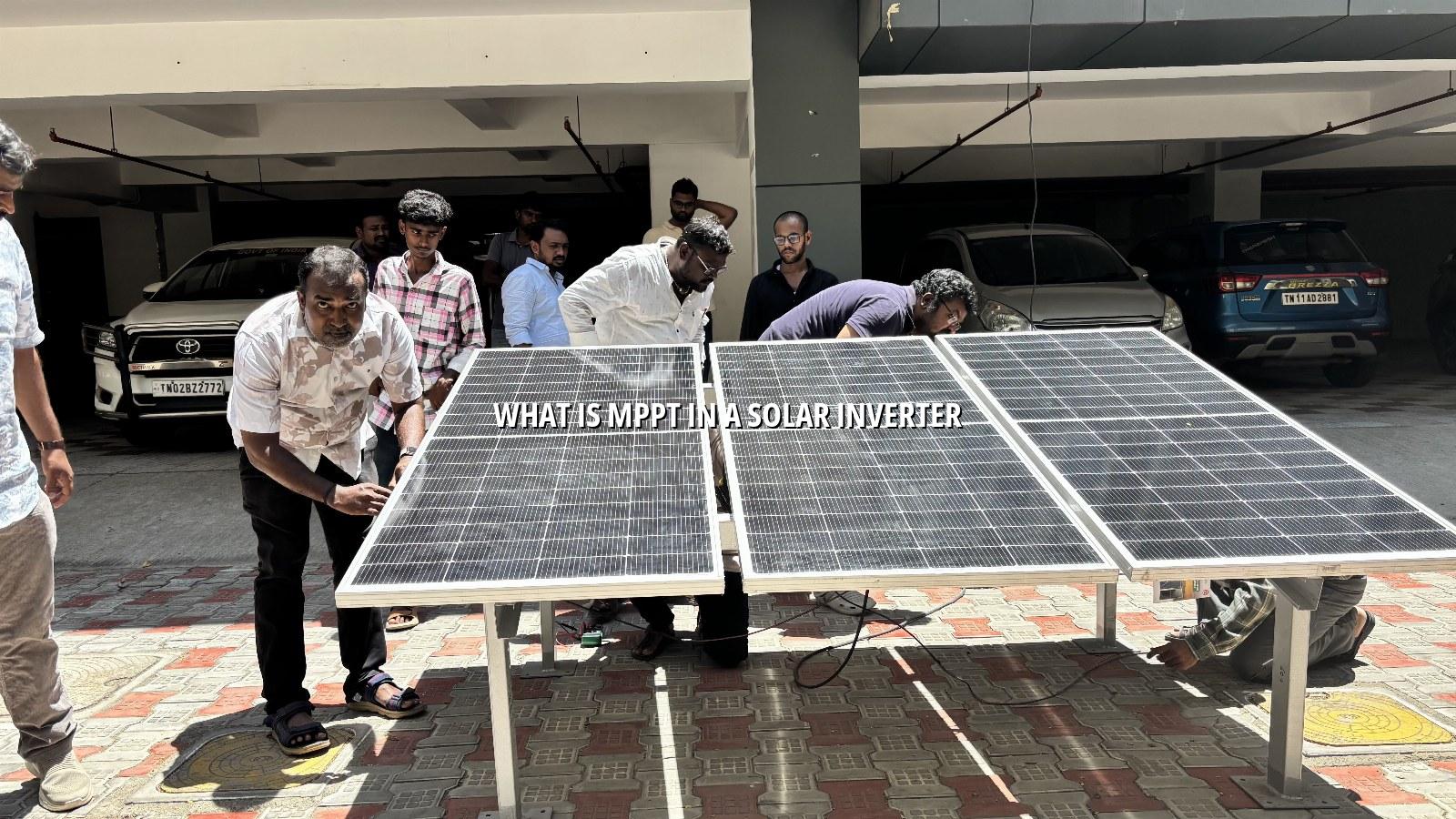
How it works
Why MPPT matters before you choose an inverter
Most people only notice MPPT after they compare two inverter datasheets and see that one model has a wider operating range or more than one tracker. That detail is easy to skip, but it changes how well the inverter matches the actual panel string on the roof. Roof angle, shade, temperature and wiring all decide whether the machine can keep the panels close to their best point.
The idea behind maximum power point tracking
Every solar panel has a sweet spot where it gives the best mix of voltage and current for the available sunlight. That sweet spot moves around as the day changes, as the panels heat up, and as a small shadow crosses part of the array. MPPT keeps searching for that point and adjusts the input so the inverter can use the energy that is really there, not the energy we wish was there.
Think of it as a live correction system. The inverter is not just passing power through; it is watching and adjusting. On a flat RCC roof in Vadasery or a sloped tiled roof in Suchindram, the same roof can have different light on different sides, so MPPT matters in a very practical way. Without it, the panels can be left working harder than they need to for less usable output.
What changes the panel output during the day
On many homes, one side of the roof gets good morning light while the other side stays under a shadow for a while. A shop building near Marthandam can have a parapet wall or another structure changing the light pattern again. MPPT helps the inverter respond to those shifts instead of letting one weak section drag the rest of the string down.
Heat matters too. Panels in our district see strong sunlight for much of the year, and panel voltage changes as temperature rises. That is why the inverter’s MPPT window should be checked against the real panel arrangement, not guessed from a headline. We look at that during a site survey, because the same inverter can suit one roof and give poor results on another.
- Start with the roof. We check usable shade-free space, roof type and direction before deciding how the panel string should be formed.
- Check the voltage range. The panels need to stay inside the inverter’s MPPT range during normal sunlight, not only on paper or in ideal test conditions.
- Match the number of trackers. If the roof has two faces that behave differently, a model with more than one MPPT tracker can handle that better.
- Factor in local exposure. In places like Aralvaimozhi and Boothapandi, wind loading and mounting strength matter as much as the inverter spec itself.
- Finish with the wiring plan. Cable route, connector quality and earthing all affect how steadily the MPPT section can do its job.
Checks that matter
How to read MPPT specs without getting misled
A bigger number on the inverter box does not automatically mean a better result. The useful questions are simpler: what is the MPPT voltage range, how many trackers are inside, and does the inverter fit the actual panel string on your roof. If the range is too narrow, the panels can spend part of the day outside the sweet spot and the loss may be hard to spot unless someone checks the live readings.
We also look at roof shape. A house with two separate roof faces in Ozhuginasery may need a different layout than a single open roof in Kottar. A farm pump setup is different again, because the solar input there is being used for a very specific load and not for a domestic rooftop profile. The same technical term appears in all three cases, but the right answer is not the same.
Things we check before we recommend a model
- Whether the panels are all facing one direction or split across two faces.
- How much shade falls in the morning and late afternoon.
- Whether the system is on-grid, off-grid or hybrid and how the inverter handles battery input.
- Whether salt-laden air near coastal pockets calls for better hardware and tighter cable sealing.
- Whether the panel string stays inside the MPPT range during hotter midday hours.
Near Manavalakurichi or Muttom, the coast can be hard on mounting hardware and connections because the air carries salt. That does not change what MPPT is, but it changes the quality of the system around it. A good inverter still needs a well-built installation around it, otherwise the control logic has less to work with. We we often say this to site owners after the first look, and it usually saves a second round of corrections later.
Quick comparison
Where MPPT shows up in common solar setups
The same MPPT idea appears in different places depending on the system type. The details change with the roof, the battery and the way the property uses electricity through the day.
| System type | What MPPT is doing | What to check on site | Where it is commonly used |
|---|---|---|---|
| On-grid solar | Tracks the panel sweet spot and sends power through the inverter toward the load and grid path | String voltage, roof shade, orientation and EB connection details | Homes, shops and offices in town areas |
| Off-grid solar | Helps the charging side use panel output better as sunlight changes | Battery bank type, load timing and available roof space | Remote sites and farms where grid supply is weak |
| Hybrid solar | Balances panel input with grid use and battery charging logic | Backup needs, load pattern and number of MPPT trackers | Homes and businesses that need backup power too |
| Solar pump setup | Finds the best panel operating point while pump demand changes through the day | Water source depth, pump rating and cable run to the field | Farm land in Thovalai and nearby agricultural pockets |
Real-world setup
What we check during a site survey
A proper survey gives us the facts we need before we talk about MPPT or any other inverter feature. We check the EB connection, the 60-day bill pattern, the actual roof space and the way the roof is built. If it is a tiled roof in Ramanputhur, the fixing method is not the same as it would be on a flat RCC terrace, and the inverter choice should fit the system layout rather than the other way round.
We also look at where the cables will run and whether the site has odd shading from tanks, trees or nearby walls. In parts of the district where wind is strong, like around the Aralvaimozhi gap, the mounting structure needs proper thought because a shaky structure and a clever inverter do not make a good system. The electronics can track well only when the panels are sitting firmly and the wiring is done cleanly.
If you are comparing products, keep these points in mind
- One MPPT input may be enough for a single roof face, but split roofs often need more planning.
- Battery-based systems and grid-tied systems do not use the same control approach.
- Partial shade can make a cheap-looking spec sheet seem better than it really is, so ask for the actual voltage range.
- Salt air, wind and monsoon moisture all affect the quality of installation around the inverter.
- The right answer is based on your roof and load, not on one universal package.
If you want to see how the technical pieces fit together, our on-grid solar, hybrid solar and solar inverters & batteries pages are useful next stops. They show the system types where MPPT appears most often and explain how we decide what suits the customer.
How JRS SunTech Energy Can Help
We match the inverter to your roof, not the other way round
At JRS SunTech Energy, we start with the roof, the EB connection and the way you actually use power through the day. Then we check the panel string, MPPT range and the rest of the system around it so the recommendation makes sense in real life. We do that for homes, shops and agricultural sites across Nagercoil and Kanyakumari District.
If your system needs subsidy guidance, documentation support, maintenance or help choosing between on-grid, off-grid and hybrid options, we can talk it through plainly. You can reach us at 9787775999, email jrssuntechenergy@gmail.com or visit our office at Door No. 227, First Floor, Cape Road, St. Xavier's Church Junction, Kottar, Nagercoil, Kanyakumari District, Tamil Nadu – 629002. Honest answer first, sale second.
Frequently asked
Questions people ask about MPPT in solar inverters
MPPT stands for Maximum Power Point Tracking. It is the control inside the inverter that keeps looking for the panel setting where the system can give the best usable output at that moment.
It keeps the inverter adjusting as sunlight, heat and shade change through the day. That matters on real roofs because the panel string does not stay in one perfect condition from morning to evening.
No, not all of them do. Many modern grid-tied, hybrid and off-grid models include it, but the number of trackers and the range they work in can vary a lot from model to model.
The panel string has to sit inside the inverter’s MPPT window during normal sunlight. If it does not, the inverter may not track properly and the system can underperform even when the panels themselves are fine.
Yes, but only to a point. MPPT can help the system adjust to changing conditions, yet it cannot remove the effect of a badly shaded roof, so the layout still needs to be planned carefully.
They are related but not identical. An MPPT charge controller is used in battery-based systems, while many solar inverters also use MPPT internally to manage the panel input before power goes to the home or battery.
Hurry up!Subsidy ends 31 March 2027 · 134 days left
Next step
Want help choosing the right MPPT setup?
Send us your roof details, the inverter model you are comparing and a photo of the EB board if you have it.
- Your electricity requirement and 60-day EB bill
- Property type — home, shop, office, farm or institution
- Backup requirement and available roof space
Related: Solar Inverters & Batteries · Hybrid Solar · Contact
Free site survey · Kottar, Nagercoil
Once you understand what MPPT in a solar inverter really does, the spec sheet gets a lot easier to read. You stop comparing only brand names and start checking whether the inverter actually fits your roof, your shade pattern and the way you use power each day. That is the part that saves trouble later.
If you want straight advice for a home, shop or field in Kanyakumari District, JRS SunTech Energy will look at it carefully and tell you what makes sense.