Solar impact
Carbon Savings From a Rooftop Solar System
See how rooftop solar changes the emissions tied to your EB use, and what we check before giving you a real estimate for a home or business.
Solar impact
What carbon savings from a rooftop solar system means in practice
Carbon savings from a rooftop solar system is really about how many EB units your roof can replace during the day. If your home, shop or office in Nagercoil uses power while the sun is up, the solar array can cover part of that demand on site, which means fewer units need to come from the grid. That shift is the whole idea. No drama, no guesswork. Just a cleaner source for a share of the electricity you were already using.
Most people who call us want one of three things straight away: a sensible estimate, a clear answer on roof suitability, and honesty about what the site can actually support. We start from the bill, then look at roof space, structure and shading, because a neat roof photo can hide a lot. Around Kottar and Vadasery we often see RCC terraces, while some older homes in Ozhuginasery still need careful attention to roof condition and cable routing before anyone talks about output.
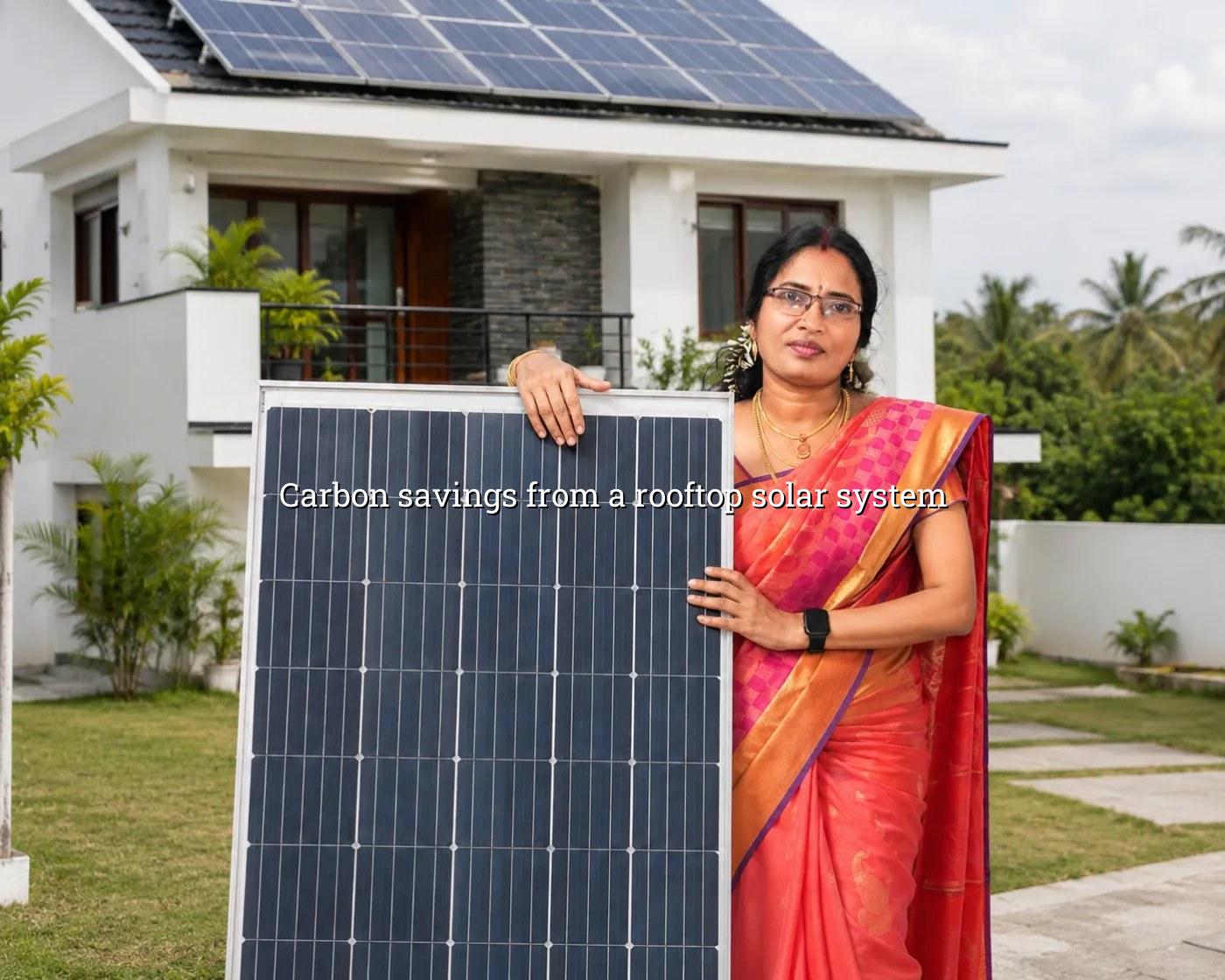
How the savings happen
Why rooftop solar lowers the carbon tied to your EB use
The principle is simple. Power made on the roof is power you do not need to draw from the grid for that moment. If the building uses that solar power right away, the amount of electricity bought from the EB connection drops, and the emissions linked to those units drop with it. For daytime homes, the change can show up quickly. For a shop or office, it can be even clearer because the building is active when the panels are producing.
Daytime use matters more than most people expect
A rooftop system gives its best carbon effect when your loads line up with the sun. Fans, lights, routers, office computers, pumps and other daytime equipment can use the solar output as it is made, which leaves less to be pulled from the grid. If the building sits empty all day and only wakes up at night, the savings pattern looks different. That is why we ask how the place is actually used, not just how it looks.
We check the site before we talk numbers
Our first look covers the EB bill, roof layout, orientation, shade from nearby walls or trees, and the route the cables will take. In homes near Suchindram or Agasteeswaram, tiled and mixed roofs often need a different fixing method from a plain RCC terrace, and the detail matters because water sealing and finish quality affect long-term performance. A number on paper is only useful if the roof can support it properly.
- More daytime self-use usually means more carbon reduction from the same roof.
- Shade from trees, tanks and nearby buildings can trim useful output quickly.
- Strong wind exposure changes how the mounting structure should be fixed.
- Salt air near the coast needs careful hardware and connection choices.
- Clean wiring, sealed entry points and correct earthing help the system keep doing its job.
Estimate methods
How we estimate carbon savings without making it vague
We don't sell one standard system and call it a day. That approach misses the point, because carbon savings from a rooftop solar system depend on the roof you actually have and the way you use electricity. We begin with the EB bill and ask what the building is doing through the day. A family home with people around at noon behaves one way, while a small office that runs only during business hours behaves another.
In our experience the site survey is where the picture becomes real. We check where the sun lands, whether the roof surface can take the mounting load, and how the installation should be sealed against weather. Around Aralvaimozhi and Boothapandi, wind loading comes up fast because the structure has to stay steady through rough spells, not just look good in a neat drawing. The same roof size can need a different support plan from one locality to the next, and that’s normal.
The basic logic is easy enough
If solar generation replaces a meaningful share of daytime grid draw, the carbon footprint of the building falls in the same direction. You don't need a complicated theory to understand it. The roof makes power. The building uses it. The grid supplies only the balance that remains. Its a direct substitution, and that is what makes the estimate useful when it is based on the actual site.
| Site factor | What we look at | Why it changes the carbon picture |
|---|---|---|
| Roof type | RCC flat roof, tiled roof or sheet roof | It changes the fixing method, cable route and the amount of roof that can be used safely |
| Shading | Trees, walls, tanks and nearby buildings | Shade cuts useful generation during the hours that matter most |
| Load timing | When fans, pumps, computers and appliances run | More daytime use usually means more solar power is consumed on site |
| Local weather | Wind, salt air and monsoon drainage | Good structure and cable sealing help the system keep working after weather changes |
That is why a roof near Muttom can call for different hardware attention than one farther inland. The sea air is not a minor detail, and neither is the monsoon drainage path. If you leave those out, the estimate starts drifting away from reality, and that helps nobody.
Our process
How we work from first contact to commissioning
The process is simple, but we keep it tied to the site so the final result reflects your actual roof and EB use.
- Contact us. Tell us what kind of building you have and why you are considering solar. Some people want cleaner daytime power, others want a better match for heavy EB use, and we start there.
- Free site survey. We visit the property, inspect the roof, check shading and look at the electrical route. In Kottar and nearby residential streets, we often find the roof itself is fine but the wiring path needs more thought.
- System design and quotation. We size the system from the bill, roof space and site conditions. If a smaller setup is the cleaner fit, we say that directly.
- Installation. Our team handles the mounting and electrical work, with care for weather sealing and finishing, especially on windy or coastal sites.
- EB and documentation. We guide the customer through the required paperwork and subsidy process where applicable, without turning the conversation into paperwork for its own sake.
- Commissioning. Once the checks are complete, the system is started and we explain how to use it in plain language.
- After-sales support. We provide one year of free service support after installation, and continued technical help afterwards based on the product, manufacturer warranty and installation.
Local conditions
Why Kanyakumari District changes the job
The district gets strong sunlight through the year, which is the reason rooftop solar makes sense here in the first place. But that is only one part of the picture. Wind exposure, coastal air and the south-west and north-east monsoon periods all affect how the system should be mounted and sealed. When those parts are treated seriously, the roof is far more likely to keep performing well over time.
In Colachel and Manavalakurichi, the air itself can be hard on hardware and electrical connections if the material choice is casual. Inland, places like Thovalai and Boothapandi often make wind loading and roof anchoring the main conversation. That is why we never say one bracket or one cable route suits every property. The same panel can work in two places, but the support system around it may need to be different.
The built stock across the district is mixed too. RCC flat roofs are common in town homes and offices, while sloped tiled roofs and sheet roofs still show up in older houses and smaller commercial buildings. For farms and agricultural land, the need may be different again, since solar water pumps or off-grid power can be the more useful answer. The site should guide the solution, not the other way around.
Maintenance keeps the carbon gain honest
Dust, bird droppings and a film of salt can trim useful output before anyone notices. A roof may look fine from the ground and still need a clean, a wiring check or a small repair after a windy spell. We inspect systems installed by other companies too, and we will tell you honestly whether it needs a repair, a replacement or simply a clean. That kind of direct answer is more useful than a glossy promise.
Practical checks
What to review before you decide on rooftop solar
A sensible solar decision begins with the building you already own. The roof, the wiring, the shade and the daytime load matter more than a brochure phrase, because those parts decide whether the carbon savings from a rooftop solar system will match your expectations. If you live in Kottar, run a shop in Marthandam or manage an office in Thuckalay, the rule is the same: start with the site and the bill, not with a fixed number.
- Check how many units are used in the daytime, not just across the whole bill cycle.
- Look for shade from trees, tanks, walls and nearby buildings before finalising the layout.
- Confirm the roof structure can take the mounting pattern safely.
- Ask how the cable route will be sealed against rain and monsoon water.
- Make sure the design accounts for wind and salt exposure where the site needs it.
If your property is close to the coast, say so early. If the wiring is old, say that too. Those details change the conversation in a useful way, and they help us give you a recommendation that fits the roof instead of forcing the roof to fit the recommendation.
How we help
How JRS SunTech Energy can help
If you want a straight answer about carbon savings from a rooftop solar system, we can inspect the site and tell you what the roof can honestly support. We do that for homes, businesses and agricultural applications, and we base the recommendation on the EB bill, roof space, structure, shading and local weather. We also handle on-grid solar, off-grid solar, hybrid solar, solar water pumps, solar water heaters, inverters and batteries, plus solar service and maintenance for existing systems.
We guide eligible customers through subsidy documentation and the applicable government solar programme, and we keep the process practical from the first visit. If you need a service visit, a new installation or help with a system installed by another company, our team can look at it without the hard sell. For a site in Nagercoil, the cleanest start is a call, a WhatsApp message or a visit to our office in Kottar.
Contact JRS SunTech Energy, Door No. 227, First Floor, Cape Road, St. Xavier's Church Junction, Kottar, Nagercoil, Kanyakumari District, Tamil Nadu - 629002. Phone: 9787775999. Email: jrssuntechenergy@gmail.com.
If you want to compare system types before you decide, the most useful next pages are solar solutions, on-grid solar, subsidy guidance and solar service & maintenance.
Frequently asked
Questions people ask about rooftop solar carbon savings
They reduce the number of units you need to take from the grid in daytime hours. That matters because the power used on site is being generated on the roof itself, so the building leans less on conventional supply for the same work.
The bill is the starting point, not the whole answer. It tells us how the building behaves over the 60-day cycle, but we still need to see the roof, shading and wiring route before saying what the system can do.
Not always, and that’s the point of checking the usage pattern first. Shops and offices that run hard in the daytime can use a bigger share of solar power directly, while a house may depend more on when people are home and what loads are on.
Roof space, orientation, shade, wind exposure, mounting choice and the timing of your load all change the outcome. In places with salt-laden air or stronger wind, the structure and connection details need more care, because poor finishing can hurt output later.
Because a roof that looks simple from the ground can tell a different story up close. We check the actual surface, the electrical route and the EB pattern, then recommend a system that fits the site instead of pushing one standard size.
Yes. We guide eligible customers through the subsidy steps and the paperwork under the applicable government programme, and we keep the focus on what the roof needs rather than overcomplicating the process.
We inspect systems installed by other companies too. Sometimes the answer is maintenance, a wiring correction or a better clean, not a full replacement, and we’ll say that plainly if that’s what the site needs.
More to check
What to review before you make the call
A good rooftop solar decision is never just about panels on a roof. It's also about how the building uses power, how the wiring is routed, whether the mounting system fits the site and whether service support will be available after installation. That is why we keep asking practical questions first. They save time later.
- Look at the EB bill and see when the building is using units most heavily.
- Check whether the roof has trees, tanks or neighbouring structures throwing shade.
- Confirm the structure and roof finish can support the proposed mounting pattern.
- Think about sealing and drainage before the monsoon starts, not after it does.
- Ask for a design that matches the roof you own, not a generic package.
We often find that the second visit is the one where the real decision gets made. The roof has been seen, the bill has been read, and the owner can judge the plan with fewer assumptions. That usually makes the next step easier.
Hurry up!Subsidy ends 31 March 2027 · 134 days left
Next step
Want a real carbon savings check for your roof?
Send us your EB bill, roof details and location so we can look at the site and advise the right solar setup.
- Your electricity requirement and 60-day EB bill
- Property type — home, shop, office, farm or institution
- Backup requirement and available roof space
Related: Solar Solutions · Subsidy Guidance · Contact
Free site survey · Kottar, Nagercoil