Solar guide
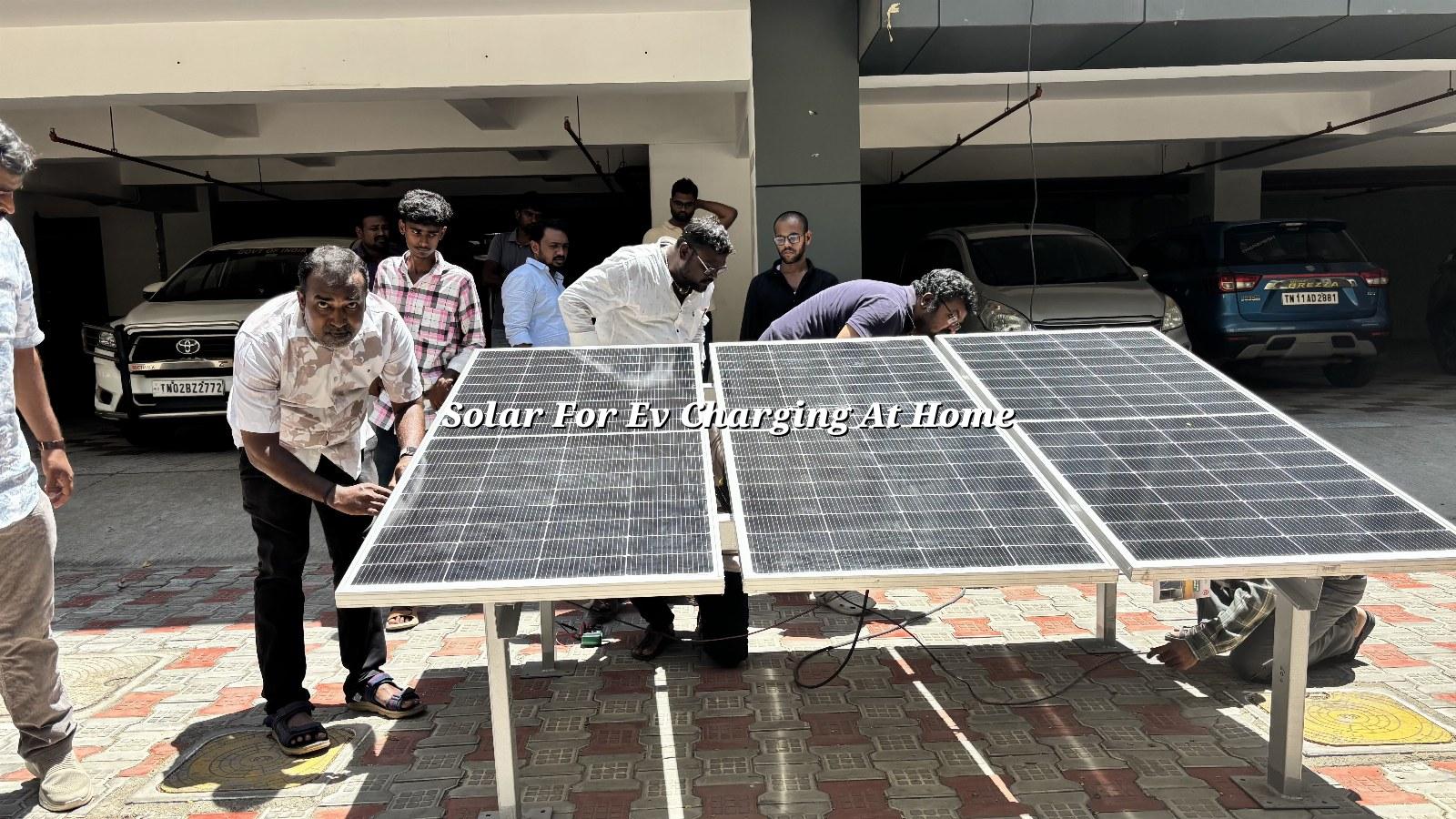
Solar for EV Charging at Home
Plan a rooftop system that fits your car, your roof and the way your home really uses power.
EV charging at home
Make home charging work with rooftop solar
Solar for EV charging at home works best when the system is shaped around your real routine, not around a generic charger brochure. If you live in Kottar or elsewhere in Nagercoil, the first question is rarely the charger itself. It’s the roof, the EB load, the parking spot and the way the car gets used on normal days.
Most people call us with the same concern in different forms. They want to know if the panels can support the vehicle, whether the existing electrical board needs changes, and if batteries are needed for evening charging. The answer changes from house to house, because a flat RCC roof behaves differently from a sloped tiled home in Suchindram, and a sheet-roof parking area brings a different cable route again. We start by looking at the house as it stands, then work out what makes sense.
Start here
What a sensible home EV solar plan has to cover
People often think the charger is the main item. It isn’t. The charger matters, but the roof structure, inverter choice, wiring path and the way the home uses power decide whether the setup feels tidy or awkward. A good plan should make charging feel ordinary.
Begin with the EB bill and charging routine
We start with the home’s actual usage in a 60-day EB billing cycle, then ask how often the EV is charged and at what time of day. That is where the sizing begins. A car that comes home every evening and charges after dinner needs a different approach from a vehicle parked in daylight at a house in Meenakshipuram or Vadasery. Same charger, different pattern.
Then check the roof and the cable route
Roof space controls how much solar can be fitted safely, and the cable route controls how clean the work will look once the job is done. Around the district we also think about wind and salt-laden air, especially in places closer to the coast, because mounting hardware and connections need to be chosen with care. During the monsoon months, drainage and sealing become part of the plan too.
- Share the basics. Send your location, EV type, EB connection details and a photo of the roof or parking area.
- We visit the site. The free survey checks shade, orientation, roof type and the space available for panels and cables.
- We design the system. You get a quotation and a clear explanation of whether on-grid solar, hybrid solar or a battery-backed option fits better.
- We install the equipment. Panels, inverter, structure, wiring and earthing are handled with the site conditions in mind.
- We handle EB steps. The paperwork and approval process tied to the rooftop work is guided by our team.
- We commission the setup. The charging arrangement is tested and the electrical connections are checked again before handover.
- We stay available afterwards. One year of free service support follows installation, with later technical help depending on the product and installation.
Local conditions
Why the district changes the way we build it
Kanyakumari District has strong sunshine through the year, which is good news for rooftop solar, but the same district also brings wind exposure and coastal air in many places. That means mounting choice, hardware selection and sealing details matter more than they might in a quiet inland town.
On a house in Colachel, we would not specify the same details that we would use for an inland RCC roof near Boothapandi. The first has more salt in the air, the second can see stronger open wind in some spots, and both need a cable path that stays dry during the monsoon. When water starts finding weak points, it shows up fast.
Solar for EV charging at home also needs to sit alongside the rest of the house load. If the home already runs a fridge, a pump or office equipment on the same EB connection, we look at that together rather than treating the charger as a separate island. That is where many systems go wrong: they were designed as if the EV were the only thing on the line.
The checks we do before we recommend a size
- How many units the home usually uses in the EB billing cycle.
- Whether the roof is RCC flat, sloped tiled or sheet-roofed.
- Shade from nearby trees, walls, tanks or taller buildings.
- Where the EV will park and how the cable will reach it.
- Whether the home needs daytime charging only or a hybrid arrangement with battery support.
Comparing options
Which solar setup suits the car and the house?
There isn’t one standard answer. Some homes only need an on-grid solar system that helps the house load and the EV charging load during the day. Others need hybrid solar because the charger is used after sunset, or because the family wants more backup power in the same system.
| Setup | Best for | What it means at home | Our view |
|---|---|---|---|
| On-grid solar | Daytime charging and normal home use | The solar system supports the house and can help charge the EV while the sun is available. | Simple and common for homes with a steady EB connection. |
| Hybrid solar | Charging after sunset or mixed backup needs | Solar works with grid supply and battery storage so the home has more control over when power is used. | Useful when the car often charges in the evening. |
| Off-grid solar | Remote sites or places with unreliable supply | The house runs with solar and battery support without leaning on the grid in the usual way. | Usually chosen only when the site conditions call for it. |
| Solar with battery backup | Backup support for selected loads | You can keep the EV charging plan separate from other home loads if needed. | Best when backup needs are clear from the start. |
If you are comparing options, use your actual routine. A family in Kottar that parks the EV at home all evening may need a different answer from a home in Padmanabhapuram where the car comes back in daylight and the roof has clearer exposure. The right design should fit the way you live, not the other way round.
What usually goes wrong
Small details that matter more than they first look
A charging setup can look finished and still feel wrong if the electrical board is cramped or the cable run was done in a hurry. We see that a lot. The homeowner wanted the EV charger close to the car park, but nobody checked whether the route passed a hot wall, a wet corner or a place where rainwater keeps hitting the conduit.
The other common issue is assuming the roof can take any structure without checking. It can’t. A sheet roof, a tiled roof and a concrete roof all need different mounting care, and the wind in this district makes that choice more serious than people think. Around Aralvaimozhi, for example, we pay extra attention to the structure and fixing points because open wind can change how the array behaves. It's one of those things that looks minor until the first rough season arrives.
Good practice before you approve the work
- Keep the EV charging point close enough to reduce cable stress, but not so close that heat and splash water become a problem.
- Use proper cable sealing where the line passes through the roof or wall.
- Check whether the inverter location stays dry during monsoon rain.
- Make sure the mounting hardware matches the roof and the local exposure.
- Ask for a walkthrough after commissioning so you know what each breaker and connection does.
Step-by-step
A practical way to start the project
The easiest way to begin is to send us the items that tell the real story: your EB bill, a photo of the roof or parking area, and a note about when the car usually gets charged. That lets us see whether the home is better suited to an on-grid approach, a hybrid arrangement or something else entirely.
After that, we can talk through the equipment, the cable path and the way the charger will sit beside the rest of the home. Homes in Nagercoil, Kottar and nearby localities all have their own small quirks, and the right answer usually comes from those quirks rather than from a one-size-fits-all rule.
What we ask for first
The first call is usually simple. We ask where you live, how the EV is used, what the EB connection looks like and whether the roof is flat, tiled or sheeted. If you can send a photo, even better. It saves time and gives us a cleaner starting point.
What happens next
After the survey, we prepare the design and explain the trade-offs in plain words. Some homes need daytime support only, some need a battery-backed plan, and some need the charger to be installed with extra attention to the line running from the board to the parking spot. We tell you what we see.
How we help
How JRS SunTech Energy Can Help
We design solar for EV charging at home the same way we handle other rooftop work: we start with the EB bill, roof space and site conditions, then match the system to the way you actually live. If your home needs on-grid solar, hybrid solar or a battery-backed setup, we will tell you plainly what fits and what doesn’t.
Our team handles the survey, installation, EB and documentation support, commissioning and the after-sales follow-up. If you want a practical plan for EV charging at home, send us your details and we’ll take it from there.
JRS SunTech Energy, Door No. 227, First Floor, Cape Road, St. Xavier's Church Junction, Kottar, Nagercoil, Kanyakumari District, Tamil Nadu - 629002. Phone: +91 97877 75999. Email: jrssuntechenergy@gmail.com.
FAQ
Questions we hear about home EV charging and solar
Yes, that is how most home setups are done. The solar system supports the house load in the daytime, and the EB connection stays in place for backup and balance.
We start with your EB bill, your charging routine, roof space and the shape of the site. Then we look at shade, orientation and the place where the car is parked, because those details change the answer a lot.
Not always. If you mostly charge in the daytime, an on-grid setup may be enough, but if charging happens after sunset or you want extra backup, a hybrid or battery-backed plan may make more sense.
We check RCC flat roofs, sloped tiled roofs and sheet roofs. Each one needs different mounting care, and the cable route matters just as much as the panel layout.
Yes, we guide the EB and documentation steps that come with rooftop solar. If subsidy guidance is relevant, we explain the current process and point you to the right details without guessing.
A photo of the roof or parking area, your EB details and a short note about when you usually charge the EV are enough to start. If the home is near the coast or in a windy spot, that helps us plan the hardware too.
Next step
Send us your roof details and charging plan
If you already know where the EV will park, send us a photo of that area along with your last EB bill. That gives us enough to start a proper sizing discussion without guessing. We can then tell you whether the best path is a simple rooftop setup, a hybrid system, or a design that keeps the charger and the rest of the house in better balance.
The main thing is to avoid a one-size-fits-all decision. Homes in Nagercoil, Kottar and the nearby service area have different roofs, different shade and different charging habits, so the right answer should come from the site.
Hurry up!Subsidy ends 31 March 2027 · 134 days left
Next step
Thinking about solar for EV charging at home?
Send us your EB bill, EV model and a photo of the roof or parking area, and we will suggest the right setup for your house.
- Your electricity requirement and 60-day EB bill
- Property type — home, shop, office, farm or institution
- Backup requirement and available roof space
Related: On-Grid Solar · Hybrid Solar · Contact
Free site survey · Kottar, Nagercoil