Solar guide
Solar Interconnection Agreement Explained
A plain look at the EB paperwork, the site checks and the approval steps that sit behind a rooftop solar connection.
EB approval help
What the agreement is really for, and why people get stuck
If you typed solar interconnection agreement explained, you probably want the real answer, not the office language. It is the approval trail that lets your rooftop solar system connect properly with the EB connection, with the wiring, meter details and system design all kept in step.
Most of the confusion comes after the roof work has already begun. A customer in Kottar may have panels chosen, structures ordered and drawings signed, then the utility asks for papers or inspection details that were never lined up with the site. That gap slows things down. Around Vadasery and Suchindram we see the same thing again and again, and it usually comes back to one simple issue: the paper file and the roof file were never checked together.
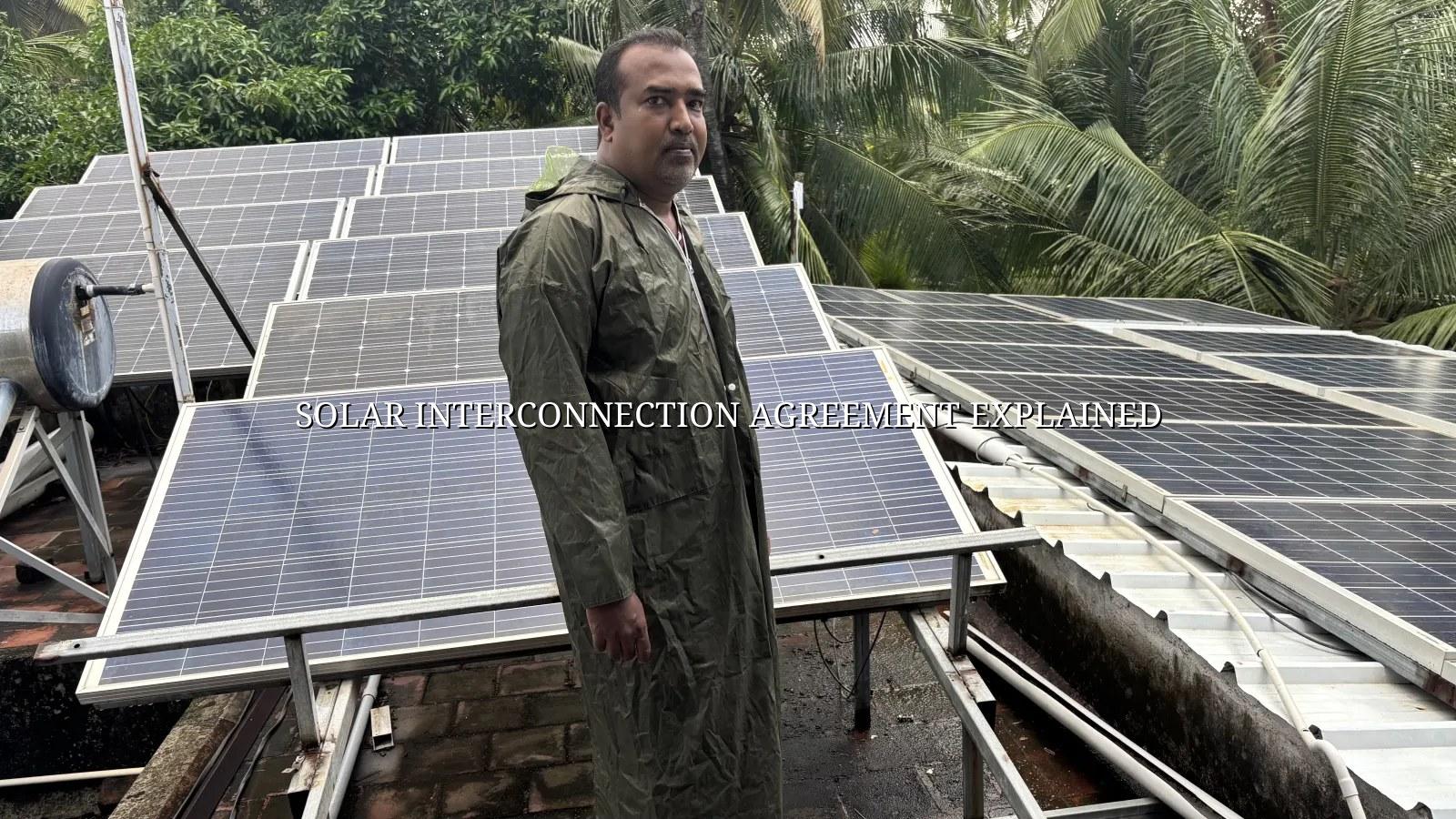
Start here
The order that keeps the EB file and the site work aligned
We never treat this as a paper-only task. The agreement, the roof work and the electrical layout have to agree with each other, so we begin by looking at the roof, the meter point, cable route, earthing and the system type before anything is filed.
Begin with the EB bill and the roof on the ground
The latest EB bill tells us more than most people expect. We check the 60-day consumption pattern, the consumer details and the existing connection because those details help us understand what size and style of system makes sense. Then we look at the roof space and structure. A flat RCC roof, a sloped tiled roof and a sheet roof all need different fixing points, and the approval file should reflect the same reality, not a guess.
Then match the design to what will be installed
Once the system layout is fixed, the papers should describe that exact plan. Consumer name, address, inverter type, panel count and equipment position all need to line up. If the drawing says one thing and the roof shows another, the approval team will ask questions. That is where people lose time. We we can avoid that by checking the design before it gets too far ahead of the site.
- Share your starting details: send the EB bill, roof type and a few clear photos so we know what we are looking at.
- Free site survey: we visit, check the roof condition, shade, cable route and the safest place for the equipment.
- Design and quotation: we recommend a suitable capacity based on your actual use, roof space and site conditions.
- Installation: our team fits the system and keeps the layout aligned with the agreed design.
- EB and documentation: we guide the forms, supporting papers and the interconnection steps needed for approval.
- Commissioning: after the site is ready, the system is checked and brought into regular operation.
- After-sales support: we remain available for service checks, follow-up help and practical questions after installation.
What the utility looks for
Why the interconnection agreement matters before the meter work
The EB side is not only checking whether panels are on the roof. They are checking whether the consumer details, meter arrangement, protection devices and wiring are in order. The interconnection agreement gives that process a clean link between what was approved and what was installed.
In practice, the questions often come from three places: the meter point, the protection side and the document set. A house in Ramanputhur may have enough roof area, but the cable entry may need better sealing because of the monsoon. A shop in Thuckalay may have a tidy roof but a shared structure that needs careful panel placement. Small things, yes, but they matter more than people expect. When the site file and the physical work line up, the approval path is much smoother.
| Check point | What we look at | Why it matters |
|---|---|---|
| Consumer and site details | Name, address, EB connection details and site location | These must match the application and the installed system |
| Roof and structure | RCC, tiled or sheet roof, plus fixing points | Mounting choice and cable routing depend on the structure |
| Protection and wiring | Isolation, earthing, cable entry and inverter position | Helps keep the connection safe and inspection-ready |
| Meter and connection point | Existing meter arrangement and utility connection location | Needed for the final interconnection approval steps |
| Weather exposure | Drainage, cable sealing and wind loading | Important during the monsoon and in windy parts of the district |
Local conditions
Why the district changes how we handle the approval work
Wind, salt air and roof type all shape the file
Kanyakumari District gets strong sunshine through the year, but it also gets proper wind exposure. That affects mounting structure strength and the way we secure cables. Near the coast at Colachel or Manavalakurichi, salt-laden air can be hard on exposed metal and connectors, so we think about the hardware and sealing at the same time as the paperwork.
Monsoon planning matters more than people think
The south-west and north-east monsoon periods do not stop solar work, but they change the way we plan the site. Drainage, roof access and cable sealing matter more, especially on sheet roofs where water can find its way into small openings. That is why we inspect first, then choose the order of work. A fixed sequence sounds neat, but real roofs do not always behave that way.
- Use the latest EB bill and keep the consumer details exactly as they appear there.
- Tell us if the roof is RCC, tiled or sheet before we suggest a layout.
- Share any shading from trees, parapet walls or overhead tanks.
- Ask early whether the system is on-grid, hybrid or battery-backed, because the paperwork changes with the layout.
- Watch the cable path where the roof meets the wall or meter room.
- For coastal homes, expect extra attention to mounting hardware and connection sealing.
Common mistakes
What usually slows solar interconnection down
Most delays are plain, practical things. A wrong name on the paperwork, a loose roof measurement, a drawing that never matched the actual site, or an installer who skipped the EB side until the end. None of it is dramatic, but it can waste time.
Paperwork that does not match the roof
If the application says one thing and the site shows another, someone has to explain the difference. That often happens when the roof changes after the first discussion or when the installer guessed the layout instead of measuring it properly. A good survey stops that problem early. It also helps us tell you honestly whether a site needs a repair, a replacement or simply a clean before the solar work moves ahead.
Leaving the utility side for the last minute
Some people think the EB step can wait until the panels are already fixed. That usually creates more back-and-forth. The safer route is to think about interconnection while the design is being settled, because then the inverter position, meter access and protection layout can be planned together. If you are in Marthandam, Kuzhithurai or nearby town areas with busy commercial roofs, that early planning helps even more because there is less room to redo things later.
The question is not only “can solar be installed?” The better question is “can this site move through approval without waste?” That is the one we ask on every visit.
How the site visit feels
What we check during the survey before any file goes out
A useful survey is not a quick walk-around. We look at roof direction, shade from tanks or nearby walls, the route the cables would need to take, where the inverter can sit, and whether the structure looks ready for the load. In the district, wind and coastal exposure can change the choice of mounting and fittings, so the survey has to be practical, not just neat on paper.
If the roof is in a home near Ozhuginasery, the owner may care most about keeping the layout tidy and low-profile. On a small office near Vadasery, the first concern may be access, clean cable routing and a place for the meter work that doesn’t disturb business hours. Same district, different use. That is why we don’t start from a fixed package.
A quick reference for different system types
| System type | Typical fit | Connection note |
|---|---|---|
| On-grid solar | Homes, shops, offices and commercial buildings with a regular EB connection | Needs the utility connection arranged around the approved design |
| Hybrid solar | Sites that want solar with battery support and grid use | Extra attention to inverter, battery and protection layout |
| Off-grid solar | Remote or utility-light sites | Focused more on battery, load planning and site independence |
| Solar water pumping | Farms and irrigation points | Connection planning depends on the application and site layout |
How JRS SunTech Energy Can Help
How JRS SunTech Energy Can Help
We handle rooftop solar as a site-specific job, not a one-size sale. That means we look at your EB bill, roof condition, structure, shading and connection details first, then we recommend the right system and help with the interconnection agreement, documentation and follow-up steps. We also provide one year of free service support after installation, with continued technical help afterwards based on the product and installation.
If your home, shop or office is ready for solar, or if you already started and got stuck at the EB stage, send us the site details and we will tell you the next practical step.
JRS SunTech Energy, Door No. 227, First Floor, Cape Road, St. Xavier's Church Junction, Kottar, Nagercoil, Kanyakumari District, Tamil Nadu - 629002. Phone: 9787775999. WhatsApp: 919787775999. Email: jrssuntechenergy@gmail.com.
Frequently asked
Questions we hear about solar interconnection agreement explained
Usually the utility and installer need your EB connection details, site address, identity and ownership-related papers, plus the system design and installation details. We check the file before submission so the names, address and equipment details match the actual site. That simple check saves a lot of back-and-forth.
It depends on the site, the paperwork and how quickly the utility side moves after inspection. A clean file usually goes faster than a file with mismatched details, so the best way to shorten the wait is to get the survey and documents right before installation starts. We keep people updated as the file moves.
Yes, because the structure and fixing points matter. A fresh RCC roof may be straightforward, while a tiled or sheet roof needs more care around fastening, cable entry and drainage. We look at that on the survey so the design and the paperwork fit the roof properly.
Yes. Shops, offices and commercial buildings often need a bit more attention to access, meter placement and cable routing, especially in busy areas like Marthandam or Kuzhithurai. We handle the site visit, design and paperwork around the actual building, not around a standard template.
We review the point raised, compare it with the site, and tell you what needs to be changed. Sometimes it is just a document correction. Sometimes it is a cable route, label or protection point. We keep it practical and tell you the next step plainly.
Hurry up!Subsidy ends 31 March 2027 · 134 days left
Next step
Need help with the EB approval side?
Send us your EB bill, roof photos and a short note about the site, and we will tell you what the interconnection process needs next.
- Your electricity requirement and 60-day EB bill
- Property type — home, shop, office, farm or institution
- Backup requirement and available roof space
Related: Subsidy Guidance · Solar Finance and EMI · Contact
Free site survey · Kottar, Nagercoil