Solar guide
Solar Pump Controller Explained
A plain-English look at what the controller does, how it protects the pump, and what we check before we suggest a system in Kanyakumari District.
Solar pump basics
Why the controller matters before water starts moving
Solar pump controller explained in simple words: it's the part between the panels and the pump that decides when the motor can start, how it behaves during changing sunlight, and when it should stop to protect itself. If you are trying to lift water from a borewell, open well or a farm storage line, the controller matters just as much as the pump motor. Get the match wrong and the system will complain long before the monsoon does.
Most people who call us are not asking for a theory lesson. They want to know why a pump starts one day and trips the next, or why the same array seems fine on paper but refuses to deliver at the field. Around Kottar and the residential edges of Nagercoil we see smaller utility pumping setups too, and the same rule holds there: the controller has to sit inside a full system that is wired, sealed and mounted properly. Near Colachel and Manavalakurichi, the salt-laden air adds another layer, so the box on the wall is only one part of the story.
How it works
What the controller actually does in the field
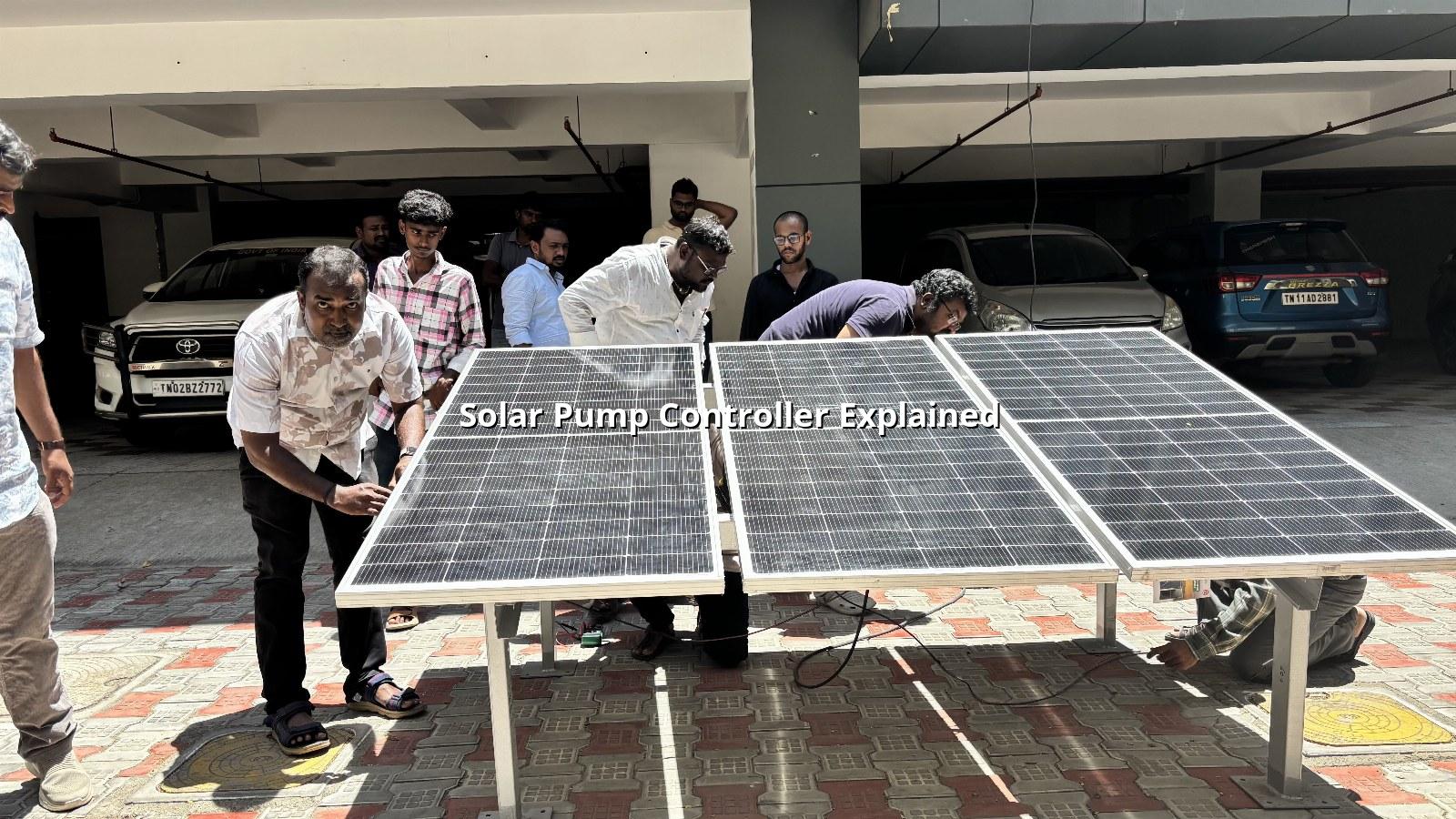
A solar pump controller is not a fancy switch. It watches the power coming from the panels, checks whether the motor can start safely, and keeps the pump inside a usable range while the sun changes. On agricultural sites around Thovalai or Boothapandi, that matters because wind exposure, long cable runs and uneven ground can all affect how the system behaves by the time the power reaches the pump house.
What people usually expect it to do
A lot of owners assume the controller simply turns the pump on at sunrise and off at sunset. It does more than that. It helps manage start-up, keeps the motor from being pushed in the wrong conditions, and can respond when the input from the panels falls away because of clouds, shade or a loose termination. That small bit of control is what keeps a good pump from sounding tired after a short while.
What we check before we suggest one
We start with the pump type, motor rating, borewell depth, water need and the actual layout available for the panels. Then we look at the site itself: the shade pattern, the route of the cables, the enclosure location, and whether the mounting can take the district's wind and monsoon conditions. If the place is close to the coast, we also think about corrosion on hardware and connections because that comes up faster than many buyers expect.
- The controller has to suit the motor type and working range.
- Panel input, cable length and pump demand should be checked together.
- Loose joints, water ingress and poor sealing are common reasons for repeated faults.
- Wind movement can shift array alignment and change the way the controller sees input.
- In coastal parts of the district, terminal care matters more than people think.
Step by step
From sunlight to water flow: the usual sequence
If you want solar pump controller explained without technical fog, it helps to follow the sequence. Each stage tells you something about whether the design is sound or whether a problem is waiting to show up later.
- Sunlight reaches the panels. The array starts producing usable power, but the controller still decides whether that power is in a safe zone for the pump.
- The controller checks the starting window. It looks for enough input before allowing the motor to come alive, which helps prevent rough starts and avoidable trips.
- The pump starts in a controlled way. Rather than a hard jolt, the controller guides the initial run so the electrical parts are not stressed for no reason.
- Running conditions are watched. If power drops too much, if the motor pulls badly, or if a fault appears, the controller can stop the set before the issue spreads.
- Water delivery follows site conditions. On a clear day in Kanyakumari District you may get steady running for longer, while a cloudy spell or a very windy day can change the pattern, and that is normal.
Controller types
Choosing the right controller for the pump, not just the catalogue
Not every controller suits every pump. That sounds obvious, but it is where many project mistakes begin. A farm site near Aralvaimozhi with an exposed layout and a long run between the panels and the pump house needs a different level of care than a compact borewell setup tucked close to the source.
| Controller type | Typical use | What we check first | Practical note |
|---|---|---|---|
| DC solar pump controller | Direct solar pumping with a compatible DC motor | Motor rating, input range, cable length | Often chosen where the layout is simple and the pump duty is straightforward |
| AC solar pump controller | Solar pumping with AC motor and drive logic | Starting demand, array size, protection features | Needs careful matching, especially on deeper borewell sites |
| MPPT-based controller | Systems that need better use of changing sunlight | Panel arrangement, input window, pump demand | Helpful when solar input moves around during the day |
| Controller with dry-run protection | Sites where the water source can change | Water level behaviour, sensor method, installation quality | Very useful where the borewell level is not stable |
That table is only the starting point. Real selection depends on the pump, the panel array, the wiring path and the site itself. Around Munchirai and Eraniel, we also pay attention to how the equipment sits on the land, because a tidy routing plan makes future checks much easier. Nobody enjoys tracing a cable through three awkward bends when the pump is already down.
Common faults
When the controller keeps stopping the system
Many problems do not begin with the controller itself. They begin with the system around it. If the panels are shaded, the cabling is loose or the pump is tired, the controller gets blamed first because it is the part people can see. That's understandable, but it doesn't always tell the full story.
What often shows up on the solar side
If the controller keeps restarting, the first thing we tend to check is the panel side. Shade from a tree, bird droppings, a tilted frame or a corroded termination can pull the input down enough to make the controller behave badly. In Kottar and similar residential or light utility sites, we have seen systems where the controller was blamed when the real issue was a weak joint at the array side or a cable that had been nicked during installation.
What can be happening on the pump side
If the controller powers up but the pump does not establish flow, the motor or borewell side may be the real issue. Blocked lines, worn parts, dry-run conditions or the wrong motor match can all create the same headache. The controller is reacting to what the system gives it, so the fix depends on checking the whole setup step by step instead of swapping parts at random.
- Check solar input before replacing the controller.
- Inspect terminations for heat marks, looseness or corrosion.
- Match the controller setting sheet against the actual pump rating.
- Look for water ingress at the enclosure and gland points.
- Review the mounting structure if wind or vibration has shifted the array.
Practical checks
What makes a controller behave well for longer
Good controller performance is usually boring, and that's a compliment. The box sits there, starts the pump when the sun allows it, and stays quiet. For that to happen, the installation has to respect a few simple things: clean wiring, a dry enclosure, sound earthing, and a mounting layout that can stand up to local wind and rain.
In coastal stretches of the district, salt air can work on terminals and metal parts faster than people expect. During the south-west and north-east monsoon periods, drainage and cable sealing matter more than they do in dry weather. And if the site has a long run from the panels to the controller, that route should be planned properly instead of being treated like a spare detail. It usually isn't spare.
A few habits that help in real use
Keep the controller area dry, clear and easy to reach. Check the frame, glands and visible cable paths after heavy wind. Ask for the controller settings and wiring details when a new installation is handed over, because later troubleshooting gets simpler when those notes are already there. People forget that part and then spend half a day re-learning their own system.
How JRS SunTech Energy can help
We look at the whole pumping setup, not just the box
We help you choose a controller that fits the pump, the site and the way you actually use water. Our team starts with the site details, checks the panel space or ground mounting area, and then looks at the borewell or water source before we suggest anything. If the system is already installed and acting up, we can inspect the controller, the pump, the wiring and the solar side together.
We work from Kottar, Nagercoil and serve farms and properties across Kanyakumari District, including places like Thovalai, Pechiparai and Aralvaimozhi where wind exposure, cable routing and local conditions have to be handled properly. Send us the pump model if you have it, a photo of the controller, and a short note on what the system is doing. That makes the first visit much more useful.
JRS SunTech Energy, Door No. 227, First Floor, Cape Road, St. Xavier's Church Junction, Kottar, Nagercoil, Kanyakumari District, Tamil Nadu - 629002. Phone: 9787775999. Email: jrssuntechenergy@gmail.com.
Frequently asked
Questions people ask about solar pump controllers
It manages the power coming from the panels and sends the right supply to the pump. In many systems it also handles start-up logic, dry-run protection and basic fault handling, so the pump is not pushed harder than it should be.
Usually yes, because the controller has to match the pump type, motor rating and the panel array. On farm sites around Thovalai, Pechiparai and Boothapandi, we also look at cable length, water source and starting conditions before we decide what fits.
The cause may be low input from the panels, loose wiring, a pump issue, or a protection setting doing its job. Salt air, weak joints, water ingress and shade on the array can all show up as repeated faults, so the whole system has to be checked, not just the box on the wall.
Some systems can be built that way, but many agricultural pumping setups use panels directly with the controller and pump. If you want backup running or evening water delivery, we would usually talk through the full design first and see whether off-grid or hybrid thinking makes sense.
We start with the pump details, borewell depth, expected discharge and the panel arrangement, then we check whether the controller can support the motor safely. A guess is a bad idea here; the wrong controller can lead to nuisance trips, poor starting or avoidable damage.
Yes, we can inspect it and tell you what is actually wrong. For a site in Kulasekharam or Thiruvattar, that might mean checking the controller setting, the pump, the electrical connections and the solar side one by one instead of replacing parts blindly.
Hurry up!Subsidy ends 31 March 2027 · 134 days left
Next step
Need the right controller for your pump?
Send us your pump details, a photo of the existing controller if there is one, and a short note on the water source. We will tell you plainly what fits and what does not.
- Your electricity requirement and 60-day EB bill
- Property type — home, shop, office, farm or institution
- Backup requirement and available roof space
Related: Solar Water Pumps · Solar Maintenance · Contact
Free site survey · Kottar, Nagercoil