Solar irrigation guide
Solar Pumping for Paddy Irrigation
How we plan solar pump systems around the field, the borewell and the way paddy is actually grown in Kanyakumari District.
Farm solar advice
Solar pumping for paddy irrigation, planned around the field you actually have
Solar pumping for paddy irrigation works best when the water source, the crop pattern and the electrical layout are treated as one job. That is how we approach it at JRS SunTech Energy. We begin with the borewell or field source, the way water needs to move across the paddy land, and the space you have for panels and structure, then we build from there instead of forcing one standard setup.
In Kanyakumari District, the same crop can need very different hardware depending on where the land sits. A farm near Thovalai may have a simple pipe run and open ground, while a paddy area closer to Thiruvattar or Boothapandi may face wind, uneven soil or tight access for mounting. Those things sound small until the first rainy week, then they become the whole story. We would rather sort them before the panels go up.
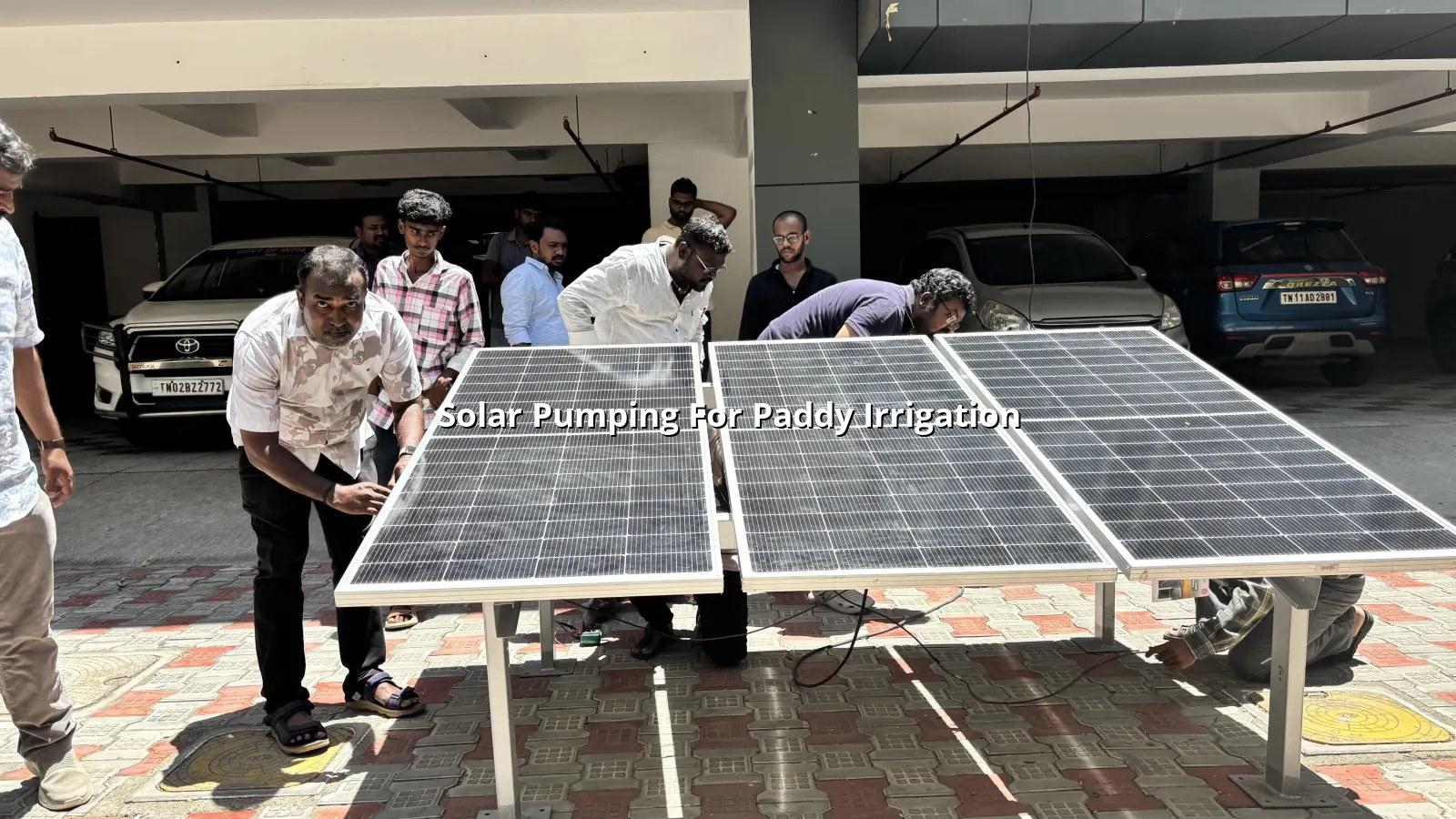
Start with the field
What actually decides the pump size and layout?
The right system is shaped by the site first, not by a brochure. Water level, pump head, pipe length, sunlight availability and the physical space for mounting all matter. We also look at the EB connection history, because the way a farm has been powered before tells us a lot about the load and the habits of the site. A good solar water pump is one that feels natural to use day after day.
Crop stage changes the water pattern
Paddy fields do not ask for the same flow at every stage, and the pump design should respect that. A young crop, a standing field and a more mature stage all pull water differently, so the system needs to be matched to real use rather than a guess from the motor nameplate. We hear this often from farmers who already know the field very well; they just want the solar side to fit that knowledge.
Mounting is part of the irrigation job
Most farm installs use ground-mounted structures near the pump room or along a useful edge of land, though some sites have sheds or utility roofs that help with part of the array. In coastal and near-coastal parts of the district, salty air can punish weak fittings, and open fields can catch stronger wind than people expect. So we choose the frame, the anchoring and the cable path with the site in mind from the start.
- Site survey: we check the borewell, open well or pump house, along with access to the field and the place the array can sit safely.
- Existing pump check: if a pump is already installed, we see whether it suits solar use or whether a different match would make more sense.
- System design: the panel layout, controller or inverter and mounting structure are chosen around the water need and local site conditions.
- Installation: our team sets the structure, runs the wiring, and keeps the outdoor layout tidy enough for regular farm work.
- Commissioning: we test the pump run, check water flow and inspect the EB side where that is part of the setup.
Why the district matters
Local ground conditions change the way a solar pump should be built
Kanyakumari District gets strong sunshine through much of the year, so the district is well suited to solar pumping for paddy irrigation. But sunlight is only half the picture. The wind line around Aralvaimozhi and the open farm stretches near Boothapandi can push a weak structure around, and that is how small looseness becomes a bigger issue later. A frame that behaves well on a calm roof may not stay so polite in a field with open airflow.
The monsoon periods are another reason to plan properly. Water can collect where you did not expect it, especially around cable entries, low-mounted equipment and poorly drained ground. We have seen projects where the panels were fine but the small details were not, and the small details are what end up costing time. It’s the sort of thing that gets missed when the system is chosen from a distance.
What we want to know on day one
We check the depth of the source, the delivery point, the pipe length, the condition of the electrical parts that already exist and whether there is a safe place for the array to stand. If the field is more exposed, we talk about stronger anchoring and neater cable routing. That is normal here, not extra. When the ground and the weather are part of the job, they should be treated that way.
Field situations
A quick reference for common paddy irrigation setups
| Situation | What usually matters most | What we check first |
|---|---|---|
| Deep borewell with a long pipe run | Lift height, cable size, starting load | Pump match and wire route |
| Open well near the paddy land | Water availability and seasonal drop | Flow pattern across the day |
| Open farm land with strong wind | Mounting strength and anchoring | Frame design and fixing points |
| Field with an existing pump set | Motor condition and electrical layout | Whether repair or replacement is wiser |
| Site that sees monsoon water logging | Drainage, cable sealing, panel height | Where water will collect after rain |
This table sounds simple, but it captures the part many people miss. A solar pump is not just panels and a motor; it is the way all the parts behave together in the field. For a farm near Kottar, the layout may be straightforward. On a more open patch closer to the district’s windier belt, the structure needs more thought and better fixing, and that difference matters from the first season itself.
Practical checks
Small details that save trouble later
Most of the complaints people have about solar pumping for paddy irrigation come from things that were visible early but ignored. A controller fixed too low, a loose conduit, a frame that shifts in wind, or a pump that never really matched the water source can create repeated irritation. So we slow down at the beginning and look at the things that are easy to miss when everyone is in a hurry.
- Keep the cable route short and protected from standing water.
- Use mounting hardware that suits the local wind and soil conditions.
- Check whether the existing pump is healthy before planning a new set.
- Make sure the array does not shade itself from nearby trees or sheds.
- Ask for a layout that leaves room for cleaning and inspection later.
- Plan for the monsoon, not only for bright months.
Farmers around Nagercoil and Kottar often tell us they want a setup that starts without fuss and keeps the work simple. Fair enough. A paddy field already has enough moving parts. The solar pump should reduce the friction, not become another piece of equipment you have to worry about every morning.
How we handle projects
How JRS SunTech Energy can help
We handle solar water pumps for farms, and we also help with the electrical side, the structure and the practical checks that come before installation. If your paddy land needs solar pumping for paddy irrigation, we will look at the source, the field and the existing setup, then tell you honestly what makes sense. If it only needs a repair or a better layout, we’ll say that too.
Our office is at Door No. 227, First Floor, Cape Road, St. Xavier's Church Junction, Kottar, Nagercoil, Kanyakumari District, Tamil Nadu - 629002. Contact JRS SunTech Energy, Mr. Pious Antony Rajan, on 9787775999, WhatsApp +919787775999, or email jrssuntechenergy@gmail.com for a farm survey and guidance.
Frequently asked
Questions farmers ask before starting solar pumping
The system uses sunlight to run the pump during the day, so water can be lifted without depending entirely on the grid. We look at the water source, the crop stage and the pipe route first, because those three things decide whether the setup will feel practical or awkward. A field in Thovalai can need a different approach from one near Thiruvattar, even when both are growing paddy.
We start with the borewell or open well, then check the pump, cable run, mounting space and the daily water need. If the site is exposed, like some farm stretches around Boothapandi, we also look at wind loading and how the frame will sit on the ground. It saves trouble later when those details are handled on day one.
Yes, but the output follows the sunlight, so the system has to be planned with that in mind. During the south-west and north-east monsoon periods, drainage and cable sealing matter a lot, and we pay extra attention to where rainwater collects. That is often what separates a neat installation from one that gives people hassle every season.
Then we check whether the pump is actually the right match for solar use, or whether the rest of the layout needs a cleaner design. Sometimes the motor is fine and the issue is the wiring, the pipe run or the way the panel array is placed. We do not push a full replacement if a smaller correction will do the job.
Yes, we guide customers through the documentation side and explain what is needed for the EB connection process. For many farmers, that part feels more confusing than the hardware itself, so we keep it plain and practical. The point is to get the job moving without making you chase ten different answers.
The mounting structure needs more thought, full stop. Around Aralvaimozhi the wind is not something to ignore, so the anchoring method and frame design become part of the real design, not an afterthought. The panels may be the same, but the structure around them may be quite different.
Hurry up!Subsidy ends 31 March 2027 · 134 days left
Next step
Need a solar pump plan for your paddy field?
Send us your field location, pump details and any EB paperwork you already have, and we will guide you from survey to installation.
- Your electricity requirement and 60-day EB bill
- Property type — home, shop, office, farm or institution
- Backup requirement and available roof space
Related: Solar Water Pumps · Solar Solutions · Contact
Free site survey · Kottar, Nagercoil