Solar guide
BIS Certification for Solar Panels
A practical guide to what BIS means, what to ask for, and how we check the hardware before it goes on your roof or farm site.
Solar compliance
BIS certification for solar panels, explained in plain words
BIS certification for solar panels is one of the first things we check when someone asks us to compare modules for a rooftop or a ground-mounted setup. If you're looking at a quote, this is not a detail to gloss over. A panel can look fine in the brochure and still carry weak paperwork, a fuzzy model reference or a supply trail that doesn't help you later.
Around Nagercoil and across Kanyakumari District, most customers want a system that works on a real EB connection, not a polished sample on a desk. The panel has to suit the roof, the budget, the site conditions and the documents all at once. On coastal homes near Kanyakumari and on wind-exposed sites towards Aralvaimozhi, we pay attention to the label, the fixing method and the cable entries because small lapses have a habit of showing up later.
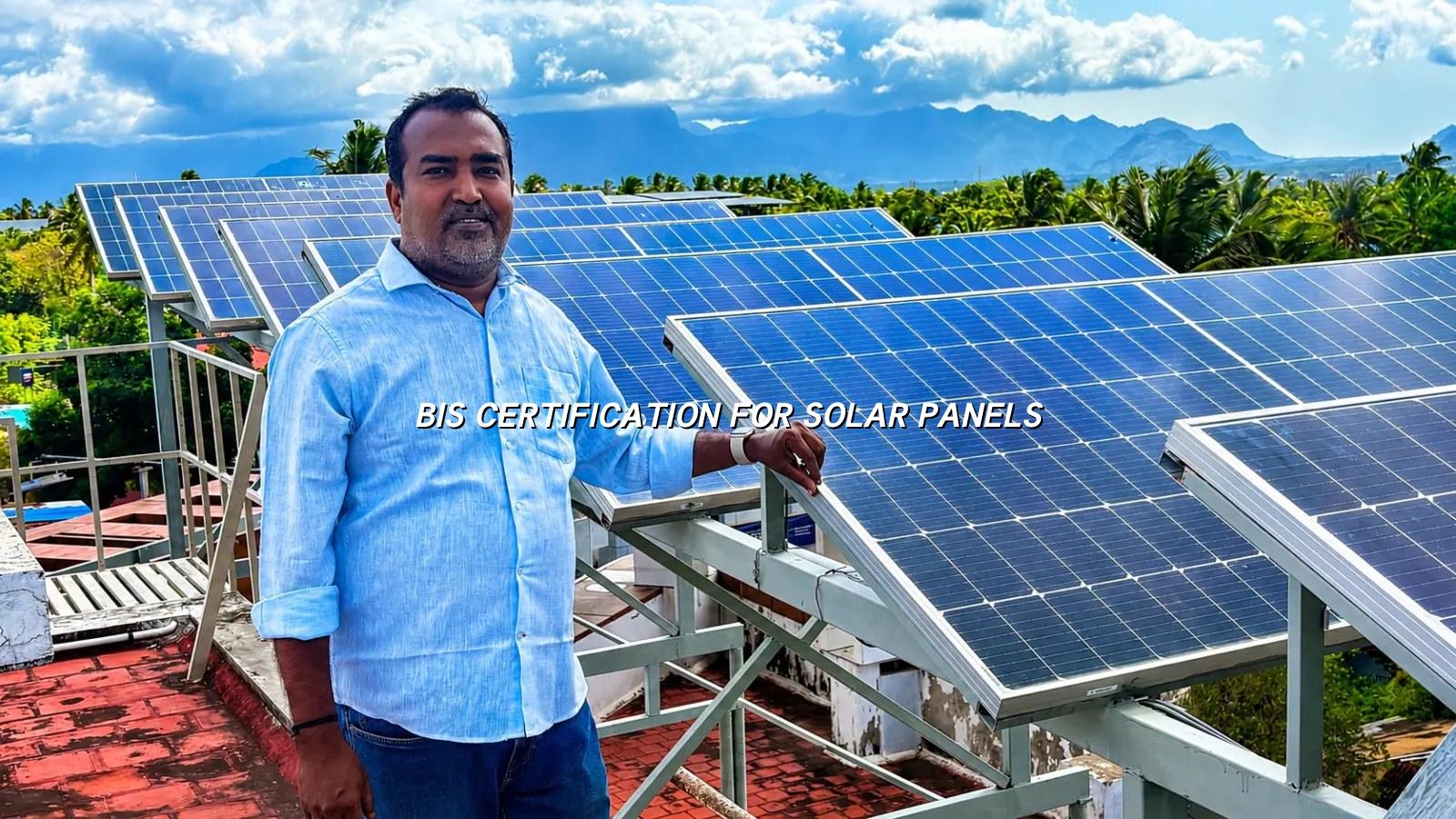
What matters first
How we check certification before anything goes on the roof
People usually ask the same thing in different words: is this panel genuine, and will it suit my place. That's the right question. A brand name alone doesn't answer it, because the wrong channel, missing papers or a mismatched model can still sit behind a familiar label.
Paper trail before hardware
We begin with the datasheet and the supplier documents. If a proposal only gives you a glossy sheet and no clear model details, that's a warning sign. For a house in Kottar or Vadasery, we want the module details to match the roof plan and the inverter plan before anyone starts talking about installation day.
The module nameplate should be readable, and the model should line up with the invoice, the carton label and the technical sheet. If those items don't match, we slow things down. It saves trouble later when you need records for billing, service or a future expansion.
The site still decides a lot
A BIS compliant panel is not a magic shield against poor design. If the roof is shaded, the structure is weak or the connections are sloppy, the system can still disappoint. We see this most often on mixed roofs in Suchindram and Agasteeswaram, where a small design miss can affect string layout and cable routing.
The district gets strong sunshine through the year, and it also gets wind, monsoon rain and salty air in many pockets. So the module certificate, mounting hardware, sealing and earthing need to be looked at together. One item alone doesn't make a solid system.
- Check that the module make and model on the invoice match the technical datasheet.
- Look for clear batch or serial identification on the panel label.
- Ask who is supplying the module and where the support will come from.
- Make sure the inverter and panel specifications make sense as one system.
- Keep copies of the proposal, invoice and site photos in one file.
Quick comparison
What usually separates a well-documented panel from a risky one
| Check | What you should see | Why it matters | Our view |
|---|---|---|---|
| Model identity | Same make and model on all papers | Avoids mix-ups and unclear supply | We verify it before the order is fixed |
| Label and serial trail | Readable label on the module | Helps with service and record keeping | We ask for photos if needed |
| Supplier documents | Invoice, datasheet and proposal matching | Shows the panel is traceable | We do not move ahead if they conflict |
| Roof fit | Layout suited to roof space and shade | Stops poor string design and awkward cabling | We study the roof before final sizing |
| Local conditions | Mounting and sealing suited to wind and rain | Important for coastal and monsoon exposure | We adjust the recommendation to the site |
This kind of check helps most when you're comparing more than one quotation. One seller may sound cheaper because the proposal is thin, the module make is unclear or the supporting documents are missing. A proper comparison takes a few minutes more, but it tells you a lot.
The buying process
What happens after you ask us about BIS certification for solar panels
We keep the process plain. No drama, no jargon wall, just a sensible check of the site and the documents before you spend on hardware.
- We look at your EB bill and site photos. That tells us the likely load pattern, roof type and whether the site is a normal home, a shop or an agricultural setup.
- We check the proposed module make and model. If the paperwork is incomplete, we ask for more before we say yes. That saves you from getting trapped in a half-baked quote.
- We study the roof, shade and structure. A flat RCC roof in Nagercoil is a different job from a sloped tiled roof in Thuckalay, and the mounting plan should reflect that.
- We align the panel choice with the inverter and layout. The module and inverter should make sense together, otherwise the system looks fine on paper and awkward on site.
- We move to installation only after the checks are clear. Then we handle the installation, EB and documentation steps in the normal seven-step flow we follow for customers.
Why the label matters more than people think
The label is not decoration. It is a quick way to confirm what you're actually buying. If the carton says one thing and the panel tells another story, that is not a small error, its a clue that the supply chain may not be clean.
In our experience, people who ask for the label early usually avoid later confusion. That is true for a house owner in Ramanputhur, a shop in Marthandam and a farm customer near Boothapandi, even though each site needs a different system style.
What we tell you if the panel is not right
We say it directly. If a panel looks under-documented or the model details do not line up, we'll tell you honestly whether it needs a replacement, a better matched proposal or simply a clearer paper trail. Nobody likes that delay, but it is better than installing something you cannot support later.
The same approach helps when customers are also asking about on-grid solar, hybrid solar or a roof with space restrictions. A clean panel choice makes the rest of the system easier to design.
Practical checks
Things worth checking before you sign off on solar panels
A lot of avoidable problems start with a rushed yes. The panel itself is only one part of the story, but it's the part most people see first, so a few calm checks help a lot.
If your roof is in a wind-prone pocket, like some sites closer to the Aralvaimozhi gap, ask how the mounting and clamps will be handled. If you're near the coast, ask about corrosion resistance in the fixing and cable terminations. If the roof is shaded by a tree or an overhead line, say so now, not after the labour team arrives.
A short list we often tell customers to keep handy
- Keep a photo of the module label before the roof is closed up.
- Ask for the inverter make and model in the same proposal.
- Check whether the roof plan leaves enough walking space for cleaning.
- Make sure the cable route is short, neat and protected from water entry.
- Keep all supplier documents in one digital folder after installation.
If the proposal also includes a battery, then the panel and storage choice must be looked at together, especially for homes with irregular use and for sites that need backup. We handle that sort of matching regularly under our inverters and batteries and lithium batteries work.
What you need from us
How JRS SunTech Energy Can Help
We help you choose a solar panel that fits the site, the EB pattern and the paperwork trail instead of pushing one standard kit on everyone. That's the way we work for homes, shops and farm sites across Kanyakumari District. If the proposal is weak, we say so. If the roof needs a different layout, we say that too.
Our team can also guide you through the documentation side, the subsidy process where it applies, and the rest of the installation flow from survey to commissioning. For panel selection, local conditions in Kottar, Thuckalay and nearby areas matter more than people expect, so we look at the actual site before we recommend anything.
Contact JRS SunTech Energy, Door No. 227, First Floor, Cape Road, St. Xavier's Church Junction, Kottar, Nagercoil, Kanyakumari District, Tamil Nadu - 629002. Phone: 9787775999 | WhatsApp: 919787775999 | Email: jrssuntechenergy@gmail.com
Frequently asked
Questions people ask about BIS certification for solar panels
It means the solar module is made to meet the relevant Indian standard and carries the paperwork that should go with it. For a customer, the main thing is simple: the panel should not be a loose, undocumented item with no traceable label or test record.
Ask for the module datasheet, the label details and the invoice line item, then cross-check the make and model. We also look at the nameplate, batch details and the supplier documents before we recommend it for installation.
For normal rooftop buying decisions, you should treat BIS compliance as a basic check, not an extra. It helps reduce the chance of getting hardware that does not match the standards expected in the Indian market.
Because a roof system is not only about generation. In Kottar, Vadasery and other residential areas, the hardware has to survive heat, wind, salty air and long cable runs, so the panel choice needs proper documentation and proper mounting too.
Yes. We check the EB pattern, roof space, structure and the documents for the module and inverter before we move ahead. If the paperwork looks weak, we tell you plainly and suggest a safer option.
Send a photo of your EB bill, a few roof photos and, if you already have a proposal, the brand and model details. That lets us see whether the panel specification fits the site and whether the paperwork looks complete.
Quick wrap-up
What to remember before you buy
BIS certification for solar panels is not the only thing that matters, but it is a sensible starting point when you want a system that is easy to support later. Once the paperwork, module identity and roof fit are clear, the rest of the project becomes much easier to manage.
If you want a real site check, not a phone guess, JRS SunTech Energy is ready to help. We will look at the roof, the EB bill and the documents, then suggest the setup that fits your place.
Hurry up!Subsidy ends 31 March 2027 · 134 days left
Next step
Want us to check your solar panel documents?
Send your EB bill, roof photos and the panel make or proposal, and we will tell you what looks right before you commit.
- Your electricity requirement and 60-day EB bill
- Property type — home, shop, office, farm or institution
- Backup requirement and available roof space
Related: Solar Solutions · Subsidy Guide · Contact
Free site survey · Kottar, Nagercoil