Solar maintenance
Bird Nesting Under Solar Panels
A practical guide to spotting, clearing and preventing nest build-up on rooftop solar systems in Kottar, Nagercoil and across Kanyakumari District.
Roof care & inspection
When birds turn a solar array into a nesting spot
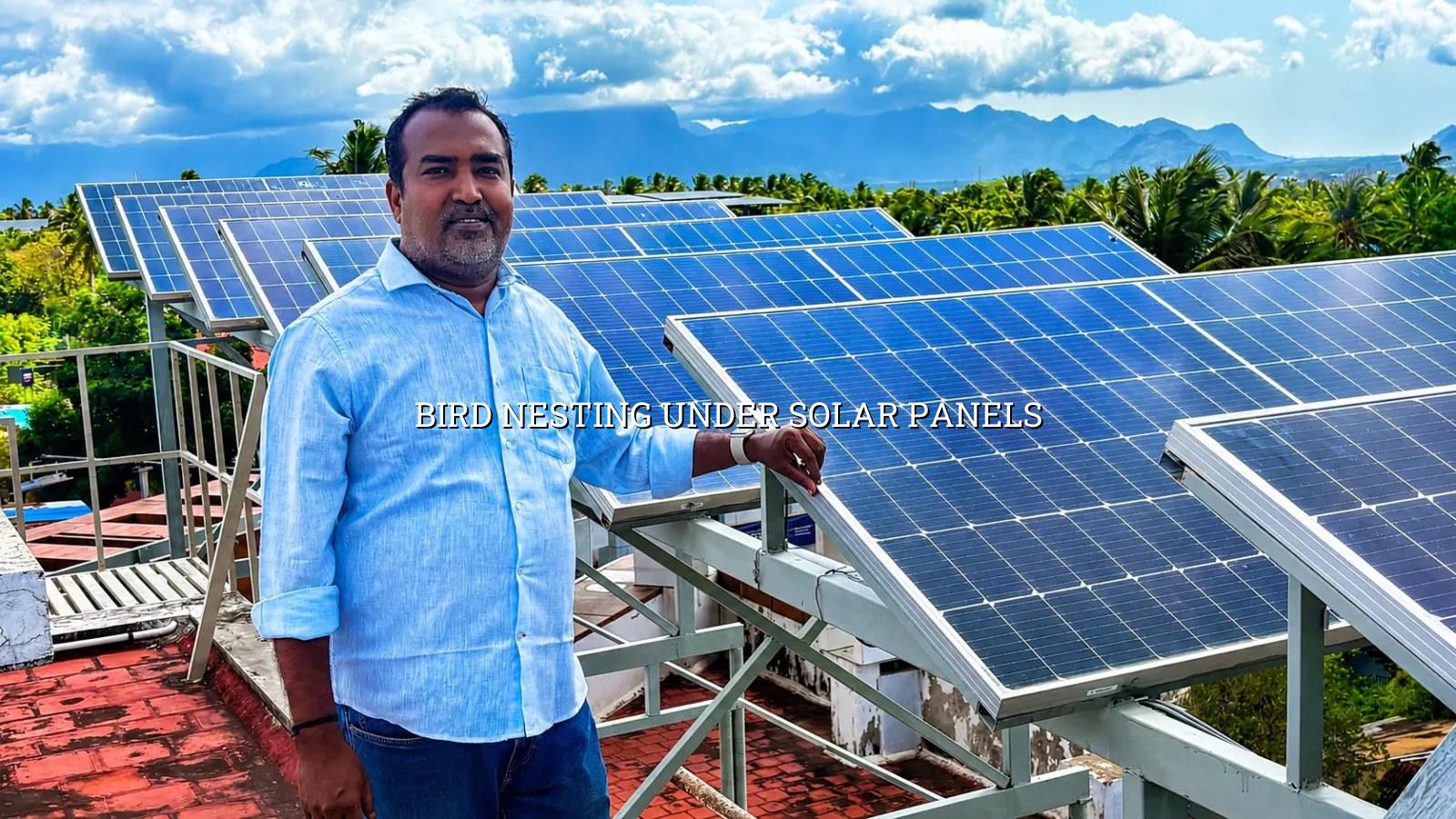
Bird nesting under solar panels usually starts quietly. A few twigs appear at the edge of one panel, then feathers, then the same birds keep coming back every morning, and by the time someone notices the mess the gap has already become a regular entry point. That is when a proper inspection matters more than a quick sweep.
Around Kanyakumari District we see this on RCC flat roofs, sloped tiled roofs and sheet roofs because the small sheltered space under a panel gives birds shade and cover. Wind matters too. On rooftops closer to the shore, from Manavalakurichi to Colachel, the mounting and edge details need a bit more care because salt-laden air and carried debris can make a loose opening worse over time.
Why it starts
Why bird nesting under solar panels happens so often
Birds are not choosing solar panels because they like solar. They want shade, shelter and a place that is not disturbed every hour. Once the first bit of nesting material is tucked into the edge, the space starts working like a small protected room.
Openings around the array edge
The most common starting point is a narrow gap between the panel frame and the roof surface. It can look harmless during installation, but birds only need a small opening to get in. On a tiled roof in Suchindram or Agasteeswaram, the roof shape can make the edge finish trickier than on a plain flat slab, so the closing method has to fit the structure rather than fight it.
Quiet, shaded space beneath the module
Birds like spots where wind is blocked and people rarely walk. Under a panel, they get cover from heat and rain, and the underside stays comfortable enough for them to return day after day. That sheltered area can also trap dust, dry leaves and droppings, and those bits keep feeding the problem if nobody checks the roof for a while.
- Start with the roof edge. Twigs, feathers and droppings below one panel line usually show where the nest is active.
- Listen in the morning. Scratching or fluttering under one section is often easier to hear than to see.
- Watch the birds return. Repeated visits to the same point tell you which gap they are using.
- Check after wind or rain. Monsoon weather can move loose material and expose the opening faster.
- Ask for inspection before removal. If cables or connectors are nearby, the work needs care and a proper check first.
What we check first
The parts that matter before cleaning the nest
We do not treat every bird problem the same way. Sometimes a careful clean is enough. Sometimes the roof needs a closing strip, mesh or a small change in the mounting layout. The right fix starts with finding the reason birds got in there at all.
Panel frames and airflow gaps
Solar panels do need space under them for airflow, but not an open cavity that birds can claim. When we inspect a rooftop in Kottar or Vadasery, we look at the frame height, the edge finish and whether the mounting line leaves an easy passage at the sides. If the opening is too wide, the answer is usually a physical closure, not just more cleaning.
Cables, connectors and loose debris
Nesting material can sit close to DC cables, junctions and clips, and that is where a sloppy clean turns into a bigger issue. We check whether the cable path has been disturbed, whether any connection is sitting in a damp pocket and whether roof debris is still collecting around the frame. On a sheet roof, drainage and sealing matter a lot because water can run under loose areas and leave a messy patch.
| What we see | What it may mean | What we usually check next |
|---|---|---|
| Twigs under one panel line | An active entry point at the edge | Gap size, closing strip and frame finish |
| Droppings on the roof below | Birds are landing there daily | Flight path, perch point and nearby shade |
| Scratching sounds at dawn | Birds may still be inside the array | Safe access, hidden nest material and wiring path |
| Loose leaves caught near the frame | The roof edge is holding debris | Drainage, sealing and whether the mounting line needs adjustment |
The work itself
How we handle bird nesting under solar panels
People often expect one quick trick, but the work usually follows a few careful steps. We inspect first, clear the nesting material safely, and only after that do we look at prevention. That order matters because the edge that let the birds in can be part of the same problem.
Our step-by-step method
We begin with a visual check from the ground and then move to a closer roof inspection if the site is safe and accessible. After that, we identify the entry gap and see whether the issue is limited to one panel line or spread across the array. If the nest is active, we clear it carefully and check the nearby wiring, clips and mounting points before closing the opening again.
On homes near the coast, say around Muttom or Rajakkamangalam, we also look closely at corrosion on brackets and fasteners because salt exposure can make older hardware look fine from a distance while the fixings are already tired. Inland, at places like Boothapandi or Thovalai, wind loading is often the bigger factor, so the prevention method can shift a little. Different roof, different answer. That is how it should be.
- We check whether the nest is active or abandoned before touching it.
- We look for hidden debris around the frame and cable entry points.
- We tell you honestly if the real issue is installation detail rather than birds alone.
- We suggest a prevention method that suits the roof type, not a one-size-fits-all fix.
- We test the system after the clean so you know the array is still behaving normally.
Stopping repeat visits
How to keep birds from returning to the same roof
Cleaning alone can remove the visible mess, but if the edge gap stays open the birds often come back. Prevention is usually a physical fix done properly and matched to the roof and mounting system.
Mesh, closing strips and edge finish
A well-chosen barrier can stop access without trapping heat or making the roof hard to service. The right option depends on how much space exists below the panel, whether the roof is tiled or RCC and how much wind the site takes through the year. In a commercial building at Thuckalay or Marthandam, access and maintenance routes matter too, so the solution has to stay serviceable.
Checks after monsoon or heavy wind
After the south-west and north-east monsoon periods, we recommend a quick look at the roof because loose debris can expose a gap that was hidden before. If the system is already due for solar maintenance, that is the right time to combine cleaning, inspection and a bird-entry check in one visit. Saves time and avoids repeat work.
What not to do
Do not stuff random material into the gap and call it done. It can block drainage or sit too close to cables. And please dont pull out an active nest with bare hands if you have not checked what is behind it, because a fast clean is not always a safe clean.
Roof conditions here
Why the same bird issue behaves differently from roof to roof
The district has strong sunshine, plenty of wind exposure and a mix of roof styles. That combination changes how bird nesting under solar panels shows up in real life.
A flat RCC roof in Nagercoil usually gives us a different access problem than a sloped tile roof in Kottar or Suchindram. On RCC, the edges and drains matter most. On a tiled roof, the shape and the fixing points matter more because birds can find a sheltered line under the panel where the tiles step down.
Near the sea, in areas like Colachel and Manavalakurichi, the air can carry salt that sits on the frames and hardware. That does not mean every site is damaged, but it does mean we check the small things closely. Loose clips, tired fasteners and open cable routes can all make a nesting problem harder to control if nobody looks at them on time.
Signs you should call for help
- Bird activity stays focused on one section of the array.
- You see nesting bits on the roof every week or so.
- There is a smell or visible staining under the panel line.
- The inverter is fine, but the roof around the array looks messy and ignored.
- Water drainage around the mounting line looks blocked after rain.
How JRS SunTech Energy can help
How JRS SunTech Energy can help with bird nesting under solar panels
We inspect rooftop solar systems across Kottar, Nagercoil and the nearby district area, and we handle cleaning, correction and preventive maintenance for systems we installed as well as systems installed by others. If the issue is only bird nesting under solar panels, we will say so. If the mounting detail, cable routing or roof edge needs attention, we will point that out and help you sort it properly.
Our team also guides customers on the right next step for on-grid solar, off-grid solar and hybrid solar systems, because the best fix often depends on the roof layout and the way the array was built. For a house, shop or farm site, we start from the actual roof and the actual problem.
JRS SunTech Energy, Door No. 227, First Floor, Cape Road, St. Xavier's Church Junction, Kottar, Nagercoil, Kanyakumari District, Tamil Nadu - 629002. Phone: 9787775999. Email: jrssuntechenergy@gmail.com.
Frequently asked
Questions people ask us about bird nesting under solar panels
The usual signs are twigs, feathers, droppings on the roof below and birds returning to the same panel line again and again. Sometimes you also hear scratching early in the morning. A small drop in generation can happen too, but people usually spot the mess first.
Yes, it can. Nest material blocks airflow, traps dirt and may sit too close to cables or connectors if the gap is left alone for too long. We inspect carefully before removing anything so the wiring and mounting parts are handled properly.
Try not to pull the nest out by hand. Note where the birds are entering, what kind of roof you have and whether the system still looks normal from the inverter side. That gives us a better idea of the work before we come.
Yes, we can. We inspect and service systems installed by others too. If the problem is only nesting and dirt, we say that plainly. If we find loose clips, open cable routes or a mounting gap that needs attention, we point that out as well.
We look at the entry gap, the edge finish and the way the array sits on the roof. The fix may be a mesh, a closing strip or a small change in the mounting layout. The right answer depends on the roof and the frame height, so we check it on site first.
Yes. Our office is in Kottar, Nagercoil and we travel across the district for inspection, cleaning and preventive solar maintenance. A tiled roof in Vadasery or Suchindram may need a different approach from a plain sheet-roof site.
Related services
Other pages that may help
If the bird issue came up during a broader roof check, these pages are useful next steps: solar maintenance, products, solar solutions, and contact. If the system still needs planning after the clean, you can also review on-grid solar or hybrid solar depending on how the site is used.
For customers asking about approvals or subsidy guidance, the subsidy page and the local solar company Nagercoil page are a good starting point.
Hurry up!Subsidy ends 31 March 2027 · 134 days left
Next step
Need help with birds nesting under your panels?
Send us a photo of the roof edge, the panel line and the spot where you hear or see bird activity. We will tell you the next step and whether a clean, a repair or a preventive fix makes sense.
- Your electricity requirement and 60-day EB bill
- Property type — home, shop, office, farm or institution
- Backup requirement and available roof space
Related: Solar Maintenance · Contact · All Topics
Free site survey · Kottar, Nagercoil