Solar for farms
Off-Grid Solar for a Remote Farm
A practical way to keep pumps, lights and small farm loads running where the EB line is weak, absent or just not dependable.
Farm solar planning
Off-Grid Solar for a Remote Farm That Matches the Actual Load
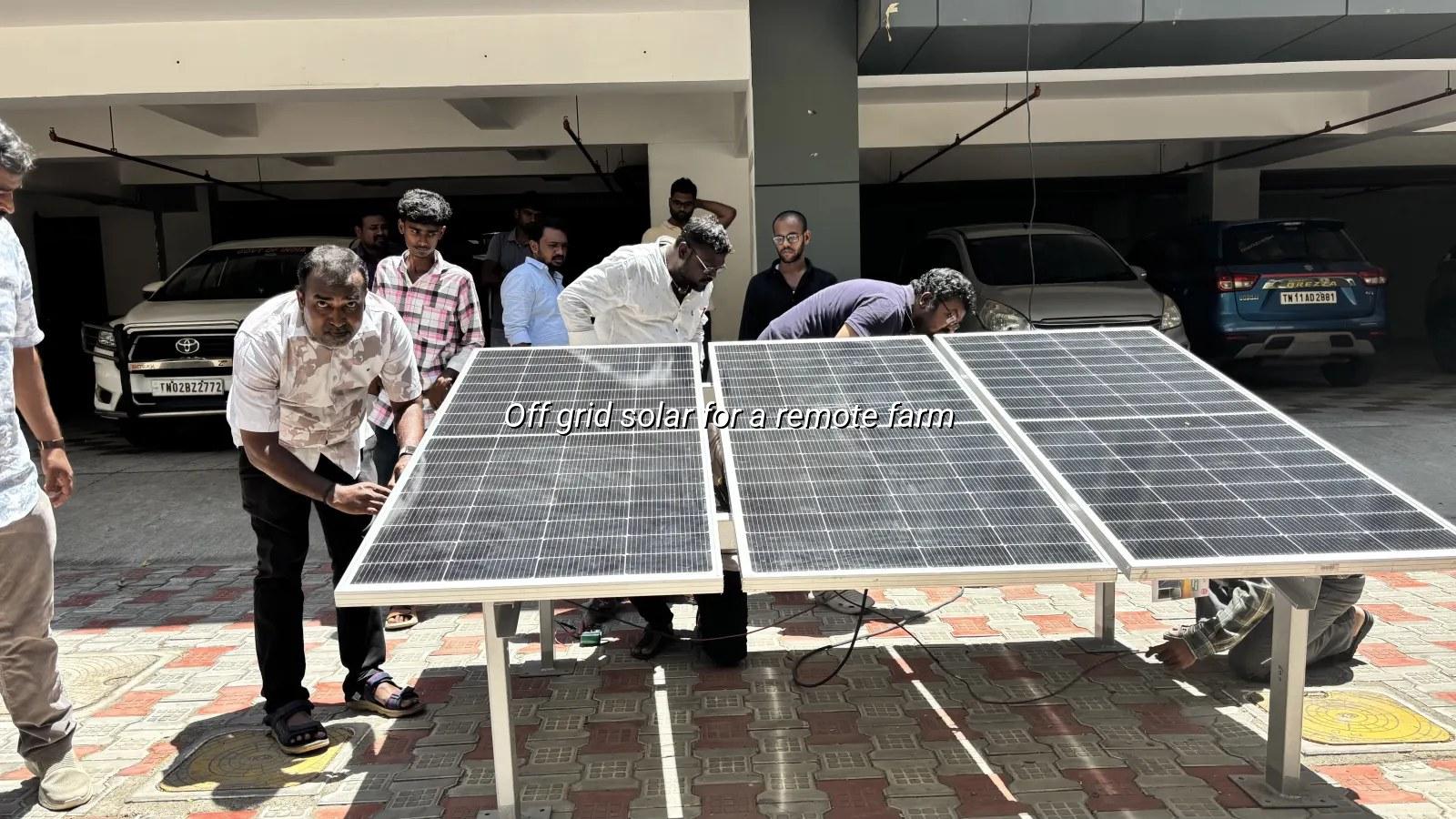
Off-grid solar for a remote farm works best when it is planned around the real chores on the site, not around a fixed product sheet. We start with the pump, the lights, the shed loads and the hours you expect to use them, then we check whether batteries, a larger inverter or a different wiring layout makes sense. A farm with a borewell near Thovalai will not be treated the same as a smaller holding closer to Pechiparai, because the water duty, cable run and shade pattern can be very different.
In Kanyakumari District, the sun is there for most of the year, but wind, salt air and monsoon spells still matter. That means the mounting structure, cable sealing and battery location need more thought than many people expect, especially on open land where the wind gets a clear run. We also keep the EB connection issue in mind if there is a weak line on site, since some farm owners still want the option of a future tie-in even when the first setup is fully independent.
What the farm needs
What off-grid solar has to cover on a working farm
A remote farm is not one load. It is a mix of starting current, running hours, weather exposure and the way people actually use the place. If the pump starts in the morning and the lights stay on in the evening, those are two very different demands. If the farm also has a small store room or guard point, that changes the battery sizing again.
Pumps, water and daily timing
For many farms, the first question is the pump. A borewell in the Thovalai side of the district may need a different arrangement from a shallow well or a transfer pump because the head, pipe length and start-up surge all matter. We check whether the pump can run directly from solar during the day, or whether battery-backed operation is needed for early morning or late evening work.
Lights, small tools and backup use
Once you add shed lights, fence lighting, chargers or a tiny office load, the farm starts asking for more than pumping alone. That is where off-grid solar for a remote farm becomes useful, because one system can carry several small needs without depending on the EB line. On a spread-out plot near Munchirai or Eraniel, that can be easier than running a generator every time there is a short job at night.
- The pump starting current is checked before we suggest an inverter size.
- Battery placement matters on farms, especially where heat and dust build up quickly.
- Open land near the coast needs better corrosion protection on hardware and connections.
- Shade from trees, sheds or a tin roof can change the array layout more than people expect.
- A strong wind load often means the mounting structure needs heavier bracing than a house roof.
How we size it
The steps we follow before we recommend a farm system
We do not start with a product brochure. We start with your actual site and the way the farm runs through the day. The order matters, because one wrong assumption can leave you with a battery bank that is too small or a pump that starts badly. The process is simple, and it saves a lot of back-and-forth later.
- We note the loads. That means pumps, lights, sockets, any shed equipment and the hours each load is used.
- We inspect the site. Roof, ground space, shade, cable path, battery room and the condition of the pump house are all checked.
- We match the inverter and battery plan. The system has to support the real load pattern, not just a nameplate figure.
- We plan the mounting and wiring. On an open farm field near Boothapandi or Aralvaimozhi, wind strength and cable protection become part of the design.
- We commission and explain the use. You should know how the changeover works, what to watch during monsoon periods and who to call if something feels off.
Why site conditions matter more in a farm than in a house
A house roof in Kottar or Vadasery has its own problems, but a remote farm brings different ones. The ground is open, dust can be higher, and the equipment may be far from the place where people stay. If the site is close to the coast, the salt-laden air can affect frames, fasteners and terminals, so we pay extra attention to the hardware we use. If the site sees strong wind, we think about bracing and fixing points before we think about the panels.
Monsoon months also change how the site behaves. Drainage around the battery or control area needs to be sensible, and cable entries should be sealed properly so water does not creep in later. It's a small thing until the first heavy rain shows you it was not small at all.
System choices
Choosing between off-grid solar, a pump system and hybrid backup
Some farms only need water. Others need water plus a little power for night work or storage. That is why we compare the options instead of pushing one standard setup. If the main job is irrigation, a solar water pump may be enough. If the farm also needs backup power, off-grid or hybrid solar can be the better fit.
| Option | Best for | What it covers | When we suggest it |
|---|---|---|---|
| Off-grid solar | Remote farms with no dependable EB line | Pumps, lights, sockets and battery-backed use | When the farm needs power independence through the day and night |
| Solar water pump | Irrigation-focused farms | Water pumping only | When water is the main need and the rest of the loads are small |
| Hybrid solar | Farms with partial grid supply | Solar, battery and EB support together | When you want backup plus the option to use the grid when available |
| Inverter with batteries | Small farm sheds or control rooms | Backup for limited loads | When the farm does not need a full solar array but still needs reliable power |
We often see people in Karungal and Marthandam assume that a larger battery always solves the problem. It does help in some cases, but only if the inverter, charging source and daily usage all line up. A battery that is too big for the charging source can be just as awkward as one that is too small, so the whole system needs to be balanced.
Useful checks
What to look at before you place an order
If you are planning off-grid solar for a remote farm, a few checks make the whole job cleaner. First, count the loads honestly. People usually remember the pump and forget the light near the store room, the charger in the office or the extra socket by the gate. Second, look at the roof or ground space as it is today, not as you hope it will be after the next repair.
Third, check the cable route. Long cable runs are common on farms, and that means voltage drop, protection and sealing matter more than they do on a compact house installation. Fourth, think about where the battery or control equipment will sit during hot afternoons and during rain. A dry shaded room is better than a corner that collects heat.
A few practical things we tell farm owners
- Keep the inverter and batteries away from damp storage corners.
- Ask for hardware that suits coastal or open-field exposure if the site is near the shore.
- Do not size the system only on one good day; look at how the farm behaves across the week.
- Make sure the pump starting method is confirmed before installation day.
- Leave room for maintenance access so cleaning and checking are not a chore later.
We also think about the farm road, because access affects installation and future service. If the route gets muddy in the monsoon, or if the site is tucked away behind crop land, that changes how we bring the materials in and where we place the equipment. Small detail, big difference.
How JRS SunTech Energy Can Help
Farm systems planned for real use, not just for paper specs
We size off-grid systems by looking at your farm's actual EB situation, water need, roof space and battery placement options. That approach is useful whether the site is a small holding near Aralvaimozhi or a larger plot closer to Pechiparai, because the layout and the load profile tell us more than a brochure ever will. We also guide you through the installation, EB-related paperwork where it applies, and the practical side of using the system day to day.
Our team handles solar panels, inverters, batteries, solar water pumps, DC cabling and complete hybrid solar packages, so you do not have to patch together parts from different places. If you want honest advice on whether you need off-grid solar, a solar water pump or a hybrid setup, speak to us and we will go through it with you.
Contact JRS SunTech Energy, Door No. 227, First Floor, Cape Road, St. Xavier's Church Junction, Kottar, Nagercoil, Kanyakumari District, Tamil Nadu - 629002. Phone: 9787775999. Email: jrssuntechenergy@gmail.com.
Frequently asked
Questions farm owners ask us about off-grid solar
It depends on the pump, the daily loads, how long you need backup and where the equipment will sit. We look at the farm as it is, not as a brochure picture, then we match the inverter, batteries, cabling and mounting to that real use.
Yes, that is the point of an off-grid system. The solar array charges the batteries and the inverter feeds the loads, so the farm can keep working even when there is no usable grid supply.
Common loads are pump sets, shed lights, security lights, charging points and a few sockets for small equipment. If you want to run a motor or pump, we first check the starting current and the actual duty cycle so the system is sized properly.
If the main need is irrigation, a dedicated solar water pump may be enough. If the farm also needs lights, charging points or backup for a small office, off-grid solar is often the better fit because it can cover more than one use.
We work across Kanyakumari District, including farm areas around Thovalai and Pechiparai, and the site visit matters more than the town name. A borewell site, a pump house and a shaded plot all lead to different choices for the structure, cabling and battery placement.
We provide one year of free service support after installation, then continued technical help as needed. If something seems off later, we check whether it is a cleaning issue, a connection issue or a part that needs attention, and we tell you straight.
Hurry up!Subsidy ends 31 March 2027 · 134 days left
Next step
Need a farm setup that fits your actual load?
Send us your pump details, the loads you want to run and a few photos of the site, and we will suggest a practical off-grid solar plan.
- Your electricity requirement and 60-day EB bill
- Property type — home, shop, office, farm or institution
- Backup requirement and available roof space
Related: Solar Water Pumps · Hybrid Solar · Contact
Free site survey · Kottar, Nagercoil