Agricultural solar
Solar Pumping for a Coconut Farm
A practical way to plan water lifting for coconut fields using the right pump, borewell match and site conditions.
Farm water planning
Solar pumping for a coconut farm starts with the water source, not the panels
Solar pumping for a coconut farm works best when the design begins with the actual well, borewell or sump and the way the field is irrigated day to day. If the pump is chosen before those details are clear, the system can look fine on paper and still be awkward on the ground. We keep it practical from the start.
In Kanyakumari District, coconut farms are often a mix of old and new field conditions. Some plots in Kottar or near Nagercoil have a simple layout and a neat access road, while others closer to the coastal side need extra care because of salt-laden air and the way wind moves across open ground. Year-round sunshine helps, but the south-west and north-east monsoon periods still matter because drainage, cable sealing and mounting choices can decide how easy the system is to live with later.
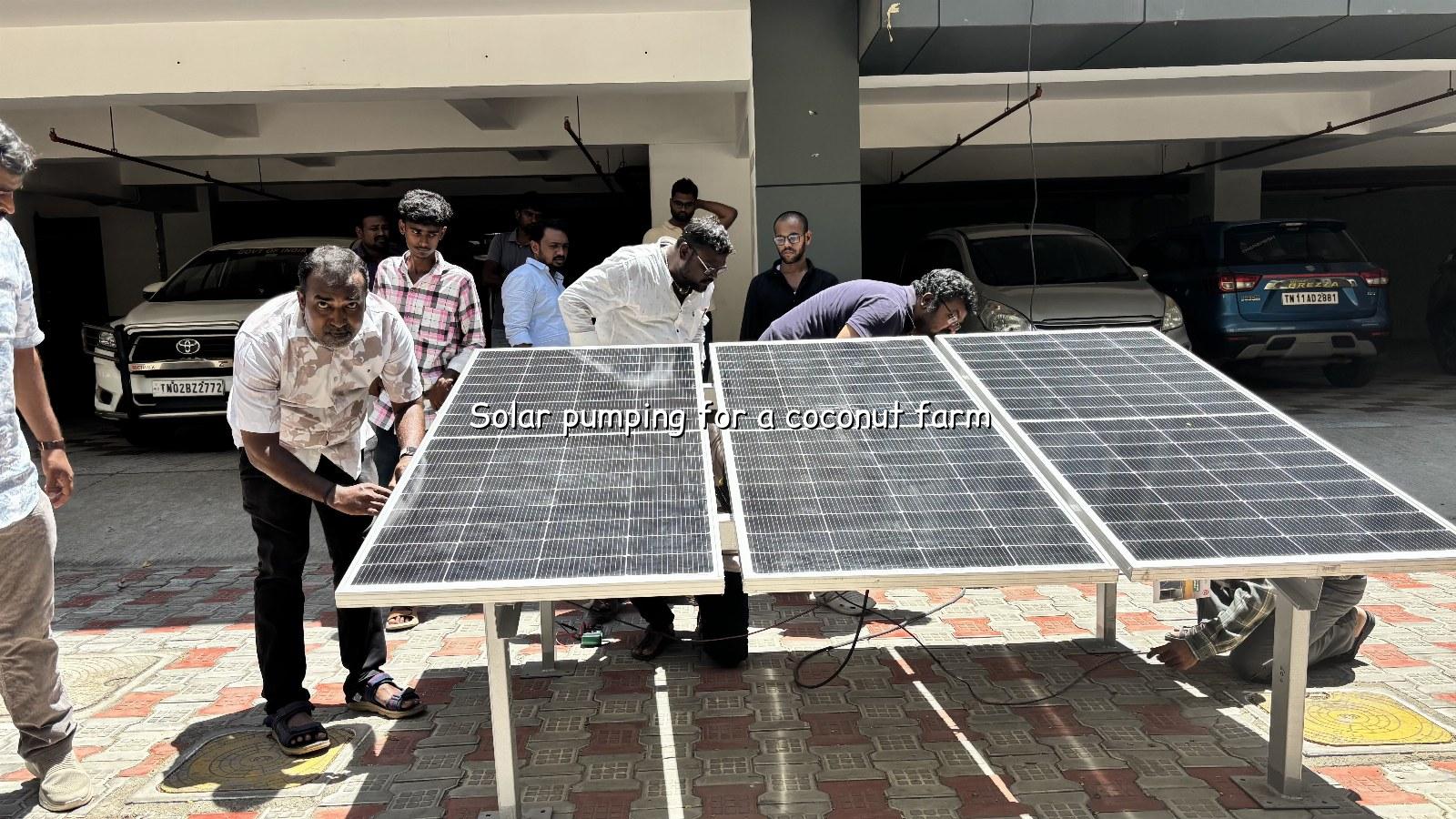
Field first
What a coconut farm pump design has to match
A coconut farm is not a factory floor. Water may need to travel a long way from the source, the rows may be spread out, and the farmer may want to store water first before sending it to the trees. That means the pump, the solar array, the cables and the mounting structure all have to fit the real site.
The water lift tells the truth
The first thing we check is how far the water actually has to move. Borewell depth is one part of that, but it is not the whole story. The static water level, the total vertical lift, the pipe run and the point where water is finally used all change the load on the pump. A system that looks oversized from a distance may still be the right one if the field needs a longer lift.
The field layout decides the installation
Coconut farms often need clear access for maintenance, and that gets missed when the layout is rushed. In places like Boothapandi and Pechiparai we see fields where the panel space, the water line and the walking path all fight for the same patch of ground. The better answer is the one that leaves room for cleaning, checks and simple repairs without disturbing the crop.
- Start with the source. We look at whether the farm uses a borewell, open well or sump before anything else.
- Measure the lift. The pump has to suit the real head and the route the water will take.
- Check where the array can sit. Ground space, shade and access all matter on a working coconut farm.
- Plan the wiring and sealing. Monsoon rain and dusty field conditions both punish loose connections.
- Keep maintenance reachable. If panels or pump parts are hard to reach, people put off simple checks.
Pump options
Which solar pumping setup fits the crop and the site?
The right arrangement depends on how the water is used, what the field can support and how much control you want over the irrigation timing. For some farms, a direct solar pump is enough. Others need a storage tank, a different controller or a setup that keeps the EB connection for separate loads.
| Setup | Best use on a coconut farm | What we check first |
|---|---|---|
| Direct solar pump | Fields where water can be lifted during daylight and used or stored right away | Source depth, daily water need, panel space and pipe route |
| Solar pump with storage tank | Farms that pump in the day and irrigate later, when field work is easier | Tank location, overflow route, height and distribution pattern |
| Solar pump with controller | Sites that need smoother start-up and better protection for the motor | Motor type, cable distance, controller fit and enclosure placement |
| Hybrid field power arrangement | Farms that want solar for pumping but still use the EB connection for other loads | Load split, pump use pattern and the existing electrical layout |
Ground mounting often makes more sense than roof mounting on a farm, especially when the trees cast moving shade through the day. A coconut field near Aralvaimozhi can also face stronger wind than a more sheltered inland plot, so the frame and fasteners need a firmer approach. Near the coast, hardware and terminations should be chosen with salt air in mind, because the cheap indoor style parts do not last well there.
The season matters too. During the monsoon, water can gather in places that were dry the week before, and that is when sealed cable runs and proper drainage start to show their value. It’s also why we ask about who will use the system every day, because a controller nobody can reach or understand tends to get ignored.
- Panel placement should leave a clear path for cleaning, not just enough room for the first installation.
- Mounting hardware needs to suit wind exposure and the open layout of the farm.
- Junction boxes and cable joints must be sealed before the rainy season, not after water finds them.
- Long pipe runs should be checked with the pump, because distance changes what works well.
- If the farm sits close to the shore, salt-laden air becomes a real maintenance factor.
How it runs
The steps we follow on a coconut farm project
We keep the process simple because farm work already has enough moving parts. The point is to find the right fit before anything is fixed in place.
From first call to commissioning
- Contact us. You tell us about the field, the source of water and how the current EB connection is being used.
- Free site survey. We visit the farm, check the slope, look at available space and see how the cable route can run.
- System design and quotation. We match the pump, the solar layout and the supporting electrical parts to the site conditions.
- Installation. Our team handles the mounting, pump setup and electrical work with care for the farm environment.
- EB and documentation. We guide the paperwork and any related process that needs to be handled.
- Commissioning. We test the system on site and check that the water flow is behaving properly.
- After-sales support. You get one year of free service support after installation, and we keep giving technical help after that.
What changes the recommendation
A farm in Kottar with easier access can be simpler to work on than a plot tucked behind several other boundaries, but access is only one part of the decision. The bigger factors are the pump head, the field layout, the shade pattern and the way the water is distributed after it is lifted. If any of those are off, the system will ask for more attention than it should.
The first conversation gives us the outline. The survey fills in the gaps. That is usually where the real answer appears, because solar pumping for a coconut farm is rarely about choosing a single component and calling it done.
Local conditions
Why the district changes the way the system is built
Kanyakumari District gives you strong sunlight, which is great for pumping, but it also gives you wind and coastal conditions that need respect. A farm nearer Thovalai may need a different mounting approach from one closer to Kulasekharam, simply because the wind load and shelter are not the same. That is why we never assume a farm from one part of the district will behave like another.
Near Munchirai, salt-laden air can be part of daily life, so we pay close attention to the hardware and the electrical connections. In open farm land, the pump controls and the array should be easy to reach, because maintenance that is awkward to do will usually be delayed. Then a small issue turns into a bigger one.
If the farm already has an EB connection
We can still design around it. Many coconut farms use solar for pumping and keep the EB connection for other needs on the property. That can make the layout cleaner and keep the pump load separate from everything else. If you are still comparing options, our pages on solar water pumps, off-grid solar and hybrid solar are useful next reads.
How JRS SunTech Energy Can Help
We plan around your farm, not around a standard package
For solar pumping for a coconut farm, we begin with the source, the water need and the way your field actually works. JRS SunTech Energy is based at Kottar, Nagercoil, and we serve coconut farms across Kanyakumari District with site visits, design, installation and the EB and documentation side when it comes up. If your field is windy, coastal or tucked into a more sheltered inland pocket, we factor that into the recommendation.
We also handle related solar work such as solar water pumps, inverters, batteries, solar water heaters and maintenance on existing systems. After installation, you get one year of free service support, and we continue with technical help after that based on the product and the installation. If you want a direct answer, send us your farm details and we’ll take it from there.
JRS SunTech Energy, Door No. 227, First Floor, Cape Road, St. Xavier's Church Junction, Kottar, Nagercoil, Kanyakumari District, Tamil Nadu - 629002. Phone: 9787775999 | WhatsApp: Chat on WhatsApp | Email: jrssuntechenergy@gmail.com
Frequently asked
Questions we hear from farm owners
We size the system around your water source, pump head and how much water the field needs through the day. In most coconut farms, the key is matching the pump to the borewell or open well, then checking cable run, panel placement and the field layout before we suggest anything.
Yes, as long as the pump and storage plan fit the way your field is used. Some farms need a steady lift in the morning and again later in the day, while others depend on drip lines or a small tank, so we look at the actual pattern instead of guessing.
Start with water source depth, seasonal water level, available land for panels and the condition of the electrical side. If the site is in a windy inland pocket near Aralvaimozhi, or a more exposed farm near Thovalai, the mounting structure needs that kind of local care.
We do site visits across Kanyakumari District and plan around the field, not just the pin on a map. For farms near Boothapandi or Pechiparai, the slope, access road, shade from trees and cable route all matter before we finalize the design.
Mostly clean panels, a check on the pump and an inspection of cable joints, earthing and mounting hardware. Farms close to the coast need a closer eye on salt air and fasteners, and we can also service existing systems installed by others.
Hurry up!Subsidy ends 31 March 2027 · 134 days left
Next step
Need a pump plan for your coconut farm?
Send us the water source detail, field location and a quick note on how you irrigate now, and we ll tell you what looks sensible.
- Your electricity requirement and 60-day EB bill
- Property type — home, shop, office, farm or institution
- Backup requirement and available roof space
Related: Solar Water Pumps · Products · Contact
Free site survey · Kottar, Nagercoil