Solar guide
Solar for a Poultry Farm
Practical solar planning for sheds, pumps, lighting, fans and backup needs on farms across Kanyakumari District.
Farm solar planning
Solar for a Poultry Farm That Fits the Shed, the Load and the Site
Solar for a poultry farm works best when it is sized from the way your farm really runs, not from a fixed package someone wants to sell you. We start with the EB bill, the roof or ground space you have, the loads that must stay on, and the conditions on the site before we talk about a system.
That matters a lot in Kanyakumari District. Poultry sheds here often sit on RCC roofs, light steel structures or sheet roofs, and the wind can be stronger than people expect, especially around Thovalai and Boothapandi. Coastal air also changes the kind of mounting hardware and connection protection we use, while farms near Colachel need extra care for corrosion and cable sealing. You do not want a system that looks neat on paper but becomes troublesome after the first monsoon.
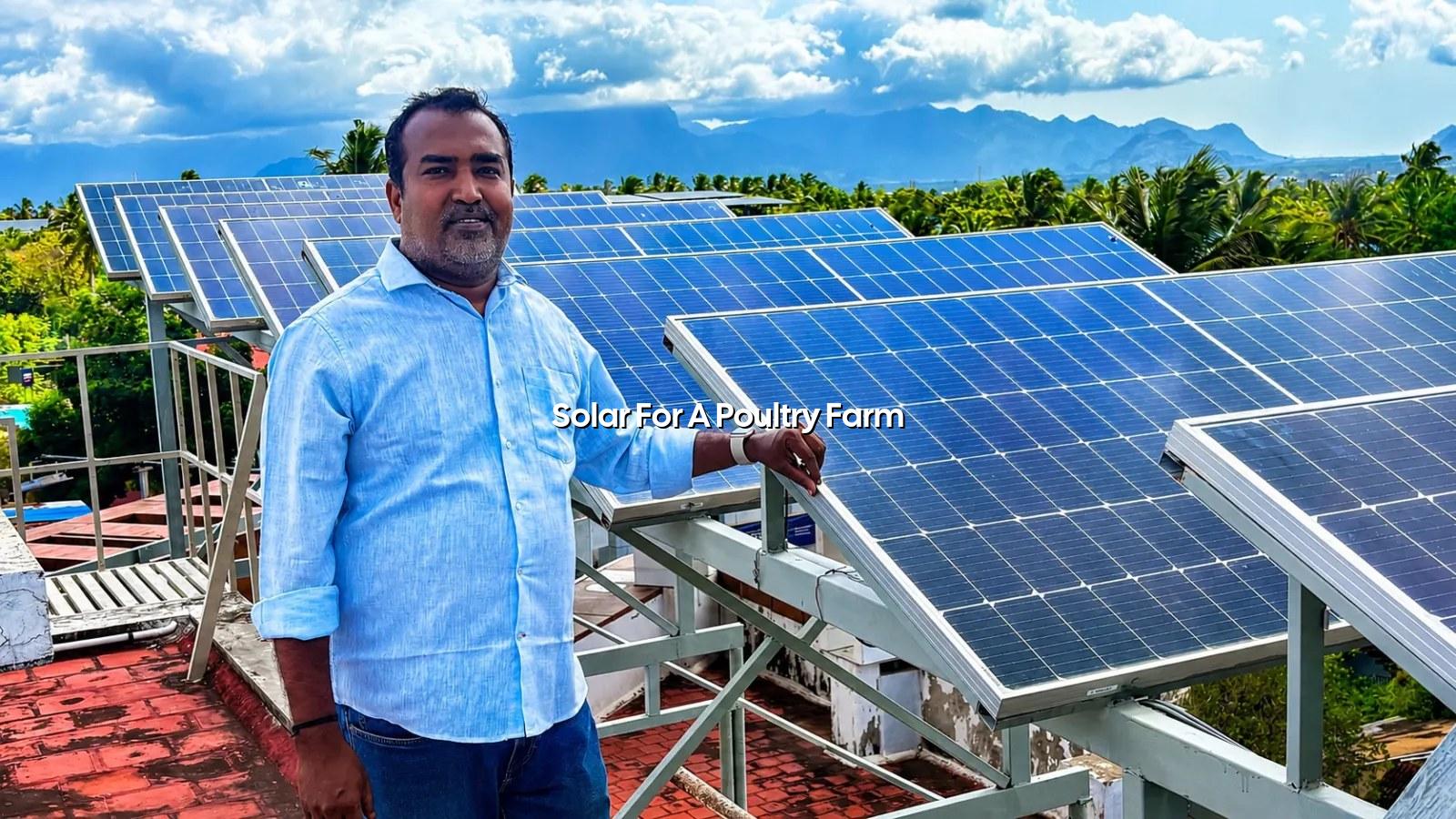
What farmers need
What a Poultry Farm Actually Needs From Solar
Poultry farms are steady, load-heavy sites. They are not like a house where power demand changes only a little through the day. The system has to respect the shed environment, the 60-day EB cycle, the need for backup, and the fact that one loose connection can create more trouble than people first think.
Daytime power for essential loads
In most farms, the first goal is to cover daytime loads such as fans, lighting, water pumps and other routine electrical needs. Solar can help cut down the units bought from the grid while the sun is strong, and Kanyakumari District gets useful sunlight through most of the year. We still check shade carefully because a single tree line or a nearby shed can pull the output down more than expected.
Backup where the shed cannot stop
Some poultry operations need backup for sensitive periods, and that is where a hybrid system or battery support may make sense. We do not push batteries just because they sound useful. If your farm in a place like Eraniel or Munchirai only needs help during short outages, we may suggest a simpler arrangement and build up from there later.
- We size from real loads, not from a brochure.
- Roof strength and wind exposure are checked before any layout is final.
- Salt-laden air near the coast needs better protection for hardware and wiring.
- Drainage and cable sealing matter during the monsoon months.
- On-grid, off-grid or hybrid choice depends on what your shed actually needs.
Sizing and selection
How We Size Solar for a Poultry Farm
The right system starts with questions you can answer from the site, not with guesswork. We want to know what the farm uses in a normal 60-day billing cycle, what must stay on through the day, how much roof area is usable, and whether the structure can take the mounting load. If those pieces are not clear, the design will be shaky from the start.
- Review the EB bill and load pattern. We check how many units the farm is using and what those units are tied to on the shed.
- Study the roof and structure. RCC flat roofs, sloped tiled roofs and sheet roofs all need different mounting decisions.
- Look at shade, wind and access. A site near Aralvaimozhi can see stronger wind conditions, so fixing and spacing have to suit the place.
- Choose the right system type. On-grid, off-grid or hybrid is chosen based on how much backup and flexibility you need.
- Plan wiring, protection and drainage. This is where many poor installs fail later, especially if the site sees heavy rain or salt air.
Most customers want a simple answer on the first call. Fair enough. We usually tell them the same thing: if the shed is sound, the roof is open and the loads are daytime-heavy, solar can work very well. If the shed needs structural correction or the wiring is already tired, we say that plainly before any quotation is issued.
System choices
Which Solar Setup Fits a Poultry Shed?
Not every poultry farm needs the same arrangement. An on-grid system is often suitable when the farm has a regular EB connection and most of the use happens during daylight. If the site has unstable supply or the owner wants a stronger backup layer, a hybrid arrangement may be a better fit. Off-grid systems make sense where the farm is more remote or where the grid supply is too unreliable for the daily work pattern.
In Manavalakurichi and Muttom, we are extra careful about salt exposure and the condition of the fixing points. In inland areas such as Boothapandi, wind loading can matter more than corrosion, so the structure details shift a bit. That is the real work, and it is why we prefer site visits before anyone makes a final call.
| System type | Best suited for | What we focus on |
|---|---|---|
| On-grid solar | Farms with steady EB supply and daytime usage | Load match, roof layout, safe interconnection |
| Hybrid solar | Sites that need backup as well as solar support | Battery planning, changeover logic, protection gear |
| Off-grid solar | Remote farms or unreliable grid locations | Storage sizing, battery management, autonomy needs |
| Solar with pumping support | Farms that also need water movement or nearby irrigation | Pump duty, line losses, motor starting behaviour |
The table is only a starting point. A shed with a good roof in Kottar will not be treated the same way as a farm building near the coast, and neither will be treated the same way as a long sheet-roof structure with patchwork repairs already on it. Real site conditions decide the final design.
Installation and upkeep
Installation Details That Matter on a Farm
Solar on a poultry farm is only as good as the small details. Cable runs need to stay neat and protected. Junctions need proper sealing. The structure has to stay firm in wind. And if the building is near the coast, you need fittings and connections that age better in salty air.
Roof type changes the job
A flat RCC roof gives us different options from a sloped tiled roof, and a sheet roof needs a different approach again. On a sheet-roof shed, access and fasteners need extra care because the fixing points are more exposed. We also look at how the roof drains during rain, since standing water and poor cable routing lead to annoying faults later.
Maintenance is not an afterthought
Dust, droppings, wind-blown debris and humidity can all affect output. That is why we include service planning from the start. We provide one year of free service support after installation, and after that we continue technical assistance as needed, with terms depending on the product, manufacturer warranty and the installation itself. If a fault looks like repair rather than replacement, we say that plainly. No drama.
- Keep cable sealing tight where the roof meets the wall.
- Check that mounting hardware suits the local wind load.
- Use the right structure finish where salt air is present.
- Plan enough access for cleaning and inspection without disturbing the shed.
- Inspect the inverter and electrical connections after heavy rain periods.
Our process
How We Handle a Poultry Farm Project, Start to Finish
We keep the process simple. You contact us, we look at the site, and then we build the proposal around the actual farm. There is no point pretending every farm should get the same answer. A poultry unit in Kottar with good roof space and clean access is one thing, while a rural shed with shade and older wiring is something else.
What happens after you call
First, we collect the basics: your location, the EB bill, and a rough idea of what the farm runs every day. Then we arrange a free site survey. After that comes system design and quotation, followed by installation, EB and documentation work, commissioning, and after-sales support. That flow keeps the job clear and avoids the usual back-and-forth that wastes time.
If the project is suitable for the applicable government solar programme, we guide you through the documentation path and the steps that need to be done carefully. We do not overstate anything. We simply explain what is possible, what is required and where the paperwork sits in the whole process. That is usually what customers want most.
Useful things to keep ready
Before the survey, keep the recent EB bill, any roof drawings if you have them, and a clear view of the shed area. If there are old repairs on the roof or a known leak point, tell us. A lot of small issues are easy to plan around when we know them early, and that saves time later on.
How JRS SunTech Energy Can Help
How JRS SunTech Energy Can Help With Solar for a Poultry Farm
We work from our office in Kottar, Nagercoil, and we handle farm sites across Kanyakumari District with the same practical approach every time. Our team checks the roof, the load pattern, the electrical setup and the local site conditions before suggesting a system, so you get something that fits the shed instead of a generic package. We also handle subsidy guidance where it applies, plus the EB and documentation steps, and we stay available after installation if you need support.
If you're planning solar for a poultry farm, send us your bill details and site location and we will take it from there.
Contact JRS SunTech Energy, Door No. 227, First Floor, Cape Road, St. Xavier's Church Junction, Kottar, Nagercoil, Kanyakumari District, Tamil Nadu - 629002. Phone: +91 97877 75999. Email: jrssuntechenergy@gmail.com.
Frequently asked
Questions People Ask Before Putting Solar on a Poultry Farm
Yes, that is usually the first question people ask. Solar can support lighting, fans, water pumping and other daytime loads while reducing the units you draw from the EB connection. We look at your actual load pattern before we suggest anything because poultry farms are not all the same.
We check the shed roof, structure, available shade, wiring route and the condition of the electrical panel. On farms near Thovalai and Boothapandi, wind exposure matters a lot, so the mounting structure has to be planned properly from the start.
Not always. If your main use is daytime operation, an on-grid or hybrid system may be enough depending on the site and backup need. If you need support for longer outages, a battery can be added after we understand the real requirement.
It can, but the hardware choice matters more in salty air. In places like Colachel and Muttom, we pay close attention to structure finish, cable sealing and connection points so the system is easier to maintain.
We start with the EB bill, the 60-day usage pattern, roof area and the loads that must stay on. Then we match that with site conditions, because a farm with good roof space and open sun is very different from one with partial shade or a weak shed frame.
We can guide you through the applicable government solar programme process where it fits, and help with the documents and installation steps. The exact path depends on the type of connection and current programme rules, so we explain that clearly before you start.
Hurry up!Subsidy ends 31 March 2027 · 134 days left
Next step
Thinking about solar for your poultry farm?
Send us your EB bill, shed details and site location, and we will check what fits your farm.
- Your electricity requirement and 60-day EB bill
- Property type — home, shop, office, farm or institution
- Backup requirement and available roof space
Related: Solar Solutions · Subsidy Guidance · Contact
Free site survey · Kottar, Nagercoil