RCC roof guide
Solar Panels on an RCC Flat Roof
What to check before you fix panels on a concrete terrace, and how we plan the structure, drainage and wiring around your actual roof.
Rooftop planning
What solar panels on an RCC flat roof really need
Solar panels on an RCC flat roof can work very well, but only when the roof is treated as a structure first and a solar site second. That sounds simple, yet a lot of poor installs start with the panels and end with leaks, bad cable runs or a row that blocks drainage. We look at the slab, the waterproofing, the parapet height and the way the sun moves across the terrace before we say yes to a layout.
In Kottar and across nearby homes, RCC terraces are common, so the question is rarely whether solar can fit. It usually comes down to how the mounting will sit on the roof, how much clear space you really have after tanks and stair rooms are accounted for, and whether the building can handle the frame arrangement you want. On an open terrace in Nagercoil, wind and heat matter too, and on a coastal roof near Colachel the salt air changes the hardware choice.
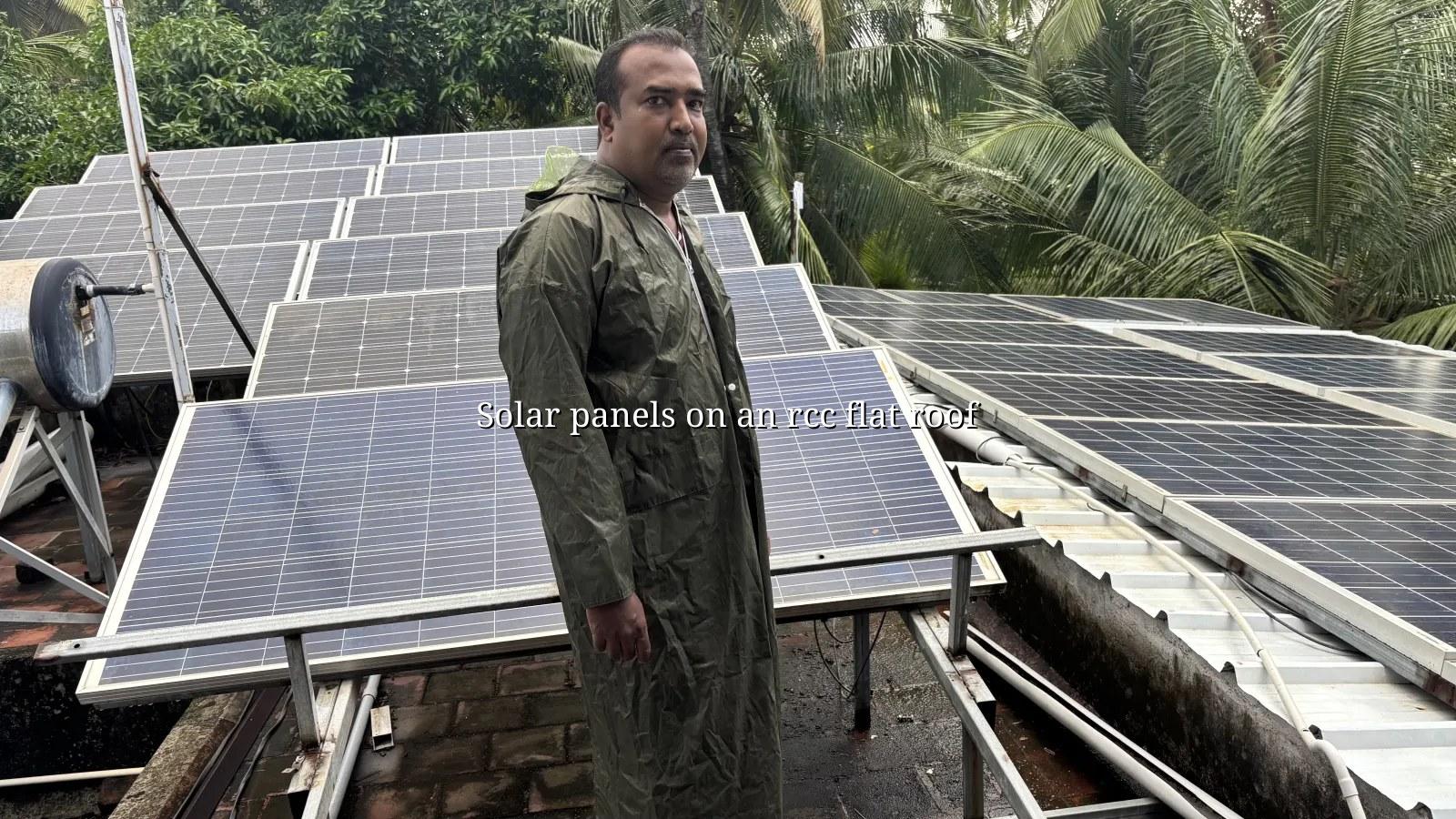
Roof checks
How we judge an RCC terrace before we recommend a system
We do not start from a standard drawing. We start from the roof you actually have, because two RCC flat roofs can behave very differently once you look closely at cracks, slope, shade and access.
Structure, slab condition and access
A good RCC terrace for solar needs more than empty floor area. We check the slab condition, any visible seepage marks, old waterproofing layers and whether the terrace has enough access for safe installation and future cleaning. If the building owner in Vadasery wants the array near the stair-head, we have to think about maintenance path and the shadow that wall may cast in the morning.
Shade, wind and roof hardware
Kanyakumari District gets strong year-round sunshine, but the terrace is still not a blank canvas. A water tank, parapet wall or nearby building can cast shade at the edges, and the wind exposure in places like Aralvaimozhi can ask for a firmer mounting approach. On a house in Thuckalay, we may keep the rows lower and tighter, while on a wider terrace we may open the spacing a bit to help air move under the modules.
- The slab should be checked for cracks, damp patches and weak corners before fixing any anchors.
- Drain outlets must stay open, with no cable bundle or frame foot sitting in the water path.
- Shade from tanks, stair rooms and nearby buildings should be mapped across the day, not guessed from one quick look.
- Coastal and near-coastal roofs need hardware and connections that stand up better to salt-laden air.
- Panel rows should leave space for cleaning, inspection and inverter access after the job is done.
Installation steps
The way we handle solar on a flat RCC roof
This is the sequence we follow on most rooftop jobs. The details change from house to house, but the order stays sensible.
- First site visit: we inspect the terrace, the EB connection and the roof layout, then note the shade points and cable route options.
- Design and quote: we match the capacity to your actual usage, roof size and structure, not to a fixed package.
- Mounting plan: we decide how the frame will sit on the RCC slab so the load is spread neatly and the drainage path stays open.
- Installation and sealing: the modules, inverter and wiring go in, and we pay attention to cable entry points and roof waterproofing details.
- Commissioning and EB process: we complete the checks, guide the documentation and help you understand the system before handover.
- After-sales support: you get one year of free service support after installation, with continued technical help after that depending on the product and the site.
Roof details
Why the same RCC roof can need a different solar layout
A flat concrete roof looks easy from the road. Once we stand on it, the real picture shows up. One terrace may have a water tank at the south side, another may have a parapet wall that throws morning shade, and a third may already have old conduit runs that should not be disturbed. That is why solar panels on an RCC flat roof should always be planned from the site itself, not from a brochure.
In our experience, homes in Kottar and Ozhuginasery often have enough terrace area for a sensible array, but the usable space is smaller than people expect after you keep clear paths around the edges. If the roof is older, we may suggest a closer look at the waterproofing before anything is fixed. We we can make the install neat, but only if the slab and the rain paths are treated with respect.
What changes the layout most
The roof angle matters less on an RCC terrace than the way shade and water move across it. A flat roof can still have a slope built into the waterproofing, and if the row is placed badly it can trap leaves or block runoff during the monsoon. On a coastal roof in Manavalakurichi, we also think about salt exposure on fasteners and exposed connection points, because small corrosion problems become annoying later if they are ignored now.
Reference table
What usually changes from one RCC flat roof to another
A quick comparison helps people see why we inspect first and sell second.
| Roof factor | What we check | Why it matters | Typical effect on the plan |
|---|---|---|---|
| Terrace condition | Cracks, seepage marks, old patchwork | Helps us avoid sealing trouble later | May change the frame position or prep work |
| Drainage path | Outlet locations and water flow direction | Prevents waterlogging around frames | Rows may be shifted to keep drains clear |
| Shade pattern | Tanks, walls, stair heads, nearby buildings | Shade can reduce usable generation windows | Module spacing and orientation may change |
| Wind exposure | Open terrace, coastal air, building height | Mounting stability and hardware choice matter | Stronger fixing and better cable protection may be used |
| Maintenance access | Walk paths and safe reach to inverter | Makes cleaning and inspection easier | Layout leaves room for service work |
Local details
RCC flat roofs in Kanyakumari District need practical choices
The district gives us strong sun for much of the year, yet the build conditions are not the same everywhere. A terrace in Boothapandi may be more sheltered than one near the coast, while an older home in Nagercoil could have a different waterproofing history than a newer RCC block. So when someone asks for solar panels on an RCC flat roof, we spend time on the roof itself before we talk about capacity or brand names.
Monsoon periods also change how the roof behaves. During the south-west and north-east monsoon, small mistakes in cable sealing or drain placement show up quickly, and that is why a tidy install matters. We prefer simple, serviceable layouts that let you clean the modules, inspect the inverter and keep the terrace usable for daily life.
A plain checklist before you decide
Check whether the terrace is already busy with tanks, clothes lines or water pipes. Check whether your EB usage in the 60-day cycle justifies the area you have. Check whether you want a system that works with the grid, or whether you need battery backup too. Then call us, because those answers decide the right design far more than a stock package ever will.
How we help
How JRS SunTech Energy can help
We handle rooftop solar the way a local team should: by looking at your actual roof, your EB connection and the way your building sits in Kottar, Nagercoil. If your terrace is RCC, we will check the slab, drainage, shade and mounting path, then suggest a system that fits homes, shops or small offices without forcing one standard layout.
We also guide eligible customers through the government rooftop solar programme, including the documents and the EB-related steps, and we provide one year of free service support after installation. If you want a practical opinion on your roof, send us a message and we will take it from there. Contact JRS SunTech Energy, Door No. 227, First Floor, Cape Road, St. Xavier's Church Junction, Kottar, Nagercoil, Kanyakumari District, Tamil Nadu - 629002. Phone: 9787775999. Email: jrssuntechenergy@gmail.com.
Frequently asked
Questions about solar panels on an RCC flat roof
Yes, we can usually plan the mounting so the load is spread properly and the waterproofing is protected. On most RCC terraces, the bigger issue is not the panel itself, it is how the base frames, cable routes and drain paths are handled. We check the roof condition first and decide what needs sealing before work starts.
Look at the slab condition, existing cracks, drainage slope and any old waterproofing patches. We also check shade from nearby walls, stair-head blocks and water tanks because those can cut generation through the day. In Kottar and nearby homes, terrace space is often enough, but the layout matters more than the size on paper.
Usually yes, because rooftop solar in Kanyakumari District has to deal with strong wind exposure and coastal air in many places. The frame choice, anchor points and cable protection all need to suit the site, especially on open terraces. If the building is close to the shore at Manavalakurichi or Colachel, we pay extra attention to hardware and fixings.
We keep the panel rows clear of drain paths and avoid blocking the outlet points. During the south-west and north-east monsoon periods, a flat roof can hold water if the layout is careless, so cable sealing and module placement matter. A neat layout helps the roof stay easier to inspect and clean later.
Yes, they can suit both, as long as the roof structure and EB usage match the system design. A home in Vadasery may need a different setup from a shop terrace in Thuckalay, because the daily load pattern is not the same. We size the system from the EB bill, roof space and site conditions, not from a fixed template.
We do. For eligible rooftop systems under the government programme, we guide customers through the documents, the EB connection steps and the general subsidy procedure. For current scheme details, you can also read our subsidy page, since those rules can change over time.
Hurry up!Subsidy ends 31 March 2027 · 134 days left
Next step
Thinking about your RCC terrace?
Send us the roof details, your EB bill pattern and a few photos of the terrace so we can suggest a sensible solar plan.
- Your electricity requirement and 60-day EB bill
- Property type — home, shop, office, farm or institution
- Backup requirement and available roof space
Related: Subsidy Guidance · Solar Solutions · Contact
Free site survey · Kottar, Nagercoil