Solar guide
Why Solar Output Is Lower in Peak Summer Heat
A plain explanation of the heat effect, what changes on real roofs in Kanyakumari District, and what we check when production looks low.
Solar performance
Why solar output drops in peak summer heat, and what that looks like on a real roof
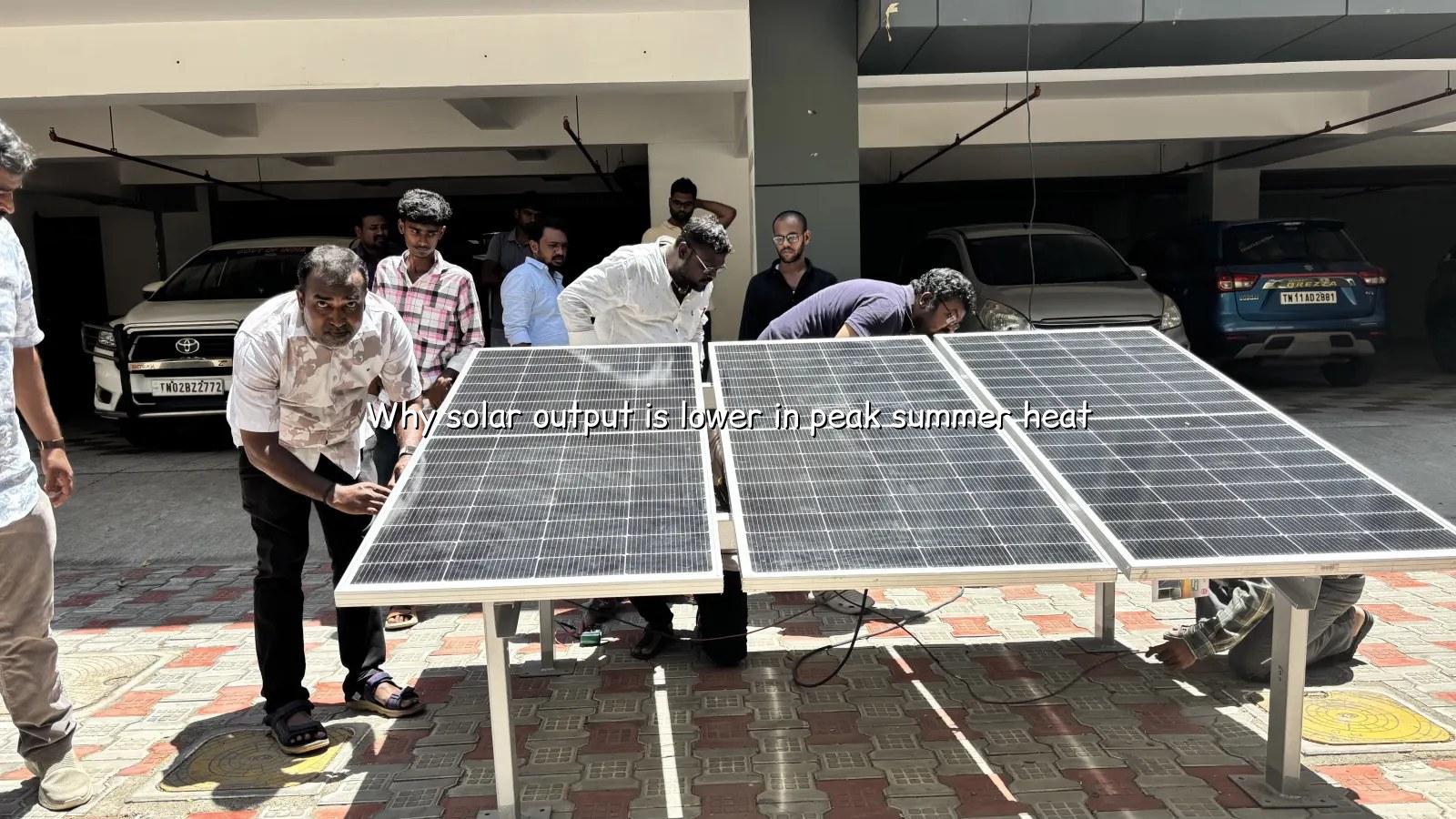
Why solar output is lower in peak summer heat is one of those questions that sounds simple until you look at the numbers at noon and they are lower than you expected. Panels need sunlight, but they also react to heat, and once the module gets hot enough the voltage falls. So a bright, cloud-free day can still give less power than a cooler morning with the same sky.
Around Kanyakumari District that pattern shows up often because the district gets strong sunshine, year-round wind exposure and, in some places, salt-laden coastal air. A roof in Kottar does not behave the same way as a farm shed near Thovalai or a house closer to Manavalakurichi. Roof material, mounting height, cable routing and the EB connection all play a part, and sometimes the difference is small enough that people only notice it when the app updates at midday.
Heat and output
What heat changes inside the panel, and why the drop is real
There is nothing mysterious about this. The panel is still receiving sun, but the electrical side of the module changes as temperature rises, and that changes the output you see.
Sunlight helps, heat trims the result
Solar cells respond to light first. After that, temperature starts to matter. On an RCC flat roof in Nagercoil or a sheet roof in Kuzhithurai, the panel surface can get much hotter than the air around it, and that pushes voltage down. The inverter then has less usable headroom, so the same roof can report a smaller figure in the afternoon than it did earlier in the day.
People often assume summer should always mean more power, because the sky looks better and the daylight is strong. That part is true up to a point, but heat starts taking back a share of the gain. On a very hot afternoon the difference can be obvious, especially if the system is already carrying dust or a bit of shade.
Airflow under the module is not a small detail
A good mounting layout leaves enough room for air to move below the panel. That gap helps the module shed heat faster, which matters a lot on roofs that hold warmth after noon. In Kottar we see this on flat roofs especially, because the slab keeps radiating heat back up for hours.
On a sloped tiled roof the pattern changes, but the same rule applies: if the array is cramped or the cable run blocks airflow, the panel stays warmer than it should. Windy districts still need careful design. You want cooling and strength together, not one at the expense of the other.
- Panel voltage falls as temperature rises, so a hot roof can produce less usable electricity even under strong sun.
- RCC roofs store heat and keep the underside of the array warm well into the afternoon.
- Dust, salt film and bird marks make the heat effect feel worse because they block light and hold grime.
- Poor cable routing and crowded mounting reduce airflow under the array.
- Wind loading still has to be handled properly, so the structure must be strong without trapping extra heat.
A simple check path
How we figure out whether the heat is the main reason
When someone calls about low summer output, we don't start with a guess. We look at the pattern, the roof and the electrical side together and then decide what is normal and what needs fixing.
- Check the timing of the drop. If the system is strong early on and then fades once the roof heats up, heat and ventilation are the first things we think about.
- Look for new shade. A tree branch that barely mattered in January can cast a stronger shadow in May, and a thin shadow can pull a string down quicker than people expect.
- Inspect the panel surface. Dust, salt and dried water marks are common in the district, especially after a dry spell near the coast or after a windy week inland.
- Review inverter messages. Warning codes, tripping and odd voltage readings help separate normal heat loss from a real electrical fault.
- Check the mounting and air gap. If the modules sit too close to the roof, the heat has nowhere to go and the array runs warmer than planned.
Roof comparison
How roof type changes summer solar output
The panel brand is only one part of the story. Roof material, mounting style and local weather all decide how much heat builds up around the array.
| Roof or site condition | What usually happens in summer heat | What we look at first |
|---|---|---|
| RCC flat roof | Holds heat through the afternoon and keeps the module warmer for longer | Air gap, mounting height, cable run, shade from tanks or parapet walls |
| Sloped tiled roof | Can breathe better, but poor placement may trap warm air in pockets | Tile condition, fixing points, underside ventilation, bird nesting signs |
| Sheet roof | Heats fast in direct sun and can pass that heat to the structure below | Fastener quality, corrosion, cable sealing, spacing for airflow |
| Coastal site with salt air | Heat plus salt film can age connections faster if maintenance is neglected | Hardware condition, earthing points, connector sealing, cleaning method |
Local conditions
Why Kanyakumari District needs a slightly sharper eye in peak summer
The district has strong sunshine, and that is good news for rooftop solar, but it also has wind exposure, monsoon moisture and coastal conditions in much of the area. On a home near Rajakkamangalam, salt-laden air can leave a light film on panels and exposed hardware, while a site inland at Boothapandi may see more heat and dust than salt. Both can show lower afternoon output, only for different reasons.
The monsoon pattern changes things again. During the south-west monsoon and the north-east monsoon, cloud cover and damp surfaces affect generation, and drainage becomes part of the conversation. Cable sealing, frame edges and connector condition matter more than people think, because water does not need much of a gap to cause trouble later.
A plain example from a site visit
A customer in Marthandam may say the system felt weaker in May than it did in February. After we check the array, we may find the panels are fine, the inverter is fine and the real issue is trapped heat under the array with a bit of dust after a dry stretch. That happens often enough that we say it plainly rather than dress it up.
Sometimes the fix is a clean and a small change in how air moves under the array. Sometimes it is a loose connector, a tired breaker or a mounting detail that needs to be corrected. We will tell you honestly whether it needs a repair, a replacement or simply a clean.
What helps most
Ways to keep summer output closer to what the system should do
A solar array does not need special treatment every week, but it does need sensible design and a bit of regular attention. In our experience the systems that hold up better in hot months are the ones with enough air gap, tidy cable runs and hardware chosen for the local site conditions. The same idea applies whether the system is for a home roof, a shop or a small commercial building.
It also helps to look at the whole installation instead of only the panel surface. If the mounting is strong but too low, or the inverter is healthy but the strings are shaded, the numbers will still disappoint you. Heat is sometimes the main cause, yet it often works together with dirt, shade or a loose electrical point.
What we usually recommend checking first
- Clean the panels properly if dust, salt or bird droppings are sitting on the glass.
- Check whether a tree, parapet or tank has started making shade at a new time of day.
- Look at the inverter screen for warnings, tripping or unusual reading changes.
- Make sure the array still has clear airflow underneath, especially on flat roofs.
- Inspect the visible cable path and the connectors for heat damage or loose fitment.
How JRS SunTech Energy can help
Inspection, maintenance and the right layout from the start
If your summer generation looks low, our team can inspect the array, check the inverter and look at the mounting, wiring and roof conditions as a whole. We handle solar service and maintenance, on-grid solar, hybrid solar, off-grid solar and solar water pumps, so the advice is based on what the system actually needs, not a one-size answer.
We also guide customers through the EB connection steps and the documentation side where it applies, and we do that for homes and businesses across Nagercoil and Kanyakumari District. If you want a straight answer on whether the issue is heat, shade, dirt or a repair, talk to us.
Contact JRS SunTech Energy, Door No. 227, First Floor, Cape Road, St. Xavier's Church Junction, Kottar, Nagercoil, Kanyakumari District, Tamil Nadu - 629002. Phone: 9787775999, Email: jrssuntechenergy@gmail.com.
Frequently asked
Questions we hear about summer heat and solar output
Solar panels turn sunlight into electricity, but heat makes the panel voltage fall. On a very hot roof, the panel still sees strong sun, yet the electrical side of the module works less efficiently. That is why a bright summer day can still produce less than a cooler morning with the same clear sky.
Not always. A temperature-related drop is normal, especially on RCC roofs or sheet roofs that hold heat through the afternoon. If the loss is larger than expected, then we check for shading, dust, inverter logs, cable joints and the mounting layout before calling it a repair.
Start with the obvious things: dust on the panels, new shade from a tree, breaker trips, inverter warnings and loose AC or DC connections. In Kottar and nearby homes we also look at roof heat, cable routing and whether the structure allows enough air movement under the panels.
Usually, yes. Panels run cooler when there is space for air to move under them, and that helps them hold output better in hot hours. The mounting structure, roof type and panel spacing all matter, so the same system can behave differently on a sloped tiled roof and an RCC flat roof.
Cloud cover and rain reduce direct sunlight, and damp weather can add grime or water marks if the array is not cleaned properly. In the south-west and north-east monsoon periods we also pay attention to drainage, cable sealing and corrosion on exposed hardware, especially in coastal stretches.
Yes. We handle inspection, performance checks, inverter troubleshooting and preventive maintenance for systems installed by other companies too. If the issue is heat, shading or a loose connection, we will tell you plainly what we find and what needs attention.
Hurry up!Subsidy ends 31 March 2027 · 134 days left
Next step
Is summer heat the real reason your solar output is down?
Send us a photo of the inverter screen, a short note on the roof type and your EB connection details, and we will help you work out what is happening.
- Your electricity requirement and 60-day EB bill
- Property type — home, shop, office, farm or institution
- Backup requirement and available roof space
Related: Solar Maintenance · On-Grid Solar · Contact