Business solar guide
Load Profile Matters More Than Roof Size for Business Solar
The right commercial solar system starts with how your EB units are used through the day, not just how much roof space you can see.
Commercial sizing
Why business solar should begin with the load, not the roof
Load profile matters more than roof size for business solar because the best system is the one your business can actually use while the sun is out. A roof can be wide open and still make a poor solar fit if the office, shop floor or workshop pulls most of its units after sunset. We see that often in Nagercoil and along nearby commercial streets where a building looks ideal from outside, yet the EB history tells a different story.
If you run a showroom, a small factory, a clinic, a warehouse or a trading office, the pattern of use matters as much as the total units in a 60-day EB bill. In Kanyakumari District, strong sunlight gives you a real advantage, but that output only becomes useful when the system matches the way your business works through the day. So we start with the bill, the roof and the site, then we talk about capacity. Not the other way around.
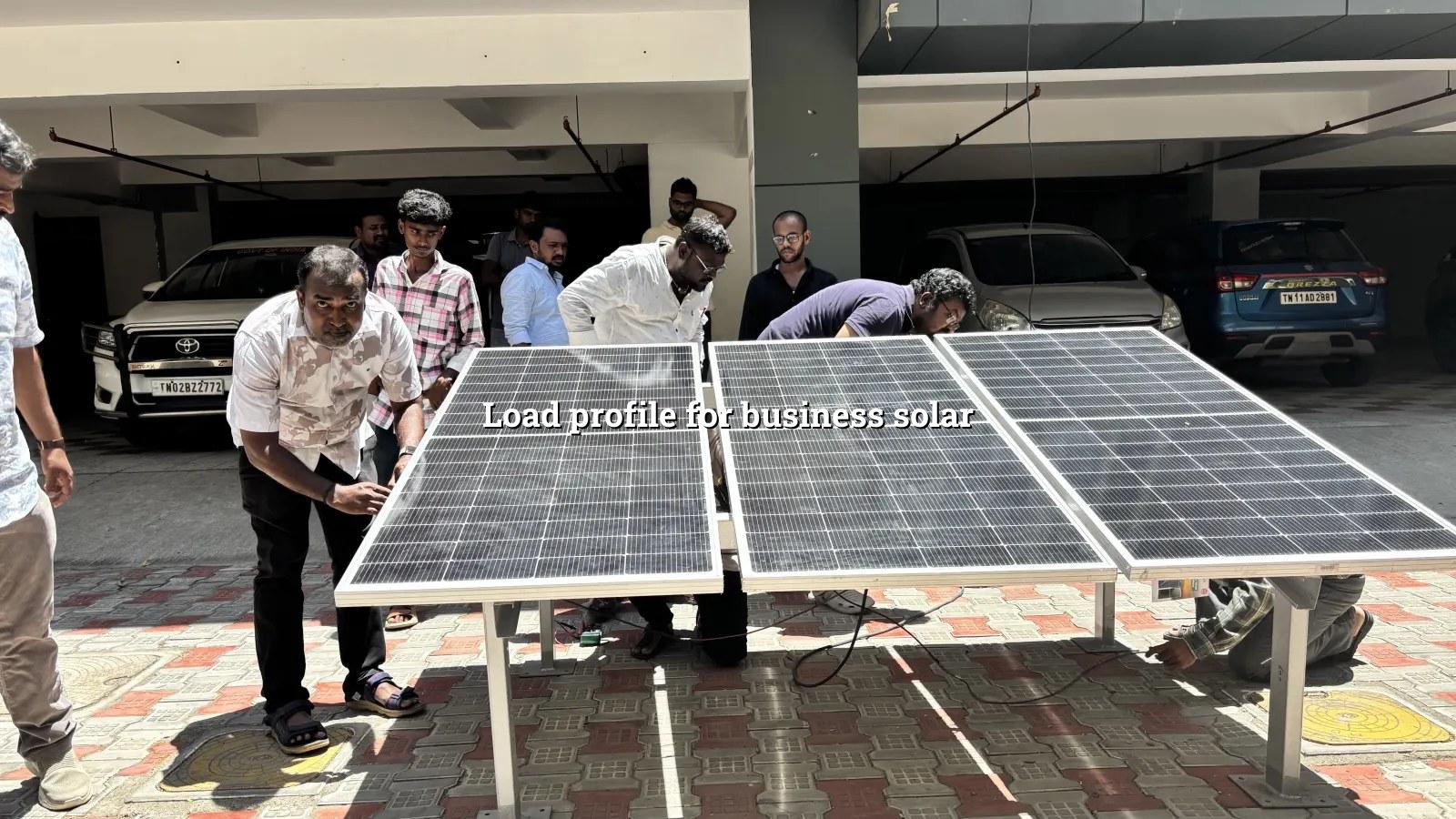
What matters first
The real clues behind a right-sized commercial solar system
Roof space helps, of course. But a commercial solar design only makes sense when we read the load pattern, the EB connection and the site layout together. A system that is too large can leave unused generation sitting on the roof, while a smaller but better matched system can cut more grid purchase during working hours. The real job is to find the point where the system fits the way the place actually runs.
Start with the 60-day EB bill and business hours
The first thing we ask for is the recent EB bill, because it tells us the total units and gives a rough view of how the business uses power over a billing cycle. Then we ask how the place runs on a normal day. A shop in Marthandam may have lights, fans and billing systems on from morning to evening, while a storage unit or office in Thuckalay may see a sharper peak during specific hours. That difference changes the solar design a lot.
Then match the roof, structure and orientation
After the load check, we look at the roof. RCC flat roofs are common in Nagercoil, while sheet roofs and sloped tiled roofs show up in town properties and older buildings. Wind exposure in the district is real, so mounting structure choice matters more than people expect, and coastal air can affect hardware and cable ends if the installation is not planned with care. Roof size still matters, just not before the load profile.
- The daytime load tells us how much solar can be used directly on site.
- The EB connection and the 60-day billing pattern show whether demand is steady or spiky.
- A big roof with low daytime usage can leave too much generation unused.
- A tighter roof with a strong load profile may deserve a more efficient layout.
- Wind, salt-laden air and monsoon drainage need to be considered before panels go up.
Sizing method
How we decide the commercial solar size in practice
We do not push one standard package. Every site gets checked from the ground up, and the order matters. The same roof can suit one business and fail another, simply because the operating pattern is different. Here is the way we usually handle it.
- Check the actual usage: we look at the EB bill, the working hours and the kind of electrical loads in use, from lighting to motors and office equipment.
- Read the roof properly: we measure usable area, shading, access, slope and the structure below the surface before talking panel count.
- Match the system type: if the business needs day-time reduction of grid power, on-grid solar may fit best; if backup is also needed, we may discuss hybrid solar.
- Plan for site conditions: in coastal or near-coastal parts of Kanyakumari District, we pay attention to mounting hardware, fasteners and cable sealing.
- Prepare for paperwork: where the applicable programme or utility process is involved, we guide the customer through EB documentation and the needed forms.
Why the roof is only part of the answer
Roof size versus load profile: what changes in the final design?
People often expect the biggest roof to decide everything. That is not how commercial solar works in the field. The table below shows why the load pattern usually has the final word.
| Factor | What it tells us | Why it matters |
|---|---|---|
| Roof size | How much panel area may physically fit | It sets the ceiling, but not the right system by itself |
| Daytime load profile | How much power the business uses while the sun is available | It shows how much solar can be consumed directly on site |
| EB connection and bill pattern | How the utility supply and units are used over the billing cycle | It helps us see whether the load is steady, seasonal or uneven |
| Roof structure and wind exposure | Whether the site can take the mounting and layout safely | Important in Kanyakumari District, especially on exposed buildings |
| Shading and orientation | How well the panels can see clean sunlight | Even a large roof can underperform if trees, tanks or walls block the sun |
Why a bigger roof can still be the wrong answer
We have seen roofs in offices near Kottar and commercial buildings closer to the town centre where there was plenty of open space, but the business ran on a modest daytime load. In that case, a bigger array would not help much because the extra power would not be used the way the owner expected. The right answer is the one that fits the consumption pattern, not the one that looks impressive on a drawing.
Why a smaller roof can still work well
Some sites in Thovalai and booth-type industrial pockets have strong daytime demand and only a compact roof. Those customers often need a careful design that makes the most of each usable square metre, with clean cable routing and a mounting layout that leaves service access. If the load is healthy, a smaller roof is not a dealbreaker. It simply changes the design logic.
What to check first
The signs your business load profile is the real starting point
If your business draws most of its power during working hours, solar can directly reduce how many units you buy from the EB connection. That is the simple version. The practical version is a little messier, because motors start in bursts, offices peak around lunch, and some buildings keep a steady base load even when staff are not many. We read those patterns before we size anything.
In Kanyakumari District, year-round sunshine is a real advantage, but the south-west and north-east monsoon periods can still affect generation through cloud cover, rain and cable exposure. So the design needs to be honest about both the roof and the load. If the building has rooftop equipment, water tanks, parapet walls or unusual shadows, we count those too. The site tells us more than a brochure ever will.
What we usually check on a commercial survey
- Recent EB bills and the 60-day unit trend.
- Business hours, shift pattern and weekend use.
- Available roof area, access points and maintenance walk paths.
- Shading from nearby structures, tanks, trees or high walls.
- Mounting needs for wind and coastal conditions, especially near the shore.
That last point gets ignored too often. A shop in Manavalakurichi faces different wear and tear from a building farther inland, and the hardware choice should respect that. We do not treat every roof the same because the district does not treat every roof the same.
How the work starts
What happens when you ask us to look at a commercial site?
Most people think the process begins with panel count. It does not. It starts with a conversation about how the building is used, then we move step by step so the design is based on facts, not guesses.
- Contact us first: share the business name, the site location in Kanyakumari District and the best time to visit.
- Free site survey: we come to the building, check the roof, the shadow lines, the structure and the available service paths.
- System design and quotation: we prepare a suitable proposal after reading the bill, the load profile and the roof limits together.
- Installation: our team fits the system according to the site conditions, including wind exposure and cable protection.
- EB and documentation: we guide the customer through the utility and paperwork steps that come with the chosen solution.
- Commissioning: the system is checked, started and tested so the owner knows how it is operating.
- After-sales support: you get one year of free service support after installation, with continued technical help afterwards based on the product and installation terms.
Local conditions
Commercial roofs in this district need a local design eye
The district gives you good sun for most of the year, but it also gives you wind, salt-laden air and seasonal rain that can change how a roof should be handled. That is why two buildings with the same total area may still need different mounting, different cable routes and different access planning. A business solar job near the coast is not the same as one farther inland.
We also look at the building stock itself. RCC flat roofs are common for many business properties, but sheet roofs and older tiled roofs still show up in town centres and mixed-use buildings. Each one changes how the system is fixed down, how service access works and how the panels should be laid out so maintenance stays practical. Sometimes the best design is the one that makes future cleaning and inspection easy.
Small details that save trouble later
- Keep drainage clear so monsoon water does not sit under the mounting line.
- Seal cable entries properly where rain and wind can push water sideways.
- Leave enough access for cleaning, inverter checks and electrical inspection.
- Choose mounting hardware with the district's wind exposure in mind.
- Match panel layout to the real roof, not to a sketch from a distance.
How JRS SunTech Energy Can Help
We size business solar from the bill, the roof and the site together
If your business is in Nagercoil, Marthandam or Thuckalay, we can visit the site, study the load pattern and tell you honestly whether the roof is the limit or the load is. We design on-grid solar, hybrid solar and other suitable options based on the actual use, not a one-size system. Our team also guides customers through EB documentation and the applicable subsidy process where it fits.
We provide solar panels, inverters, batteries, complete hybrid solar power system packages and service support after installation. If you want a proper commercial assessment, send us your EB bill and a few photos of the roof, or book a survey and we will take it from there.
JRS SunTech Energy, Door No. 227, First Floor, Cape Road, St. Xavier's Church Junction, Kottar, Nagercoil, Kanyakumari District, Tamil Nadu - 629002. Phone: 9787775999. Email: jrssuntechenergy@gmail.com.
Related solutions
Where this topic connects with the rest of our solar work
Business solar is rarely a one-page decision. A customer often starts with sizing, then asks about subsidy steps, finance, maintenance or whether a hybrid system suits the site better. These links may help if you are comparing options.
- On-Grid Solar for daytime grid reduction at shops, offices and commercial buildings.
- Hybrid Solar if you need battery support as well as solar generation.
- Solar Service & Maintenance for inspection, troubleshooting and preventive care.
- Subsidy Guidance to understand the general documentation process.
- Solar Finance and EMI if you want to discuss payment options before deciding.
Frequently asked
Questions business owners ask before they size a system
Because your daytime usage decides how much solar you can actually use on site. A shop, office, cold room or workshop with steady daytime demand can get real benefit from a system sized around that demand, while a roof with extra space may still be a poor match if the load is low or uneven.
We look at recent EB bills, the kind of work done during business hours, and the site conditions. If the use is spread across lighting, computers, motors or equipment, the pattern matters more than the roof alone, and that shapes the capacity we suggest.
Yes, and that happens often. A roof may hold more panels than the business can use productively, so we usually start from actual consumption, the available EB connection, and the way the building runs on a normal working day.
Then the roof may become the limit, and we work within it. In that case we may discuss efficient panel layouts, better mounting planning, or whether another solar solution from our range fits the site better.
Yes, we guide customers through the applicable documentation and the general process where it applies. For current details on the government programme, you can also check our subsidy page and then speak with us about your site.
We see it in many kinds of commercial buildings, especially in places like Nagercoil, Marthandam and Thuckalay where roof area and operating hours do not always tell the same story. The building use matters first, then the roof.
Hurry up!Subsidy ends 31 March 2027 · 134 days left
Next step
Need help checking your load profile?
Send your EB bill, business hours and a few roof photos, and we will tell you what size makes sense for your site.
- Your electricity requirement and 60-day EB bill
- Property type — home, shop, office, farm or institution
- Backup requirement and available roof space
Related: Commercial Solar Solutions · Subsidy Guidance · Contact
Free site survey · Kottar, Nagercoil