Solar solutions
Solar for Schools and Colleges
Practical rooftop solar planning for school blocks, college buildings and campus facilities that want lower daytime grid use without disturbing classes.
Campus solar planning
Solar for Schools and Colleges that fits real campus use
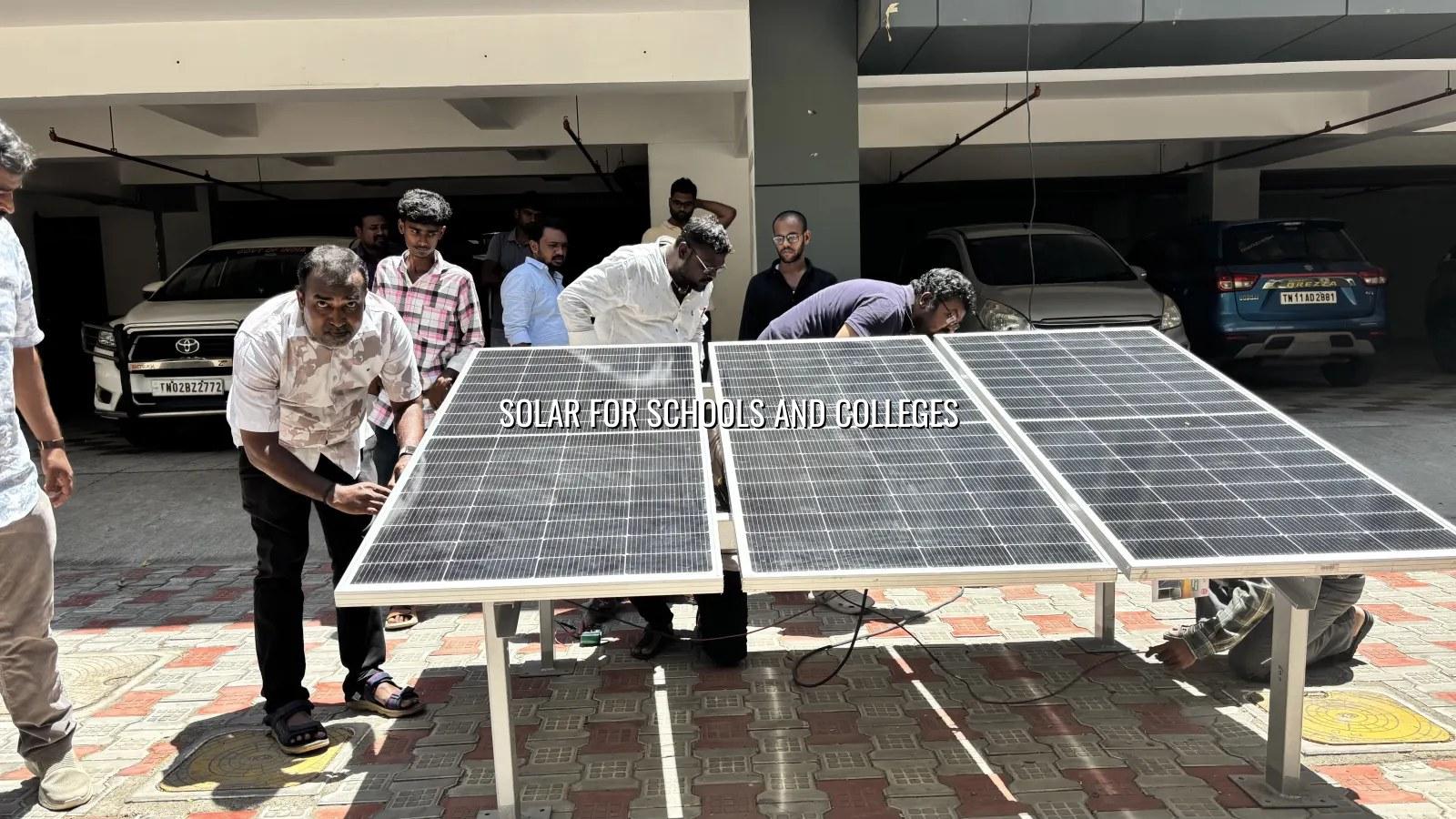
Solar for schools and colleges works best when it is built around the day your campus actually lives through. A school usually has a strong daytime load from fans, lighting, computers, office equipment and classrooms, while a college can layer in labs, admin blocks and sometimes hostels too. We look at the EB bill, the roof, the structure and the routine before we suggest anything.
That matters in this district because the roofs are not all the same. A campus in Nagercoil may have a wide RCC terrace, while another in Kottar or nearby Suchindram may have older tiled sections or sheet roofing that needs a different fixing method. Wind exposure, salt in the air and monsoon drainage all shape the final design, so a one-size proposal usually misses the point.
Where planning starts
What campus owners need to check before fitting solar
Most principals and administrators ask the same two questions first: where can the panels sit, and how much of the daytime load can solar cover without disrupting the campus? The answer comes from a roof check, a load check and the EB connection together.
Roof area, shade and safe access
A school may have one main terrace or several smaller blocks. Colleges often have a mix of old and new buildings, which means the survey has to look at each roof on its own terms. We measure usable area, watch for shade from staircase rooms, water tanks and nearby trees, and check how the roof is used during the day. If staff or maintenance workers need access, that space has to stay free.
Daytime generation should match campus hours
The main gain from solar for schools and colleges is daytime offset. A school in Marthandam that runs mainly in class hours has a different pattern from a college around Thuckalay where admin work, computer labs and evening functions may all share the same electricity lines. We size the system from the units used across a 60-day EB billing cycle, not just from the nameplate load on paper.
- Start with the basic details. Send the campus location, latest EB bill and a short note on how the buildings are used.
- We inspect the site. Our survey covers roof type, shade, orientation, cable paths and the condition of the structure.
- We design around the site. The system capacity and equipment mix come after the survey, not before it.
- The installation is planned around campus movement. We keep access routes clear and work in a way that does not get in the way of classes more than necessary.
- We handle the EB and paperwork side. For eligible rooftop solar cases, we guide the documentation and the steps involved in the government solar process.
- Commissioning and support follow. Once the system is live, we explain the basics and stay available for service support.
Campus realities
Practical points that matter on school and college rooftops
Campus projects need more discipline than a simple house installation. There are more people on site, more access points and usually more electrical points to coordinate with the office staff, the electrician and the management. In our experience the cleanest projects are the ones where the team knows the block map, the roof access and the working hours before the first bracket is fixed.
Weather matters too. The south-west monsoon and the north-east monsoon both affect the way we think about drainage, cable sealing and roof slope, even if the installation itself is not blocked by rain for long. On a sheet roof near the coast a small mistake at a cable entry can become a nuisance later, and nobody wants extra interruptions during exams.
What we usually look for on campus visits
- Usable roof area on each block and whether the surface can support the structure safely.
- Condition of the main EB panel, sub-panels and any existing inverter room or electrical point.
- Shade from trees, parapet walls, staircase rooms and nearby blocks.
- Wind loading and mounting method, especially on open terraces and exposed edges.
- Corrosion risk on coastal or near-coastal campuses and the hardware choice that goes with it.
- Whether the campus is better suited to on-grid solar, hybrid solar or a mix of both.
Choosing a system
Which solar setup suits a school or college?
Not every campus needs the same system. Some only need daytime offset, some want support for selected loads, and some have separate blocks that should be treated differently. We explain the options in plain words and tie them to the roof and the EB connection.
| Campus situation | What usually fits | Why it suits the site |
|---|---|---|
| School with regular daytime EB use | On-grid solar | Useful when the campus wants to reduce grid units during working hours and already has a stable EB connection. |
| College that needs backup for office or critical rooms | Hybrid solar | Works when selected loads need support from a battery during outages or unstable supply periods. |
| Remote campus building or field facility | Off-grid solar | Best where a grid connection is weak, absent or unsuitable for the load pattern. |
| Campus pump room or garden irrigation area | Solar water pumps | Useful for agricultural colleges, gardens and water lifting needs where sunlight can do the work directly. |
| Hostel hot water or utility block | Solar water heaters | Good where hot water demand is steady and the roof can carry the collector layout. |
On-grid is common, but not automatic
For many schools, on-grid solar is the first option we review because the campus is already tied to the grid and most of the usage happens in daylight. That said, the best answer still depends on the roof and the load. A campus in Kuzhithurai with a compact roof may need a tighter design than a larger school block in Padmanabhapuram, even if both want the same broad result.
Backup needs change the design
A college office, computer lab or exam cell may need backup for selected points, and then hybrid solar becomes worth discussing. We do not force a battery into every project. If backup is not really needed, a simpler system can be neater and easier to maintain.
Installation details
How we handle the work on an active campus
A school is not a vacant roof, and a college is rarely quiet for long. So we plan the sequence carefully, mark access routes and keep the material stacking area controlled. If the management wants us to coordinate with the office or electrician, we can work that way too. It saves time later.
The structure itself matters a lot. In Kanyakumari District, wind can affect the edge rows and open terraces, so mounting choice matters as much as the module count. On coastal or near-coastal sites we also think about salt-laden air and the long-term condition of fasteners, clamps and cable terminations, especially where Colachel or Manavalakurichi exposure conditions are part of the site. That is one reason we never treat every roof the same.
A few habits that help campus projects go smoother
- Keep a single staff contact for the site survey, access and later handover.
- Share any old drawings or previous solar work before installation starts.
- Tell us which blocks must stay open during class hours and exam periods.
- Ask for a proper cable path plan if the campus has multiple buildings.
- Keep the roof edge, water tank area and stair landing details clear during the survey.
Local planning
Why the district setting matters for campus solar
Solar for schools and colleges in this district has its own rhythm. A campus in Aralvaimozhi may have stronger wind exposure than an inland site, while an office-heavy building in Nagercoil may care more about daytime offset and neat electrical routing than roof spread. The local context changes the design, and that is exactly why the survey comes first.
We also pay attention to the way roofs age. RCC flat roofs can work very well if the structure is sound, but cracked waterproofing or poor drainage needs attention before a solar array is added. On tiled or sheet roofs, fixing points and waterproof sealing become part of the conversation from the start. If the campus has a hostel, library or lab block, each building can be reviewed separately instead of forcing one layout across all of them.
The goal is simple. Make the campus use less grid power in daylight, keep the roof safe, and avoid a setup that looks neat on paper but becomes awkward to maintain. That is where careful sizing and local experience save headaches.
How we help
How JRS SunTech Energy can help your campus
We handle solar for schools and colleges from the first call through the final handover. Our team will survey the site, design a suitable system, install it carefully and guide the EB and documentation steps where the applicable programme allows. We also give one year of free service support after installation, with continued technical help afterwards based on the product and the site.
If you're planning a campus project in Nagercoil or anywhere else in Kanyakumari District, send us the latest EB bill, roof details and a short note about your buildings. We will tell you honestly whether the site needs a repair, a replacement part or simply a well-planned solar layout.
JRS SunTech Energy, Door No. 227, First Floor, Cape Road, St. Xavier's Church Junction, Kottar, Nagercoil, Kanyakumari District, Tamil Nadu - 629002. Phone: 9787775999 | Email: jrssuntechenergy@gmail.com
Frequently asked
Questions we hear about solar for schools and colleges
We start with the roof, the EB bill and the day plan. After that we map where students move, which blocks stay busy, and which roof areas can be used without turning the place upside down during class hours.
Around Kottar and Suchindram you will mostly see RCC terraces, with some older sloped tile roofs and sheet sections mixed in. Each type needs a different fixing method, especially where wind and coastal air are part of daily life.
Yes. If the campus has a regular EB connection, on-grid solar is often the first option we review because it helps daytime use while keeping the building tied to the grid. We size it from the real load pattern, not from a generic package.
Yes, we do. For eligible rooftop solar cases, we guide the customer through the paperwork and the steps involved, and we keep the process clear for the office team. For current subsidy details, our subsidy page is the place to check.
The latest EB bill, rough roof details, the building count and a short note on daytime use are enough to begin. If you also share whether the campus has flat, tiled or sheet roofs, we can narrow the design much faster.
Yes, we can check it. We look at inverter condition, the electrical connections, module mounting, cable joints and whether the issue comes from dirt, shading, wiring or a part that has failed. Sometimes it needs a repair, sometimes a replacement part, and sometimes it simply needs a proper clean and tightening.
Hurry up!Subsidy ends 31 March 2027 · 134 days left
Next step
Is your campus ready for solar?
Send us the campus location, latest EB bill and roof details, and we will suggest the right system after a proper site survey.
- Your electricity requirement and 60-day EB bill
- Property type — home, shop, office, farm or institution
- Backup requirement and available roof space
Related: Subsidy Guidance · Solar Finance & EMI · Contact
Free site survey · Kottar, Nagercoil