Commercial Solar
Solar for Small Factories and Workshops
Practical rooftop solar planning for units that care about EB bills, roof space, daytime load and steady work without guesswork.
Factory Solar Planning
Solar for small factories and workshops that matches the load you actually use
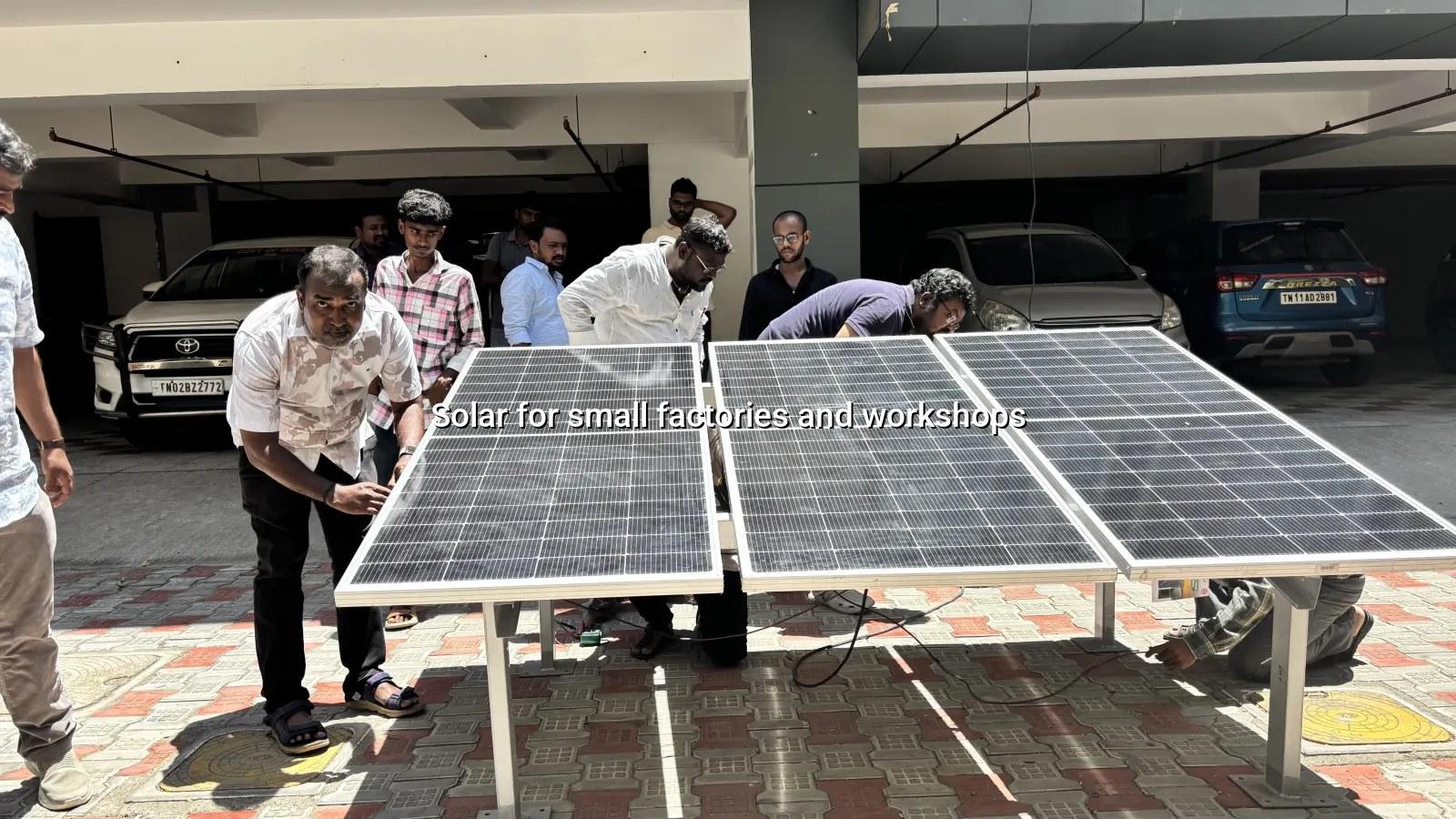
Solar for small factories and workshops should begin with the machines, not with a brochure system. If your unit runs cutting tools, motors, polishing equipment, compressors, fans or packing lines during the day, solar can help bring down the units you buy from the EB connection while keeping the site practical to run.
We see a lot of owners in Nagercoil who know their roof can take panels, but they are not sure how much of it should be used or whether the wiring panel needs work first. That is normal. In Kanyakumari District the answer depends on roof shape, shade, wind exposure and how the building is built, so the right system for a sheet-roof workshop in Karungal is not the same as a RCC factory block near Thuckalay. We start from the actual site, then we work backwards to the system.
Where the design starts
The first decisions are about the site, not the panels
The quickest mistake is to treat every workshop as if it works the same way. A machine shed, a packaging room and a small fabrication unit may all sit under the same roof line, but their electricity use is very different. We plan from the EB connection, the roof layout and the way the unit is actually used during the day.
In Kottar and Vadasery, many commercial roofs have a mix of equipment, water tanks and service access that eats into the usable area. On the other hand, a simple RCC slab in a quieter part of the town can leave more open space for a clean panel layout. We check that before anyone talks about capacity, because the site decides what is realistic.
EB bill, load pattern and working hours
The 60-day EB bill shows the pattern of use, but it never tells the whole story. We ask when the heavier machines start, whether the unit runs through lunch, whether some loads are only used for a few hours and whether there is a quiet spell in the afternoon. A workshop with steady daytime use usually gives solar a cleaner match than one that runs most of its load late in the evening.
Roof type and structural reality
Small factories in this district sit on RCC roofs, sloped tiled roofs and sheet roofs, sometimes with open sides and sometimes with a fairly crowded top. Each one needs a different mounting approach. On sheet roofs, spacing and fasteners need careful attention; on RCC roofs, waterproofing, access and the route to the inverter matter just as much as the panel layout.
- We size from actual daytime consumption, not from a generic chart.
- We inspect roof condition, shade and access before giving a quotation.
- We consider wind load where the building is exposed, especially on open industrial roofs.
- We check whether the electrical panel and earthing need correction first.
- We guide the EB and documentation steps so the file does not get stuck on avoidable errors.
How we take it step by step
A simple process for owners who need the job done without extra rounds
Most people who call us want the same thing: a clear answer on whether the roof, the load and the building can support solar without turning the site into a construction mess. So we keep the process straightforward. No guessing, no rushing the survey, and no pretending the roof is better than it really is.
- Contact us first. Send your EB bill, your address, and a few photos of the roof, the meter board and the main machine area. If you know the working hours, that helps too.
- Free site survey. We visit the factory or workshop, study shade, structure, roof access and cable paths, then look for the safest usable area.
- System design and quotation. After the survey, we prepare a practical layout based on the actual roof and the load pattern. We do not force one standard package onto every site.
- Installation. The team fixes the structure, sets the panels, installs the inverter and handles the wiring with care for alignment, sealing and earthing.
- EB and documentation. We guide the paperwork side and the steps connected to the applicable rooftop solar programme so the work does not stall on forms.
- Commissioning. Once everything is ready, we test the system and explain the basic operation to the owner or the supervisor on site.
- After-sales support. We stay reachable after installation, and the first year of free service support is part of how we work.
What changes the design
Wind, salt air and monsoon rain are part of the job here
Commercial rooftop solar in Kanyakumari District has to stand up to local weather, not just neat drawings. The district gets strong winds in open areas, and the coast brings salt-laden air into places like Colachel and Manavalakurichi. That affects the hardware choice, the connection detail and how the mounting structure is fixed.
Fixings, structure and open roofs
A light structure may look fine during installation, but if the roof is exposed and the wind gets under it, the job starts asking for trouble. We pay attention to the mounting frame, the fasteners and the way the array sits on the roof so the system behaves properly in real conditions. That matters more on industrial buildings with open edges and taller profiles.
Rain paths, drainage and cable sealing
The southwest and northeast monsoon periods matter too. Water should move away from the installation, not through it. We look at drainage routes, cable entry points and sealing around penetrations, because a roof that collects water around the wrong place can turn a simple job into a maintenance headache.
| Site factor | What we check | Why it matters |
|---|---|---|
| Roof type | RCC slab, sheet roof or tiled support area | Changes the mounting method and the safe layout |
| Shade | Nearby trees, walls, water tanks and roof equipment | Affects the usable panel area and string planning |
| Wind exposure | Open roofs and elevated edges | Influences the structure and fixing detail |
| Electrical panel | Main board condition, earthing path and cable route | Helps the system connect safely and cleanly |
| Monsoon drainage | Water flow, entry points and sealing | Reduces the chance of water ingress around the installation |
Questions owners should ask
What to check before you approve a rooftop solar proposal
A proper proposal should tell you more than the panel count. It should show how the roof is being used, what part of the roof is actually usable and how the electrical side will be handled. If a quote skips those points, you are probably looking at a plan that will be hard to live with later.
We have seen small units in Marthandam and Kuzhithurai where the owner had already bought parts from somewhere else, but nobody had thought through the roof work or the cable route. That kind of setup can drag on for weeks. It is better to slow down once and get the layout right than keep revisiting the same fault after commissioning.
A short checklist for the site visit
- How much of the roof is still usable after shade and access are removed?
- Will the mounting system suit the wind exposure at my building?
- Do I need work on the panel board or earthing before installation?
- Which inverter and panel combination fits this load pattern?
- How will rainwater and cable entry points be sealed?
If you are comparing solar for small factories and workshops, keep the discussion tied to your own site rather than to a standard package. The roof tells the truth fast.
When another solar setup may fit better
A workshop that runs mainly in the daytime and has a regular EB connection often points toward an on-grid system. If the supply is unstable or the site needs battery backup for specific tasks, a hybrid design may make more sense. For remote work areas, farm-linked sheds or sites with no dependable grid supply, off-grid can be the better fit. You can compare those approaches on the pages for on-grid solar, hybrid solar and off-grid solar.
Products and support
What we supply for commercial rooftops and backup needs
For small factories and workshops, the components matter as much as the roof plan. We supply solar panels, solar inverters from Sungrow, Deye, Growatt, Polycab and Eastman, along with home and office inverters, lead-acid batteries and lithium batteries. If the site needs backup power or a hybrid layout, we can talk through that too.
We also work with solar water pumps from CRI Pumps and Shakti Pumps, solar water heaters from V-Guard and Racold, and solar DC cables from Polycab. The aim is not to add parts for the sake of it. It is to match the right equipment to the site so the installation stays clean and manageable.
How JRS SunTech Energy Can Help
If you run a small factory or workshop in Nagercoil or anywhere else in Kanyakumari District, we can inspect the site, explain the options and build a system around the way you actually work. We handle solar for small factories and workshops from survey to commissioning, and we help with the EB and documentation steps so the job keeps moving.
Our office is at Door No. 227, First Floor, Cape Road, St. Xavier's Church Junction, Kottar, Nagercoil, Kanyakumari District, Tamil Nadu - 629002. You can call us on 9787775999, email jrssuntechenergy@gmail.com, or message us on WhatsApp through the site.
Frequently asked
Questions we hear from workshop owners
We start with your EB bill, the load that runs in the daytime, roof area and the way your machines are used. A unit with welding, motors or cutting machines needs a different design from a tailoring or packing workshop, so we do not treat every site the same.
Yes, often it still can. We look at the usable roof, the shadow pattern through the day and the cable run, then decide whether the system should be split across two roof faces or kept on the clearest stretch.
Check the roof condition, sheet thickness, waterproofing, earthing path and how the existing electrical panel is arranged. In places like Thuckalay and Karungal, we also pay attention to wind exposure and salt-laden air if the site is near the coast.
Usually they do, especially when the supply arrangement and document set are not up to date. We help with the practical side of the EB and documentation process, and we explain what is needed without making it confusing.
We provide one year of free service support after installation, and after that we still help with technical issues, subject to product type, manufacturer warranty and the installation itself. If something looks off, we would rather inspect it than guess from a phone call.
That is often the best kind of site for solar. When machines, lights, fans or compressors run while the sun is out, the system has a better chance to offset the units you would otherwise take from the grid.
One more thing before you decide
A good rooftop solar job in a factory is one that fits the roof, the machine schedule and the way the building is used every day. If you keep those three in front of you, the rest of the discussion gets clearer very quickly.
We will tell you honestly if a repair, a redesign or a different system is the better path. That is usually what owners appreciate most, because nobody wants a site that looks neat on paper and awkward in real life.
Hurry up!Subsidy ends 31 March 2027 · 134 days left
Next step
Thinking about solar for your factory roof?
Send us your EB bill, roof photos and a short note about your machines, and we will tell you what looks workable on site.
- Your electricity requirement and 60-day EB bill
- Property type — home, shop, office, farm or institution
- Backup requirement and available roof space
Related: Solar Solutions · Products · Contact
Free site survey · Kottar, Nagercoil