Roof leak help
Solar Panel Water Leakage on the Roof
See what usually causes a leak, how we inspect it, and why the roof side and solar side both need attention.
Roof leak help
Why solar panel water leakage on the roof starts in the small details
Solar panel water leakage on the roof usually begins with one weak point that was not sealed, fitted or finished as it should have been. The panel gets blamed first because it's the newest thing on the roof, but the real trouble can sit at a mounting foot, a cable entry, an old crack in the slab, or a spot where heat and rain have already worked the surface loose.
We see this across Kanyakumari District on RCC flat roofs, tiled homes and sheet roofs, and the pattern changes from street to street. A house in Kottar with a flat slab needs a different check from a sloped roof in Suchindram, and a coastal house near Colachel faces salt air that ages small parts faster than most people expect. The roof tells the truth if you inspect it properly, and the solar array should be checked as part of that same story.
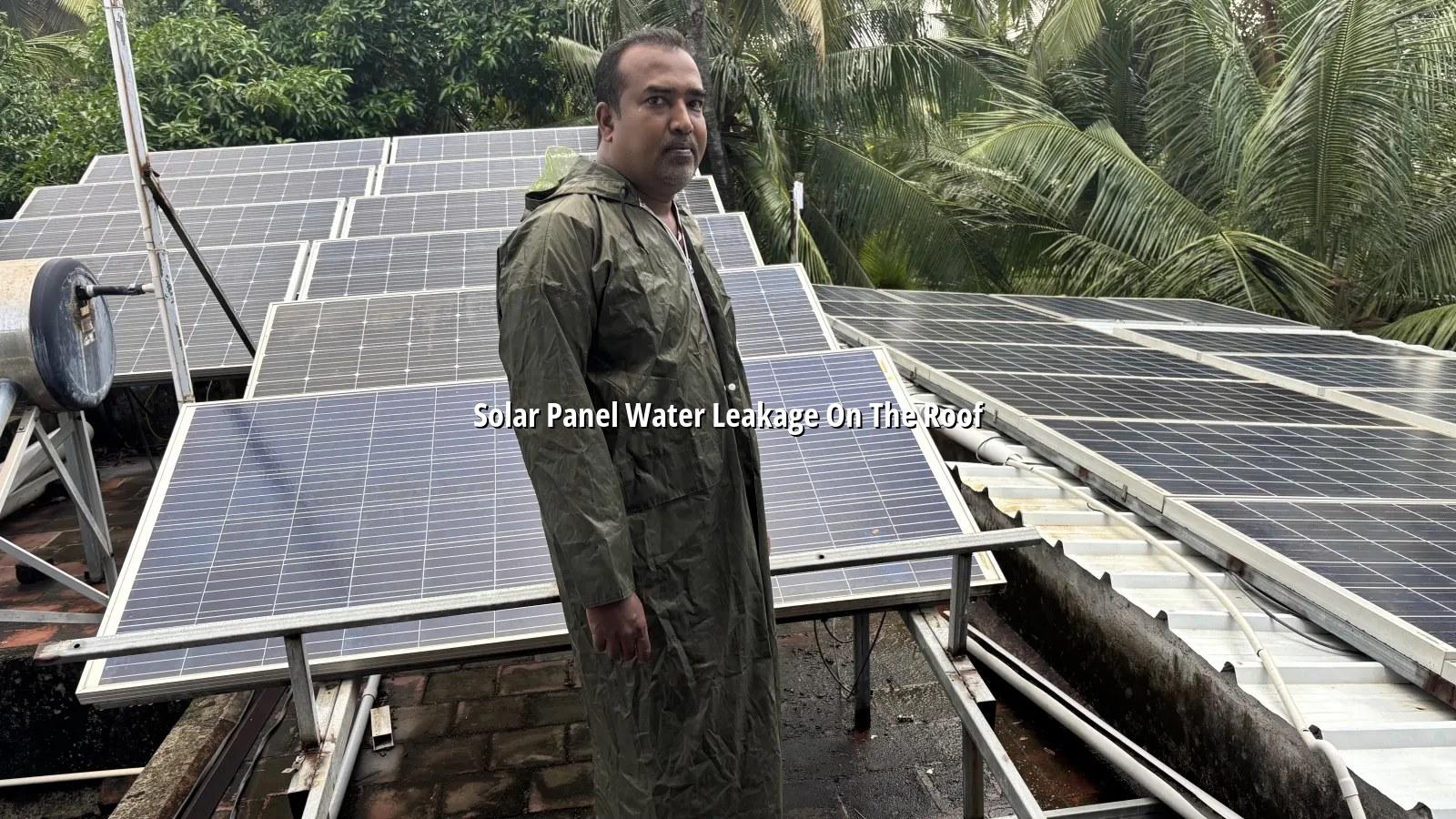
Leak causes
Where the water usually gets in, and why it shows up somewhere else
A roof leak under solar panels is rarely one single fault. We look at the roof sheet, the drilling points, the sealant, the cable route and the mounting structure together, because water follows the weakest opening and often travels before it leaves a mark indoors.
Mounting points and older roof weak spots
On many homes the actual leak starts at one fixing point that was not sealed properly, or at a roof patch that had already weakened before the solar work began. A tiny gap can stay hidden until the south-west monsoon brings heavy rain and wind, then the ceiling stain appears somewhere else and everyone assumes the panel itself is the problem.
In and around Vadasery we often see this on older RCC roofs where the slab has hairline cracks near the parapet or around a tank line. If a panel frame was installed over that zone, the roof may need both sealing and a better fixing detail, otherwise the repair just keeps coming back.
Cable entry, drain paths and sheet roofs
Cable entries are a common weak point because the opening is small and easy to overlook. If the gland is loose or the sealant breaks, water creeps in during rain and runs along the cable before it drips inside. Sheet roofs need even more care, because one poor overlap or rusted screw can send water under the sheet and make the fault look bigger than it is.
Near the coast, like at Manavalakurichi, salt-laden air can shorten the life of small metal parts and unprotected connections, so we inspect the hardware around the array and the junctions closely. That is one reason we prefer a slow, proper inspection over a quick visual guess.
- Check the indoor sign first. Find the exact ceiling spot, the smell, the stain pattern and whether the mark grows after rain.
- Trace the roof side. Look above that line for mounting feet, cable exits, cracked tiles or failed sealant.
- Review the structure. See whether the roof slope, RCC slab or sheet overlap is draining water away or holding it near the panel base.
- Test the problem area. If needed, isolate one section, open the route and inspect the fixing points, not just the visible surface.
- Repair the real cause. Reseal, refit, replace or redirect the detail that allowed water in, then verify after the next rain.
What to check
How we approach solar panel water leakage on the roof
The first thing we tell customers is simple: don't patch the ceiling and stop there. A paint job can hide the stain for a while, but the roof still leaks and the slab keeps taking water. We look at the roof from the solar side, the inside side and the drainage side, because all three matter.
Roof type matters a lot in Kanyakumari District. A tiled roof in Thovalai needs careful tile lifting and reinstatement, while a flat RCC roof in Nagercoil often needs better sealing around the mounting line and a smarter cable route. The district gets strong sunshine most of the year, so the roof also expands and contracts, and that movement can open up a small gap that was fine on installation day.
Signs that point to the actual fault
If the damp patch sits near a mounting leg, the fix may be around that fixing point. If the stain appears below a cable path, the entry gland or conduit seal may be the issue. When the leak shows up after a heavy monsoon burst, drainage and flashing get more attention than the panel frame itself. We can usually tell a lot from the pattern if the roof isn't disturbed before the inspection.
The right repair also depends on what was installed earlier. On an on-grid roof in a shop building, the array layout and cable run may be different from a home system, and the fix must respect that layout. If the problem is more about the roof than the panels, we say so and keep the solar side as light as possible.
Quick comparison
Common leak sources and how they usually show up
| Possible source | What you may notice | What we usually check |
|---|---|---|
| Mounting point seal | Small stain near a fixing line or bolt area | Sealant condition, roof surface crack, fastening alignment |
| Cable entry point | Water mark near the cable route or junction area | Gland tightness, conduit route, entry slope, weather sealing |
| Tile or sheet overlap | Leak after wind-driven rain, often with no mark directly above | Overlap fit, screw condition, rust, broken tile edge, drainage path |
| Old roof crack | Repeat damp patch even after a simple patch job | Crack length, slab movement, parapet junction, earlier repair quality |
| Drainage blockage | Water ponding near the array during monsoon showers | Slope, runoff path, debris, outlet blockage, edge sealing |
Roof care
What makes the problem worse if you leave it
Water is patient. Once it gets into a crack, it can move along the slab, behind plaster and through the roof edge before you see the real source. That is why a small leak can turn into a larger repair if it is left after one or two rains.
In a place like Kottar or Suchindram, where many houses have mixed roof ages and different repair history, the hidden issue is often the old patch under the solar work. If the installer drilled through a weak layer or reused a tired seal, the roof may leak again even after the visible stain is cleaned up.
Simple things that help before a technician arrives
- Take photos of the inside stain and the roof side before anyone cleans or patches it.
- Note whether the leak appears only during rain, only after windy rain, or after a long wet spell.
- Check whether the solar array, pipe route or cable line sits directly above the damp mark.
- Do not keep applying fresh sealant on top of old loose material.
- Ask for a roof-and-solar inspection together, not a quick panel-only visit.
We also look at the local weather pattern. The north-east monsoon can expose a detail that looked fine in summer, and a roof in Aralvaimozhi with stronger wind exposure may need a different mounting choice than a sheltered inner-street home. That is normal. The roof should suit the site, not a one-size setup.
How we help
How JRS SunTech Energy Can Help
We inspect solar panel water leakage on the roof by looking at the roof condition, the mounting detail, the cable entry and the water path inside the building. If the system needs a local correction, we handle that; if the roof needs separate repair first, we will say so plainly. Our work covers homes, shops and agricultural sites across Kanyakumari District, and we keep the advice tied to what your site actually needs.
We also help after installation with one year of free service support, and we continue technical assistance after that. For a roof leak check, send us the roof type, the place where the stain appears and a few photos if you have them.
JRS SunTech Energy, Door No. 227, First Floor, Cape Road, St. Xavier's Church Junction, Kottar, Nagercoil, Kanyakumari District, Tamil Nadu - 629002. Phone: 9787775999 | Email: jrssuntechenergy@gmail.com
Frequently asked
Questions we hear about roof leaks after solar work
Yes, it can happen if a fixing point was not sealed well, if a flashing was left open, or if the roof already had a weak patch. Most of the time the solar system is not the only reason, so we check the roof, the mounting line and the cable entry together before saying what really needs repair.
We start with the indoor marks, then follow the water path from the ceiling side and the roof side. On an RCC roof or a tiled roof, the leak is often away from where the water shows up inside, so a proper check is better than guessing. If the array needs to be opened, we do that carefully and keep the layout in mind.
No, not always. Some leaks come from loose pipe routes, damaged sealant around cable entry points, or a roof surface that cracked later because of movement and heat. Drilling can be a factor, but the whole installation detail matters, especially in coastal parts of Kanyakumari District.
Stop using the guesswork approach and look at the exact spot during or after rain if you can. Take a few photos, check whether the leak is near a mounting point, and call us for an inspection before more water gets into the slab or wood. That helps us decide whether it is a seal issue, a roof issue, or both.
We do. A lot of calls come from people in Nagercoil and nearby places who need a fresh opinion on an older rooftop system, and we are happy to check the structure, the waterproofing and the electrical side. If the problem is simple, we say so. If it needs more work, we explain that too.
Sometimes yes, sometimes no. If the issue is a small sealing gap, we may be able to correct that locally. If the mounting arrangement is putting stress on the roof or the route for the cable entry is poor, some sections may need to be lifted and reset so the fix actually lasts.
Hurry up!Subsidy ends 31 March 2027 · 134 days left
Next step
Seeing a leak after solar work?
Send us the roof type, the age of the system and a few clear photos. We’ll tell you what looks like a seal issue, what looks like roof damage, and what needs a proper inspection.
- Your electricity requirement and 60-day EB bill
- Property type — home, shop, office, farm or institution
- Backup requirement and available roof space
Related: Solar Service & Maintenance · Solar Solutions · Contact